Uddin Md Mesbah, Zhou Ying, Bick Alexander G, Burugula Bala Bharathi, Jaiswal Siddhartha, Desai Pinkal, Honigberg Michael C, Love Shelly-Ann, Barac Ana, Hayden Kathleen M, Manson JoAnn E, Whitsel Eric A, Kooperberg Charles, Natarajan Pradeep, Reiner Alexander P, Kitzman Jacob O
Cardiovascular Research Center, Massachusetts General Hospital, Boston, MA, USA.
Program in Medical and Population Genetics and the Cardiovascular Disease Initiative, Broad Institute of Harvard and MIT, Cambridge, MA, USA.
Immun Ageing. 2022 May 24;19(1):23. doi: 10.1186/s12979-022-00278-9.
Clonal hematopoiesis of indeterminate potential (CHIP), the age-related expansion of mutant hematopoietic stem cells, confers risk for multiple diseases of aging including hematologic cancer and cardiovascular disease. Whole-exome or genome sequencing can detect CHIP, but due to those assays' high cost, most population studies have been cross-sectional, sequencing only a single timepoint per individual.
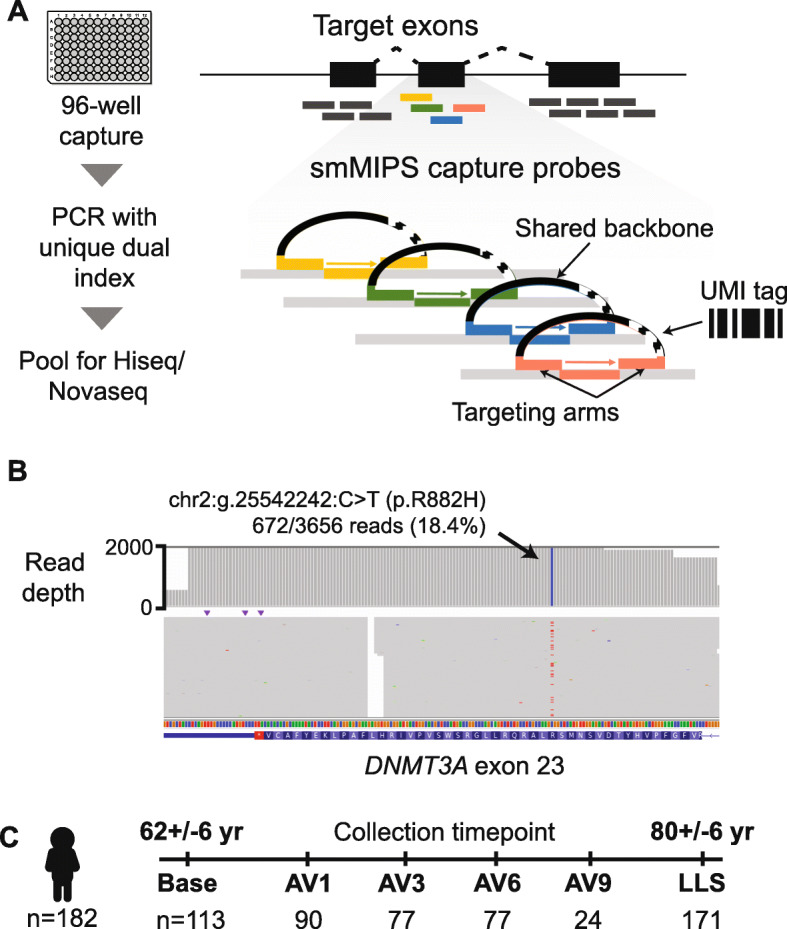
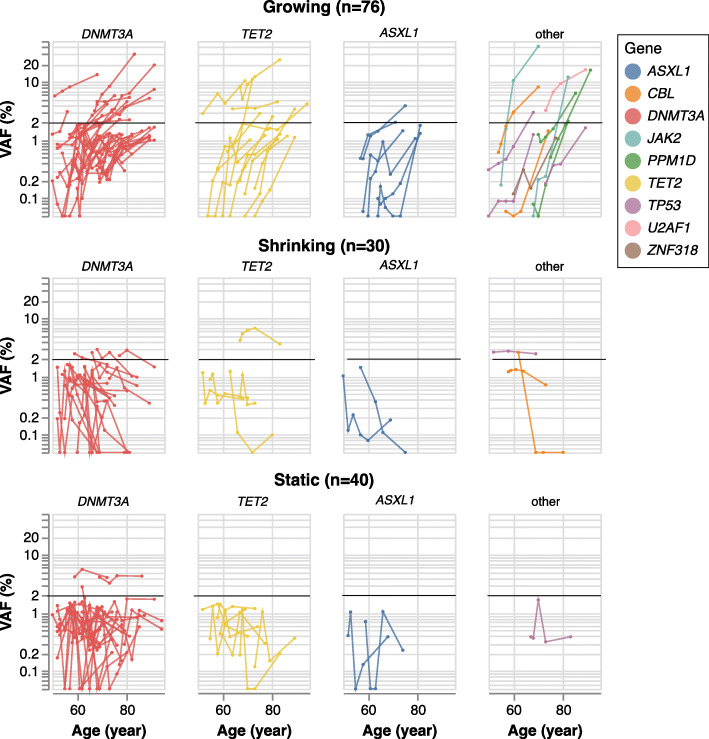
We developed and validated a cost-effective single molecule molecular inversion probe sequencing (smMIPS) assay for detecting CHIP, targeting the 11 most frequently mutated genes in CHIP along with 4 recurrent mutational hotspots. We sequenced 548 multi-timepoint samples collected from 182 participants in the Women's Health Initiative cohort, across a median span of 16 years. We detected 178 driver mutations reaching variant allele frequency ≥ 2% in at least one timepoint, many of which were detectable well below this threshold at earlier timepoints. The majority of clonal mutations (52.1%) expanded over time (with a median doubling period of 7.43 years), with the others remaining static or decreasing in size in the absence of any cytotoxic therapy.
Targeted smMIPS sequencing can sensitively measure clonal dynamics in CHIP. Mutations that reached the conventional threshold for CHIP (2% frequency) tended to continue growing, indicating that after CHIP is acquired, it is generally not lost. The ability to cost-effectively profile CHIP longitudinally will enable future studies to investigate why some CHIP clones expand, and how their dynamics relate to health outcomes at a biobank scale.
不确定潜能的克隆性造血(CHIP),即与年龄相关的突变造血干细胞扩增,会增加包括血液系统癌症和心血管疾病在内的多种衰老相关疾病的风险。全外显子组或基因组测序可以检测到CHIP,但由于这些检测成本高昂,大多数人群研究都是横断面研究,每个个体仅测序一个时间点。
我们开发并验证了一种用于检测CHIP的经济高效的单分子分子倒置探针测序(smMIPS)检测方法,该方法针对CHIP中11个最常发生突变的基因以及4个反复出现的突变热点。我们对从女性健康倡议队列中的182名参与者收集的548个多时间点样本进行了测序,时间跨度中位数为16年。我们在至少一个时间点检测到178个驱动突变,其变异等位基因频率≥2%,其中许多在早期时间点的检测阈值远低于此。大多数克隆性突变(52.1%)随时间扩增(中位倍增期为7.43年),其他突变在没有任何细胞毒性治疗的情况下保持稳定或大小减小。
靶向smMIPS测序可以灵敏地测量CHIP中的克隆动态。达到CHIP传统阈值(频率2%)的突变往往会继续增长,这表明在获得CHIP后,它通常不会消失。以具有成本效益的方式纵向分析CHIP的能力将使未来的研究能够调查为什么一些CHIP克隆会扩增,以及它们的动态如何在生物样本库规模上与健康结果相关。