Lee Ji Eun, Ko Kyung Ok, Lim Jae Woo, Cheon Eun Jung, Song Young Hwa, Yoon Jung Min
Department of Pediatrics, Konyang University Hospital, Konyang University College of Medicine, Daejeon, Korea.
Pediatr Gastroenterol Hepatol Nutr. 2022 May;25(3):240-250. doi: 10.5223/pghn.2022.25.3.240. Epub 2022 May 9.
This study aimed to examine the advantages and usefulness of transient elastography (Fibroscan) in diagnosing non-alcoholic steatohepatitis in children and adolescents compared to those of abdominal computed tomography and liver ultrasonography.
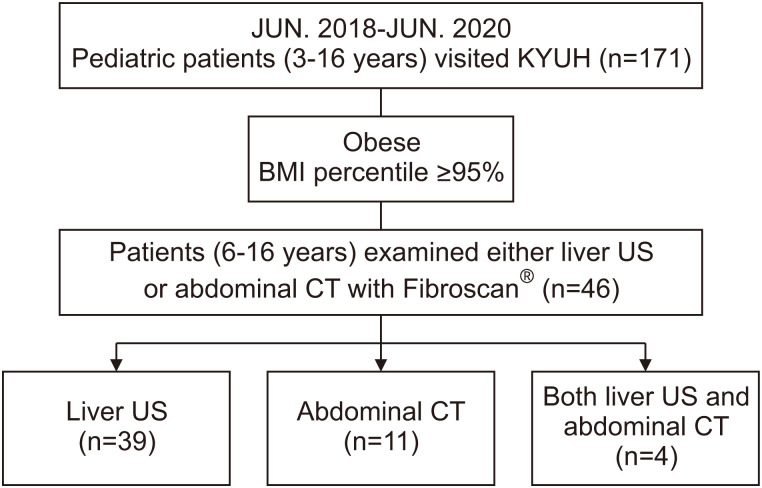
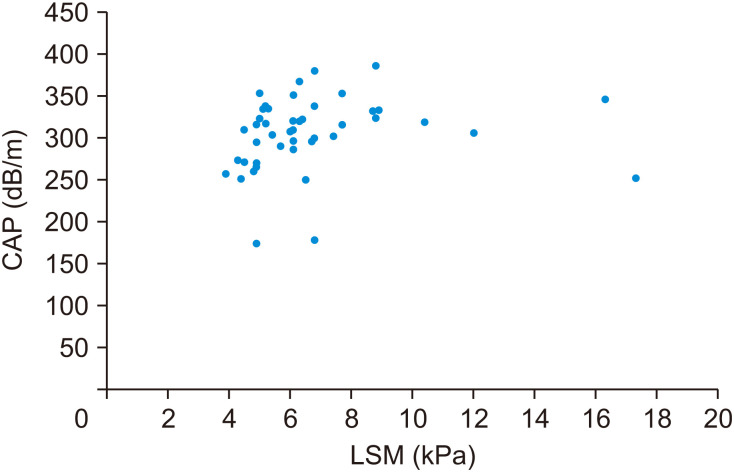
Forty-six children and adolescent participants aged between 6 and 16 years who underwent transient elastography (Fibroscan) as well as liver ultrasonography or abdominal computed tomography were included. Thirty-nine participants underwent liver ultrasonography and 11 underwent computed tomography. The physical measurements, blood test results, presence of metabolic syndrome, and the degree of liver steatosis and liver fibrosis were analyzed, and their correlations with transient elastography (Fibroscan), abdominal computed tomography, and liver ultrasonography, as well as the correlations between examinations, were analyzed.
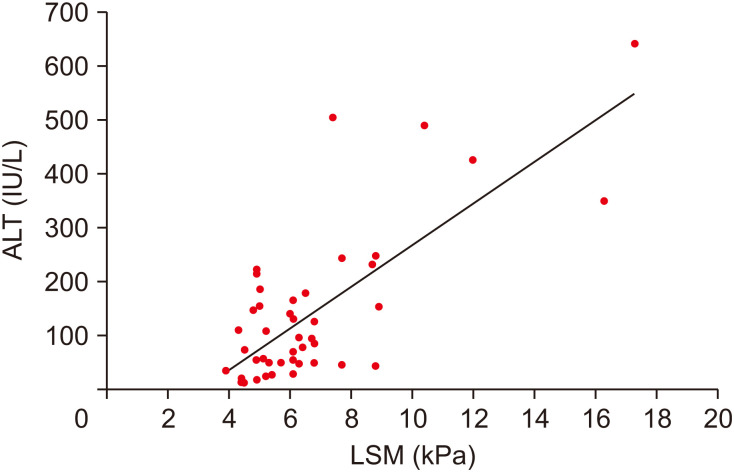
Thirty-six participants (78.3%) were boys, and the mean age was 12.29±2.57 years, with a mean body mass index of 27.88±4.28. In the 46 participants, the mean values for aspartate aminotransferase, alanine aminotransferase, and total bilirubin were 89.87±118.69 IU/L, 138.54±141.79 IU/L, and 0.77±0.61 mg/dL, respectively. Although transient elastography (Fibroscan) and abdominal computed tomography grading had a statistically significant positive correlation with aspartate aminotransferase and alanine aminotransferase values, the correlations between the results of grading performed by transient elastography (Fibroscan), abdominal computed tomography, and liver ultrasonography were not statistically.
We confirmed that each examination was correlated with the results of some blood tests, suggesting the usefulness and possibility of diagnosis and treatment of steatohepatitis mediated by transient elastography (Fibroscan) in the department of pediatrics.
本研究旨在探讨与腹部计算机断层扫描和肝脏超声检查相比,瞬时弹性成像(Fibroscan)在诊断儿童和青少年非酒精性脂肪性肝炎中的优势和实用性。
纳入46名年龄在6至16岁之间接受瞬时弹性成像(Fibroscan)以及肝脏超声检查或腹部计算机断层扫描的儿童和青少年参与者。39名参与者接受了肝脏超声检查,11名接受了计算机断层扫描。分析了身体测量数据、血液检测结果、代谢综合征的存在情况以及肝脏脂肪变性和肝纤维化程度,并分析了它们与瞬时弹性成像(Fibroscan)、腹部计算机断层扫描和肝脏超声检查的相关性,以及各项检查之间的相关性。
36名参与者(78.3%)为男性,平均年龄为12.29±2.57岁,平均体重指数为27.88±4.28。在46名参与者中,天冬氨酸转氨酶、丙氨酸转氨酶和总胆红素的平均值分别为89.87±118.69 IU/L、138.54±141.79 IU/L和0.77±0.61 mg/dL。虽然瞬时弹性成像(Fibroscan)和腹部计算机断层扫描分级与天冬氨酸转氨酶和丙氨酸转氨酶值具有统计学意义的正相关,但瞬时弹性成像(Fibroscan)、腹部计算机断层扫描和肝脏超声检查的分级结果之间的相关性无统计学意义。
我们证实每项检查都与某些血液检测结果相关,提示在儿科部门使用瞬时弹性成像(Fibroscan)诊断和治疗脂肪性肝炎具有实用性和可能性。