Department of Neurology, Nippon Medical School, Bunkyo-ku, Tokyo, Japan.
Department of Neurology, Nippon Medical School, Bunkyo-ku, Tokyo, Japan
BMJ Open. 2022 May 24;12(5):e054269. doi: 10.1136/bmjopen-2021-054269.
JTR-161 is a novel allogeneic human cell product consisting of dental pulp stem cells isolated from the extracted teeth of healthy adults. It is currently under development as a cell-based therapy for ischaemic stroke. The aim of this study is to evaluate the safety and efficacy of JTR-161 in patients with acute ischaemic stroke when given as a single intravenous administration within 48 hours of symptom onset.
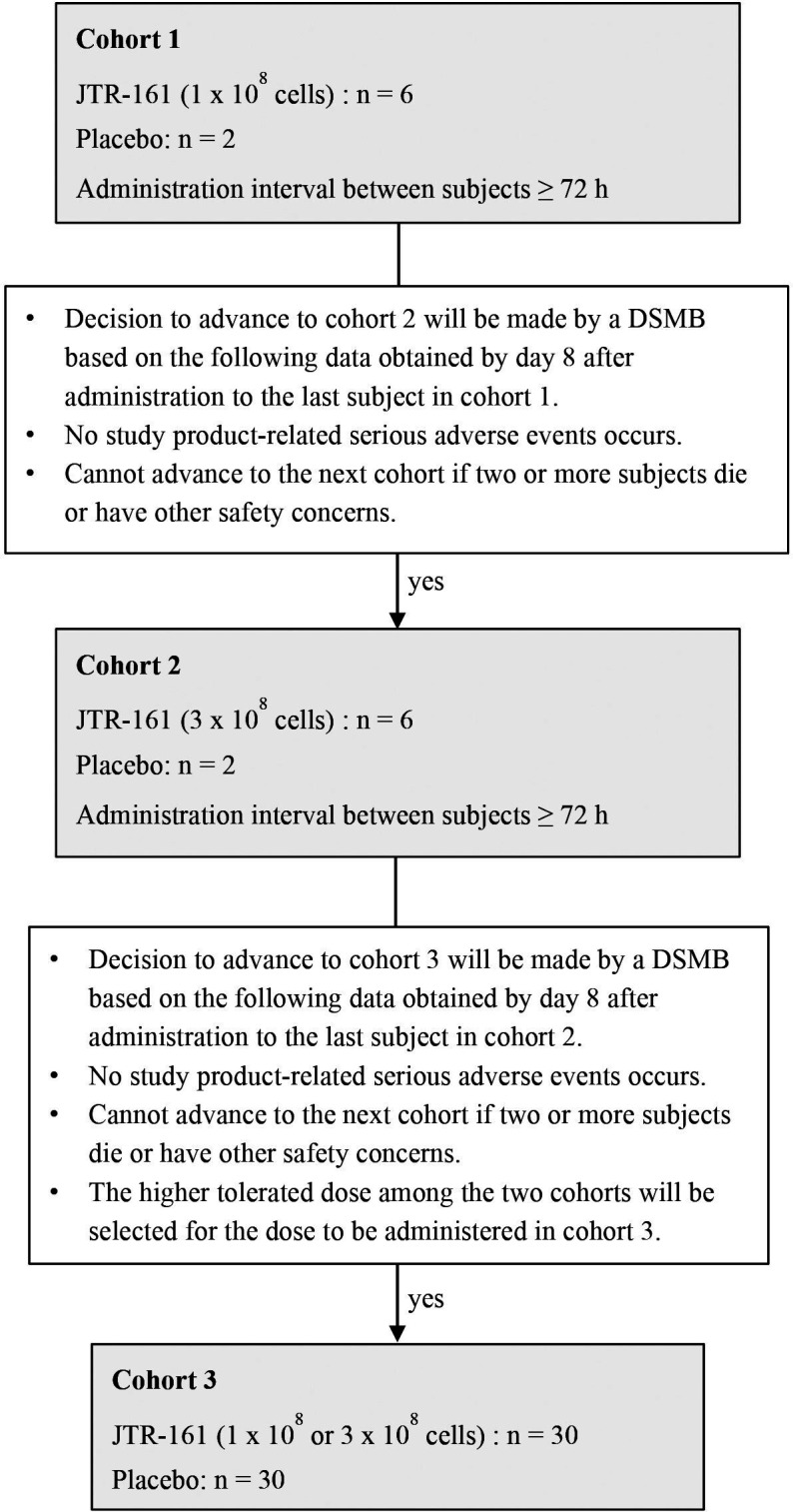
This is a first-in-human, randomised, double-blind, placebo-controlled, multicentre, phase 1/2 clinical trial to be conducted in Japan (from January 2019 to July 2021). Patients with a clinical diagnosis of anterior circulation ischaemic stroke with a National Institutes of Health Stroke Scale (NIHSS)score of 5-20 at baseline were enrolled. Patients previously treated with recombinant tissue-type plasminogen activator and/or endovascular thrombectomy were allowed to be enrolled. The study consists of three cohorts: cohorts 1 and 2 (each eight patients) and cohort 3 (60 patients). Subjects were randomly assigned to receive either JTR-161 or placebo in a 3:1 ratio in cohorts 1 and 2, and in a 1:1 ratio in cohort 3. The number of cells administered was increased sequentially from 1×10 (cohort 1) to 3 x 10 (cohort 2). In cohort 3, the higher tolerated dose among the two cohorts was administered. The primary endpoint is the proportion of patients who achieve an excellent outcome as defined by all of the following criteria at day 91 in cohort 3: modified Rankin Scale ≤1, NIHSS ≤1 and Barthel Index ≥95.
The protocol and informed consent form were approved by the institutional review board at each participating study site. A manuscript with the results of the primary study will be published in a peer-reviewed journal.
NCT04608838; JapicCTI-194570 and Clinical Trials. gov.
JTR-161 是一种新型同种异体人细胞产品,由从健康成年人提取的牙髓干细胞组成。它目前正在作为缺血性中风的细胞治疗方法进行开发。本研究的目的是评估 JTR-161 在症状发作后 48 小时内单次静脉内给药的急性缺血性中风患者中的安全性和疗效。
这是一项在日本进行的首次人体、随机、双盲、安慰剂对照、多中心、1/2 期临床试验(2019 年 1 月至 2021 年 7 月)。招募了具有临床诊断为前循环缺血性中风且基线时国立卫生研究院中风量表(NIHSS)评分 5-20 的患者。允许先前接受重组组织型纤溶酶原激活剂和/或血管内血栓切除术治疗的患者入组。该研究由三个队列组成:队列 1 和 2(各 8 例患者)和队列 3(60 例患者)。受试者在队列 1 和 2 中以 3:1 的比例随机分配接受 JTR-161 或安慰剂,在队列 3 中以 1:1 的比例随机分配。给药细胞数依次从 1×10(队列 1)增加到 3×10(队列 2)。在队列 3 中,给予两个队列中耐受性更高的剂量。主要终点是第 91 天时队列 3 中符合以下所有标准的患者比例:改良 Rankin 量表≤1、NIHSS≤1 和巴氏量表≥95。
该方案和知情同意书已获得每个参与研究地点的机构审查委员会的批准。主要研究结果的论文将发表在同行评审的期刊上。
NCT04608838; JapicCTI-194570 和 ClinicalTrials.gov。