Department of Nosocomial Infection Management, Zhongnan Hospital of Wuhan University, Wuhan, China.
Hubei Engineering Center for Infectious Disease Prevention, Control and Treatment, Wuhan, China.
Front Public Health. 2022 May 9;10:883453. doi: 10.3389/fpubh.2022.883453. eCollection 2022.
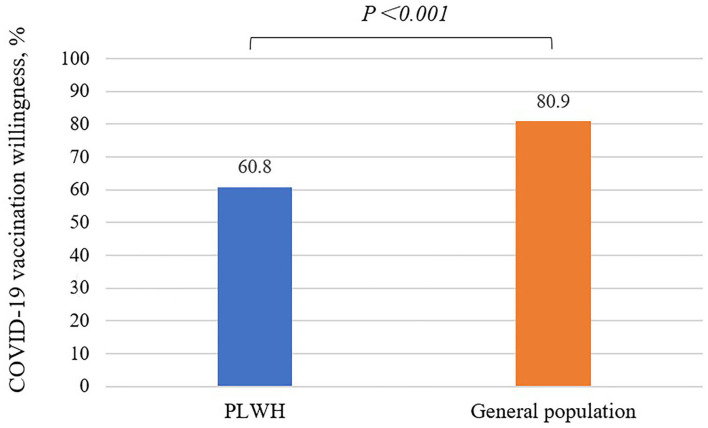
Vaccination is essential to controlling the pandemic of coronavirus disease 2019 (COVID-19). People living with HIV (PLWH) were considered more vulnerable to the severe acute respiratory syndrome coronavirus 2 (SARS-CoV-2) infection compared with the general population. Therefore, it is urgent to protect PLWH from SARS-CoV-2 infection. For PLWH, vaccine hesitancy could be more common and may compromise vaccine coverage. Our study aimed to investigate the willingness to receive the COVID-19 vaccination among PLWH and associated factors. A cross-sectional online survey was performed among PLWH and the general population from 4 April to 18 April 2021 in Wuhan, China. The multivariable logistic regression was used to analyze associated factors for COVID-19 vaccination willingness among PLWH. A total of 556 PLWH and 570 individuals from the general population were enrolled. The COVID-19 vaccine willingness among PLWH was 60.8%, which was relatively lower than that in the general population (80.9%) ( < 0.001). The results of multivariable analysis indicated that PLWH with comorbidities (OR = 2.07, 95% CI: 1.25-3.45), those who had idea about PLWH would be more serious if they were infected with SARS-CoV-2 (OR = 1.67, 95% CI: 1.11-2.51) and those who thought their antiretroviral therapy (ART) would be affected by COVID-19 epidemic (OR = 2.04, 95% CI: 1.22-3.42) had higher willingness to receive COVID-19 vaccination. PLWH who had a monthly income over 5,000 RMB (OR = 0.64, 95% CI: 0.45-0.92) and had a sex orientation as non-homosexual (OR = 0.67, 95% CI: 0.47-0.96) were associated with lower willingness for COVID-19 vaccination. Our findings showed that the PLWH had a lower willingness for COVID-19 vaccination compared with the general population in Wuhan. Targeted interventions such as health education should be conducted to increase the willingness for COVID-19 vaccination among PLWH, thus enhancing COVID-19 vaccine uptake among PLWH.
接种疫苗对于控制 2019 年冠状病毒病(COVID-19)大流行至关重要。与一般人群相比,艾滋病毒感染者(PLWH)被认为更容易受到严重急性呼吸综合征冠状病毒 2(SARS-CoV-2)感染。因此,迫切需要保护 PLWH 免受 SARS-CoV-2 感染。对于 PLWH,疫苗犹豫可能更为普遍,并可能影响疫苗接种率。我们的研究旨在调查 PLWH 对 COVID-19 疫苗接种的意愿及其相关因素。我们于 2021 年 4 月 4 日至 4 月 18 日期间在中国武汉对 PLWH 和一般人群进行了横断面在线调查。多变量逻辑回归用于分析 PLWH 对 COVID-19 疫苗接种意愿的相关因素。共纳入 556 名 PLWH 和 570 名一般人群。PLWH 对 COVID-19 疫苗的接种意愿为 60.8%,相对低于一般人群(80.9%)(<0.001)。多变量分析结果表明,患有合并症的 PLWH(OR=2.07,95%CI:1.25-3.45)、认为 PLWH 如果感染 SARS-CoV-2 会更严重的人(OR=1.67,95%CI:1.11-2.51)和认为他们的抗逆转录病毒治疗(ART)会受到 COVID-19 流行影响的人(OR=2.04,95%CI:1.22-3.42)对 COVID-19 疫苗接种的意愿更高。月收入超过 5000 元人民币(OR=0.64,95%CI:0.45-0.92)和性取向为非同性恋(OR=0.67,95%CI:0.47-0.96)的 PLWH 与对 COVID-19 疫苗接种的意愿较低有关。我们的研究结果表明,与武汉一般人群相比,PLWH 对 COVID-19 疫苗接种的意愿较低。应开展有针对性的干预措施,如健康教育,以提高 PLWH 对 COVID-19 疫苗接种的意愿,从而提高 PLWH 对 COVID-19 疫苗的接种率。