Department of Immunology, H. Lee Moffitt Cancer Center and Research Institute, Tampa, Florida, USA.
Department of Biostatistics and Bioinformatics, H. Lee Moffitt Cancer Center and Research Institute, Tampa, Florida, USA.
J Immunother Cancer. 2022 May;10(5). doi: 10.1136/jitc-2022-004605.
Accumulation of regulatory T cells (Treg) has been described to often correlate with poor prognosis in many solid tumors. How Treg presence impinges on limited functionality and clonal composition of tumor-associated CD8 +T cells has important implications for their therapeutic targeting in the tumor microenvironment. In the present study, we investigated how accumulation of Tregs contributes to T cell dysfunction and clonal constriction of tumor-infiltrating CD8 +T cells.
Resected melanoma and lung adenocarcinoma tissues from tumor-bearing mice or patients were analyzed. The proportions and phenotype as well as clonal diversity of tumor-associated CD8 +T cells were evaluated by flow cytometry and single-cell T-cell receptor (TCR) sequencing, respectively, at early or advanced tumor stages or under Treg depletion conditions. Furthermore, antigen-specific T cells were evaluated on adoptive transfer into tumor-bearing mice in the presence or absence of anti-CTLA-4 antibody or CTLA-4 Ig. Lastly, tumor-bearing mice were treated with anti-KLRG1 antibody and/or bromodomain inhibitor JQ1 with interleukin (IL)-2 immune complexes to determine therapeutic efficacy.
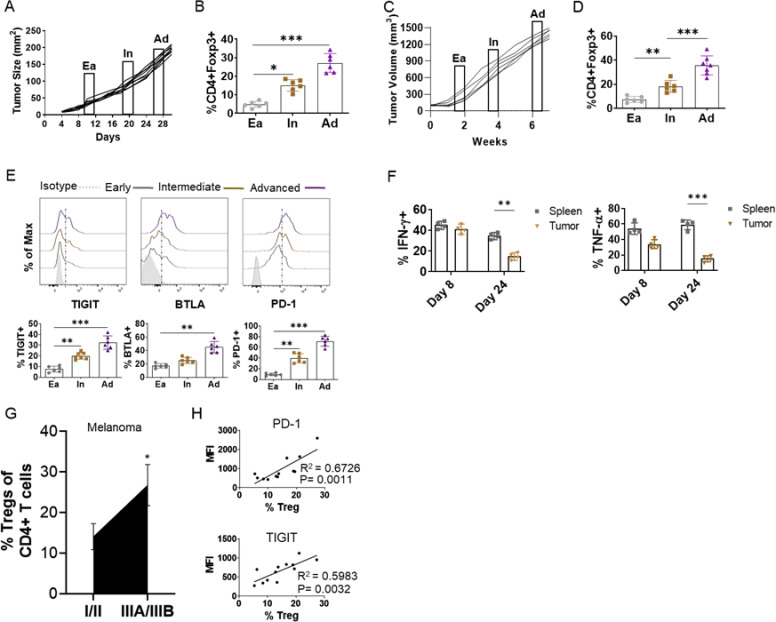
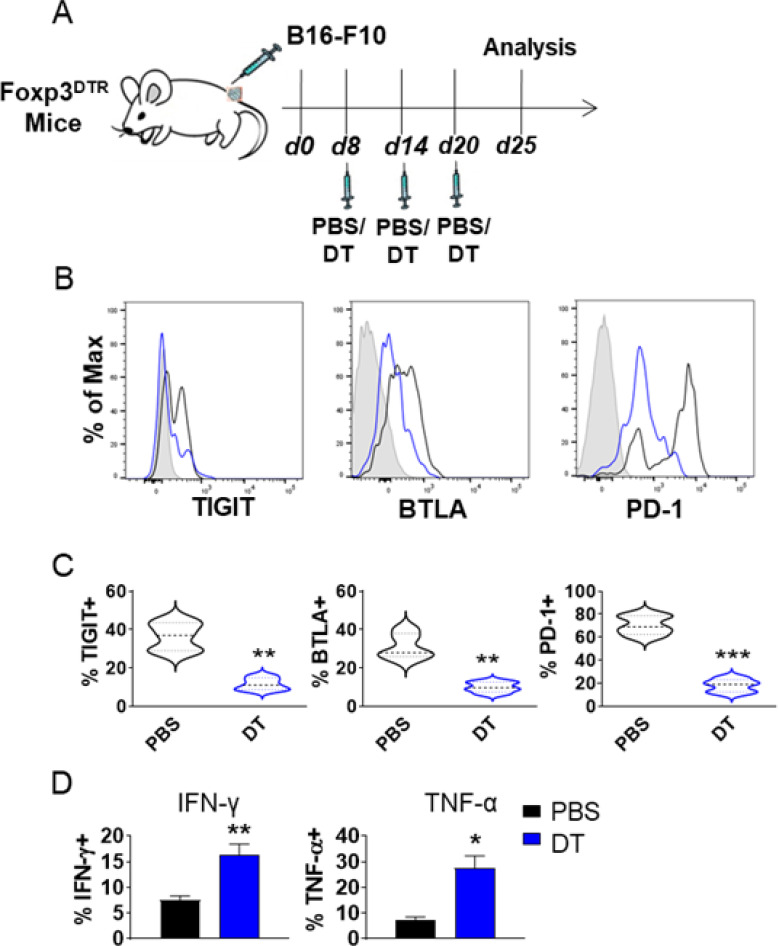
We demonstrate that the emergence of exhaustion-like phenotype and impaired effector functionality in tumor-associated CD8 +T cells is positively correlated with Treg accumulation in the tumor bed and this dysfunctional phenotype becomes reversed on Treg reduction in murine melanoma and lung cancer models. Heightened tumor-associated Treg-expressed CTLA-4 is key to emergence and sustenance of this phenotype. Furthermore, TCR sequencing revealed a clonal shrinkage of tumor-infiltrating CD8 +T cells as tumor progressed, which was associated with reduced survival profile concomitant to increasing Treg proportions. Limited IL-2 availability was a key mechanism contributing to this peripheral repertoire reshaping as Treg depletion improved IL-2 levels, rescued CD8 +T cell viability, and improved their clonal diversity. Finally, targeted reduction of tumor but not peripheral Tregs through JQ1 and/or anti-KLRG1 antibody significantly improved antitumor response in melanoma-bearing mice when supplemented with IL-2 immune complexes.
Collectively, our study reveals a bimodal program enacted by Tregs to support T cell dysfunction in the tumor bed and highlights a promising therapeutic regimen for localized reprogramming of the tumor microenvironment to curb Treg impairment of antitumor CD8 +T cell response in favor of improved antitumor immunity.
在许多实体瘤中,调节性 T 细胞(Treg)的积累常与预后不良相关。Treg 的存在如何影响肿瘤相关 CD8+T 细胞的有限功能和克隆组成,对其在肿瘤微环境中的治疗靶向具有重要意义。在本研究中,我们研究了 Treg 的积累如何导致 T 细胞功能障碍和肿瘤浸润 CD8+T 细胞的克隆收缩。
分析了荷瘤小鼠或患者的切除黑色素瘤和肺腺癌组织。通过流式细胞术评估肿瘤相关 CD8+T 细胞的比例和表型,以及通过单细胞 T 细胞受体(TCR)测序分别评估其克隆多样性,在早期或晚期肿瘤阶段或在 Treg 耗竭条件下进行评估。此外,在存在或不存在抗 CTLA-4 抗体或 CTLA-4 Ig 的情况下,通过过继转移到荷瘤小鼠中来评估抗原特异性 T 细胞。最后,用抗 KLRG1 抗体和/或溴结构域抑制剂 JQ1 联合白细胞介素(IL)-2 免疫复合物治疗荷瘤小鼠,以确定治疗效果。
我们证明,肿瘤相关 CD8+T 细胞出现衰竭样表型和效应功能受损与肿瘤床中 Treg 的积累呈正相关,在小鼠黑色素瘤和肺癌模型中降低 Treg 后,这种功能障碍表型会逆转。肿瘤相关 Treg 表达的 CTLA-4 升高是出现和维持这种表型的关键。此外,TCR 测序显示,随着肿瘤的进展,肿瘤浸润 CD8+T 细胞的克隆收缩,这与存活率降低同时发生,同时 Treg 比例增加。有限的 IL-2 可及性是导致这种外周谱系重塑的关键机制,因为 Treg 耗竭可提高 IL-2 水平,挽救 CD8+T 细胞活力,并改善其克隆多样性。最后,通过 JQ1 和/或抗 KLRG1 抗体靶向减少肿瘤但不减少外周 Treg,当与 IL-2 免疫复合物联合使用时,可显著改善荷黑色素瘤小鼠的抗肿瘤反应。
总之,我们的研究揭示了 Treg 发挥的双重作用,以支持肿瘤床中的 T 细胞功能障碍,并强调了一种有前途的治疗方案,用于局部重新编程肿瘤微环境,以抑制 Treg 对抗肿瘤 CD8+T 细胞反应的损害,有利于改善抗肿瘤免疫。