Ehrmann Daniel, Harish Vinyas, Morgado Felipe, Rosella Laura, Johnson Alistair, Mema Briseida, Mazwi Mjaye
Department of Critical Care Medicine, Hospital for Sick Children, Toronto, ON, Canada.
Temerty Centre for Artificial Intelligence Research and Education in Medicine, University of Toronto, Toronto, ON, Canada.
Front Pediatr. 2022 May 10;10:864755. doi: 10.3389/fped.2022.864755. eCollection 2022.
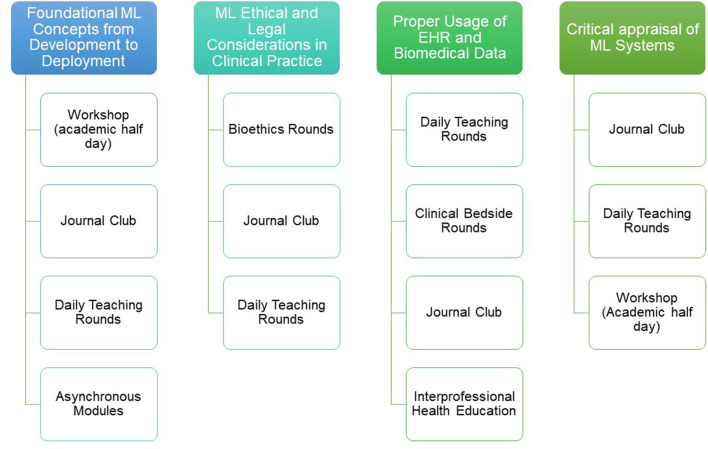
Pediatric intensivists are bombarded with more patient data than ever before. Integration and interpretation of data from patient monitors and the electronic health record (EHR) can be cognitively expensive in a manner that results in delayed or suboptimal medical decision making and patient harm. Machine learning (ML) can be used to facilitate insights from healthcare data and has been successfully applied to pediatric critical care data with that intent. However, many pediatric critical care medicine (PCCM) trainees and clinicians lack an understanding of foundational ML principles. This presents a major problem for the field. We outline the reasons why in this perspective and provide a roadmap for competency-based ML education for PCCM trainees and other stakeholders.
儿科重症监护医生面临着比以往任何时候都更多的患者数据。整合和解读来自患者监护仪和电子健康记录(EHR)的数据在认知上成本高昂,可能导致医疗决策延迟或不理想,甚至对患者造成伤害。机器学习(ML)可用于促进从医疗数据中获取见解,并已为此目的成功应用于儿科重症监护数据。然而,许多儿科重症医学(PCCM)学员和临床医生缺乏对机器学习基础原理的理解。这给该领域带来了一个重大问题。我们在此观点中概述了原因,并为PCCM学员和其他利益相关者提供了基于能力的机器学习教育路线图。