Akkarakittichoke Nipaporn, Jensen Mark P, Newman Andrea K, Waongenngarm Pooriput, Janwantanakul Prawit
Inter-Department Program of Biomedical Sciences, Faculty of Graduate School, Chulalongkorn University, Bangkok, Thailand.
Department of Rehabilitation Medicine, University of Washington, Seattle, WA, USA.
Pain Rep. 2022 May 23;7(3):e1014. doi: 10.1097/PR9.0000000000001014. eCollection 2022 May-Jun.
Neck and low back pain are significant health problem in sedentary office workers. Active break and postural shift interventions has been proved to reduce the incidence of new onset of both neck and low back pain.
To identify variables that moderate the effects of active breaks and postural shift interventions on the development of neck and low back pain in office workers.
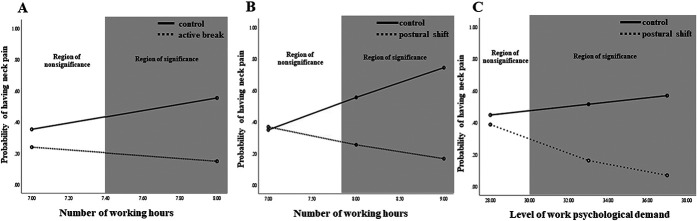
Using data from a 3-arm (active break, postural shift, and control group) cluster randomized controlled trial (N = 193), we evaluated the moderating effects of age, job position, education level, sex, perceived psychological work demands, number of working hours, and using a chair with lumbar support on the benefits of 2 interventions designed to prevent the development of neck and low back pain in office workers. Moderation analyses were conducted using the Hayes PROCESS macro, with post hoc Johnson-Neyman techniques and logistic regressions.
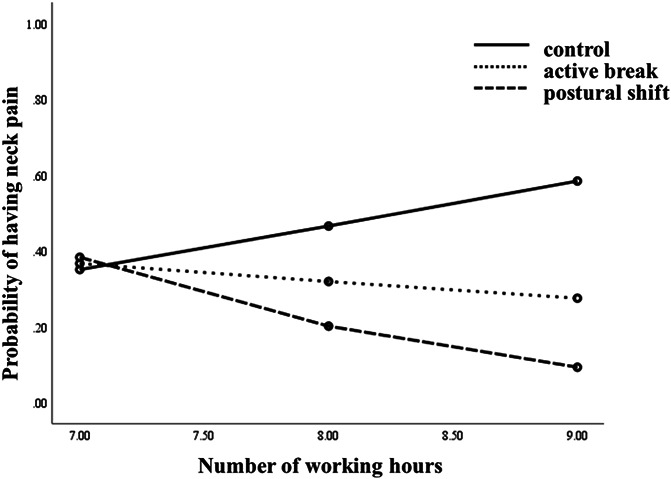
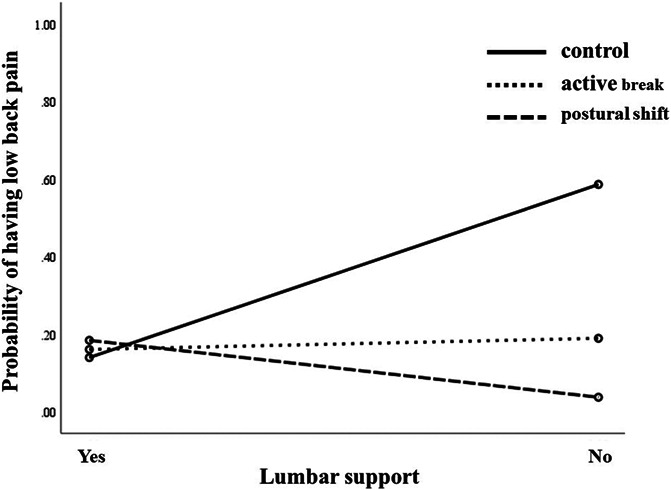
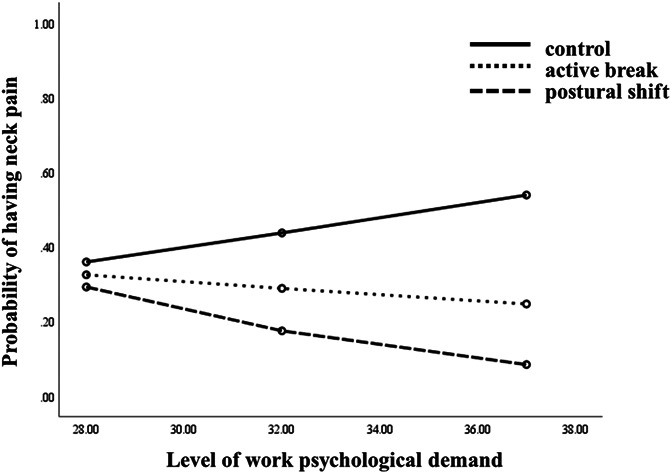
Significant interactions between intervention groups and 3 moderators assessed at baseline emerged. For the prevention of neck pain, the effect of the active break intervention was moderated by the number of working hours and the effect of the postural shift intervention was moderated by the level of perceived psychological work demands and the number of working hours. For the prevention of low back pain, the effect of postural shift intervention was moderated by having or not having a chair with lumbar support.
The study findings can be used to help determine who might benefit the most from 2 treatments that can reduce the risk of developing neck and low back pain in sedentary workers and may also help us to understand the mechanisms underlying the benefits of these interventions.
颈部和下背部疼痛是久坐办公室职员面临的重大健康问题。积极休息和姿势转换干预已被证明可降低颈部和下背部疼痛新发的发生率。
确定可调节积极休息和姿势转换干预对办公室职员颈部和下背部疼痛发展影响的变量。
利用一项三臂(积极休息、姿势转换和对照组)整群随机对照试验(N = 193)的数据,我们评估了年龄、工作职位、教育水平、性别、感知到的心理工作需求、工作时长以及使用带腰部支撑的椅子对两种旨在预防办公室职员颈部和下背部疼痛发展的干预措施效果的调节作用。使用Hayes PROCESS宏进行调节分析,并采用事后约翰逊 - 奈曼技术和逻辑回归。
在基线时评估的干预组与3个调节变量之间出现了显著交互作用。对于预防颈部疼痛,积极休息干预的效果受工作时长调节,姿势转换干预的效果受感知到的心理工作需求水平和工作时长调节。对于预防下背部疼痛,姿势转换干预的效果受是否使用带腰部支撑的椅子调节。
研究结果可用于帮助确定哪些人可能从两种可降低久坐职员颈部和下背部疼痛风险的治疗中获益最多,也可能有助于我们理解这些干预措施获益的潜在机制。