Prawit Janwantanakul, Department of Physical Therapy, Faculty of Allied Health Sciences, Chulalongkorn University, Bangkok, 10330, Thailand.
Scand J Work Environ Health. 2021 May 1;47(4):306-317. doi: 10.5271/sjweh.3949. Epub 2021 Apr 27.
This study evaluated the effects of the promotion of active breaks and postural shifts on new onset of neck and low-back pain during a 6-month follow-up among high-risk office workers.
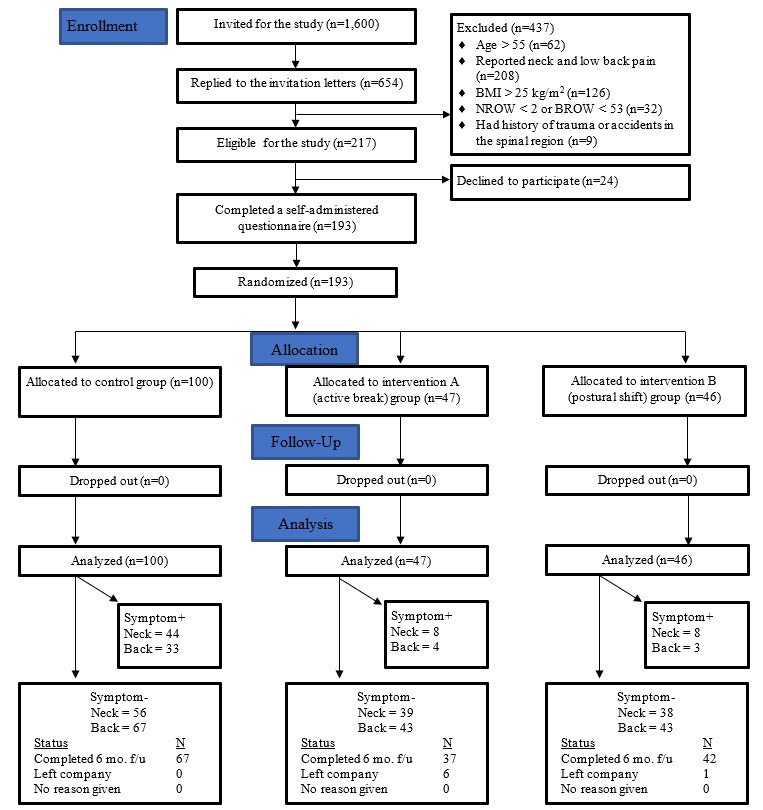
A 3-arm cluster-randomized controlled trial with 6-month follow-up was conducted among healthy but high-risk office workers. Participants were recruited from six organizations in Bangkok, Thailand (N=193) and randomly assigned at cluster level into active break intervention (N=47), postural shift intervention (N=46), and control (N=100) groups. Participants in the intervention groups received a custom-designed apparatus to facilitate designated active breaks and postural shifts during work. Participants in the control group received a placebo seat pad. The primary outcome measure was new onset of neck and low-back pain during 6-month follow-up. Analyses were performed using Cox proportional hazard models.
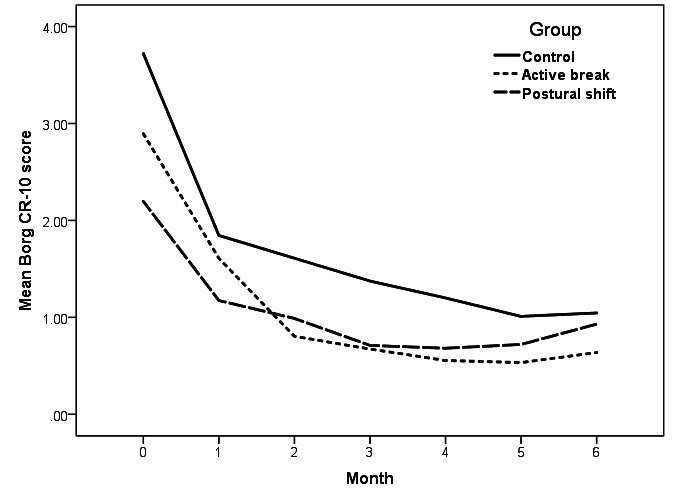
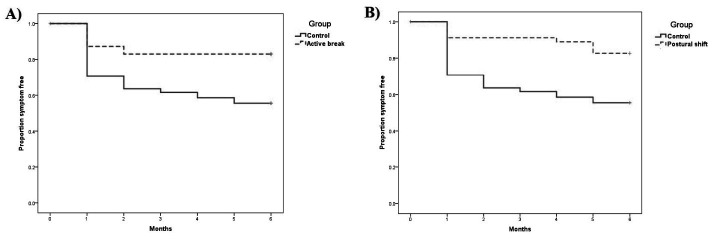
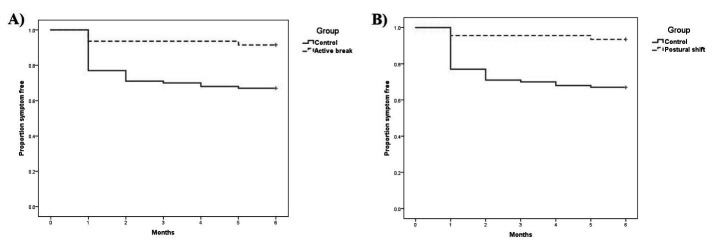
One-hundred and eighty-six (96%) predominantly female participants were successfully followed up over six months. New onset of neck pain during the 6-month follow-up occurred in 17%, 17%, and 44% of the participants in the active break, postural shift, and control groups, respectively. For new onset of low-back pain, these percentages were 9%, 7%, and 33%, respectively. Hazard rate (HR) ratios after adjusting for biopsychosocial factors indicated a protective effect of the active break and postural shift interventions for neck pain [HRadj 0.45, 95% confidence interval (CI) 0.20-0.98 for active break and HRadj 0.41, 95% CI 0.18-0.94 for postural shift] and low-back pain (HRadj 0.34, 95% CI 0.12-0.98 for active break and HRadj 0.19, 95% CI 0.06-0.66 for postural shift).
Interventions to increase either active breaks or postural shifts reduced new onset of neck and low-back pain among high-risk office workers.
本研究评估了在 6 个月的随访中,促进主动休息和姿势变换对高风险办公室工作人员新发颈痛和腰痛的影响。
这是一项为期 6 个月随访的 3 臂聚类随机对照试验,在泰国曼谷的 6 个组织中招募了健康但处于高风险的办公室工作人员(N=193),并按聚类水平随机分配到主动休息干预组(N=47)、姿势变换干预组(N=46)和对照组(N=100)。干预组的参与者接受了一种定制的仪器,以在工作期间促进指定的主动休息和姿势变换。对照组的参与者接受了安慰剂座垫。主要结局指标是 6 个月随访期间新发颈痛和腰痛。采用 Cox 比例风险模型进行分析。
186 名(96%)主要为女性的参与者成功随访 6 个月。在 6 个月的随访期间,主动休息组、姿势变换组和对照组参与者新发颈痛的比例分别为 17%、17%和 44%。新发腰痛的比例分别为 9%、7%和 33%。调整生物心理因素后,主动休息和姿势变换干预对颈痛的危害比(HR)分别为 0.45(95%CI 0.20-0.98)和 0.41(95%CI 0.18-0.94),对腰痛的危害比分别为 0.34(95%CI 0.12-0.98)和 0.19(95%CI 0.06-0.66)。
增加主动休息或姿势变换的干预措施可减少高风险办公室工作人员新发颈痛和腰痛的发生。