Mayerl Hannes, Stolz Erwin, Großschädl Franziska, Rásky Éva, Freidl Wolfgang
Institute of Social Medicine and Epidemiology, Medical University of Graz, Graz, Austria.
Institute of Nursing Science, Medical University of Graz, Graz, Austria.
BMJ Open. 2017 Aug 28;7(8):e015710. doi: 10.1136/bmjopen-2016-015710.
The main objective of this research was to investigate the buffering effects of an individual's physical, mental and social resources in the relationship between psychosocial job demands and (1) health symptoms, (2) mental strain and (3) the body mass index (BMI), respectively.
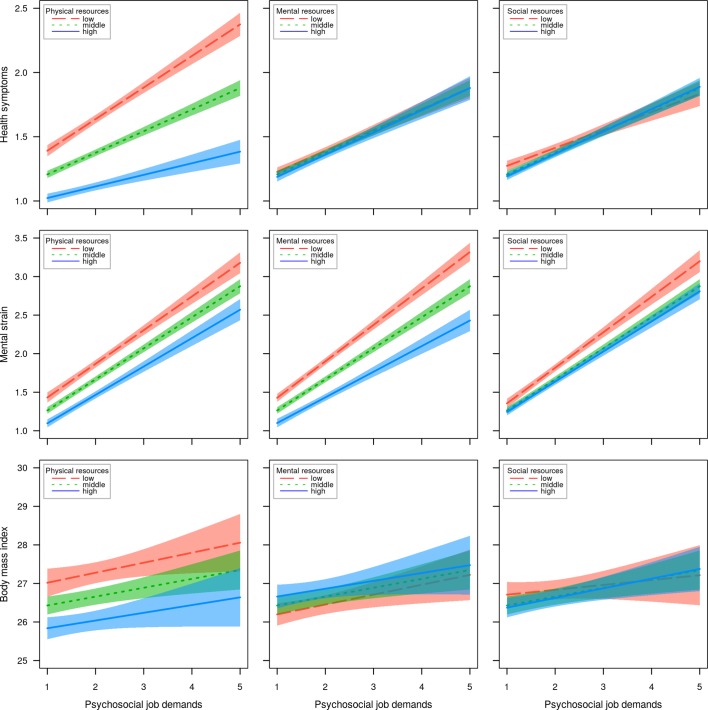
We performed moderated regression analysis to examine data from a large cross-sectional survey of an Austrian employee sample (n9434).
The results revealed a robust association between psychosocial job demands and health symptoms as well as mental strain, but only a weak relationship between psychosocial job demands and BMI. Although the personal resources showed a positive effect on health symptoms and mental strain, only weak evidence was found for the hypothesised interaction with psychosocial job demands. Solely the physical fitness of a person was found to mitigate the impact of psychosocial job demands on health symptoms.
In conclusion, personal resources substantially accounted for the prediction of health. However, the interactions between psychosocial job demands and personal resources only slightly contributed to explaining the variation in health.
本研究的主要目的是分别调查个体的身体、心理和社会资源在心理社会工作需求与(1)健康症状、(2)心理压力和(3)体重指数(BMI)之间关系中的缓冲作用。
我们进行了调节回归分析,以检验来自奥地利员工样本(n = 9434)的大型横断面调查数据。
结果显示心理社会工作需求与健康症状以及心理压力之间存在强烈关联,但心理社会工作需求与BMI之间的关系较弱。尽管个人资源对健康症状和心理压力有积极影响,但仅发现了与心理社会工作需求的假设交互作用的微弱证据。仅发现个人的身体健康可以减轻心理社会工作需求对健康症状的影响。
总之,个人资源在很大程度上解释了对健康的预测。然而,心理社会工作需求与个人资源之间的交互作用仅略微有助于解释健康方面的差异。