Li Tong, Wang Baofu, Ding Hao, Chen Shiqi, Cheng Weiting, Li Yang, Wu Xiaoxiao, Wang Lei, Jiang Yangyang, Lu Ziwen, Teng Yu, Su Sha, Han Xiaowan, Zhao Mingjing
Key Laboratory of Chinese Internal Medicine of Ministry of Education, Dongzhimen Hospital, Beijing University of Chinese Medicine, Beijing, China.
Department of Oncology, Shanxi Traditional Chinese Medical Hospital, Taiyuan, China.
Front Pharmacol. 2022 May 10;13:857331. doi: 10.3389/fphar.2022.857331. eCollection 2022.
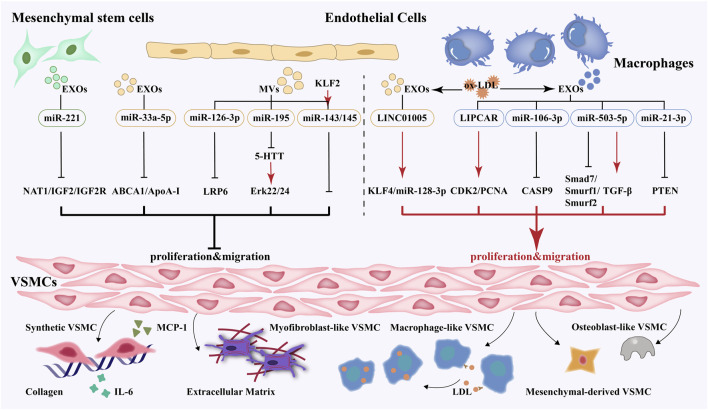
Atherosclerosis (AS)-related diseases are still the main cause of death in clinical patients. The phenotype switching, proliferation, migration, and secretion of vascular smooth muscle cells (VSMCs) have a pivotal role in atherosclerosis. Although numerous research studies have elucidated the role of VSMCs in AS, their potential functional regulations continue to be explored. The formation of AS involves various cells, such as endothelial cells, smooth muscle cells, and macrophages. Therefore, intercellular communication of blood vessels cannot be ignored due to closely connected endothelia, media, and adventitia. Extracellular vesicles (EVs), as the vectors of cell-to-cell communication, can deliver proteins and nucleic acids of parent cells to the recipient cells. EVs have emerged as being central in intercellular communication and play a vital role in the pathophysiologic mechanisms of AS. This review summarizes the effects of extracellular vesicles (EVs) derived from multiple cells (endothelial cells, macrophages, mesenchymal stem cells, etc.) on VSMCs in AS. The key findings of this review are as follows: 1) endothelial cell-derived EVs (EEVs) have anti- or pro-atherogenic effects on VSMCs; 2) macrophage-derived EVs (MEVs) aggravate the proliferation and migration of VSMCs; 3) mesenchymal stem cells can inhibit VSMCs; and 4) the proliferation and migration of VSMCs can be inhibited by the treatment of EVs with atherosclerosis-protective factors and promoted by noxious stimulants. These results suggested that EVs have the same functional properties as treated parent cells, which might provide vital guidance for treating AS.
动脉粥样硬化(AS)相关疾病仍是临床患者的主要死因。血管平滑肌细胞(VSMC)的表型转换、增殖、迁移和分泌在动脉粥样硬化中起关键作用。尽管众多研究阐明了VSMC在AS中的作用,但其潜在的功能调节仍在不断探索中。AS的形成涉及多种细胞,如内皮细胞、平滑肌细胞和巨噬细胞。因此,由于血管内皮、中膜和外膜紧密相连,血管的细胞间通讯不容忽视。细胞外囊泡(EV)作为细胞间通讯的载体,可将亲代细胞的蛋白质和核酸传递给受体细胞。EV已成为细胞间通讯的核心,并在AS的病理生理机制中发挥重要作用。本综述总结了多种细胞(内皮细胞、巨噬细胞、间充质干细胞等)来源的细胞外囊泡(EV)对AS中VSMC的影响。本综述的主要发现如下:1)内皮细胞来源的EV(EEV)对VSMC具有抗动脉粥样硬化或促动脉粥样硬化作用;2)巨噬细胞来源的EV(MEV)加剧VSMC的增殖和迁移;3)间充质干细胞可抑制VSMC;4)用动脉粥样硬化保护因子处理EV可抑制VSMC的增殖和迁移,而有害刺激物则可促进其增殖和迁移。这些结果表明,EV具有与处理后的亲代细胞相同的功能特性,这可能为治疗AS提供重要指导。