Nguena Nguefack Hermine Lore, Gabrielle Pagé M, Guénette Line, Blais Lucie, Diallo Mamadou, Godbout-Parent Marimée, Angarita-Fonseca Adriana, Lacasse Anaïs
Département des Sciences de la Santé, Université du Québec en Abitibi-Témiscamingue, Rouyn-Noranda, QC, Canada.
Centre de Recherche du Centre Hospitalier de l'Université de Montréal, Montréal, QC, Canada.
Front Pain Res (Lausanne). 2022 May 10;3:830153. doi: 10.3389/fpain.2022.830153. eCollection 2022.
Understanding gender differences in chronic pain (CP) outcome research is essential to optimal treatment delivery. This study explored the associations between gender identity, gender roles, and the number of non-life-threatening pain medication adverse effects reported as severe by people living with CP.
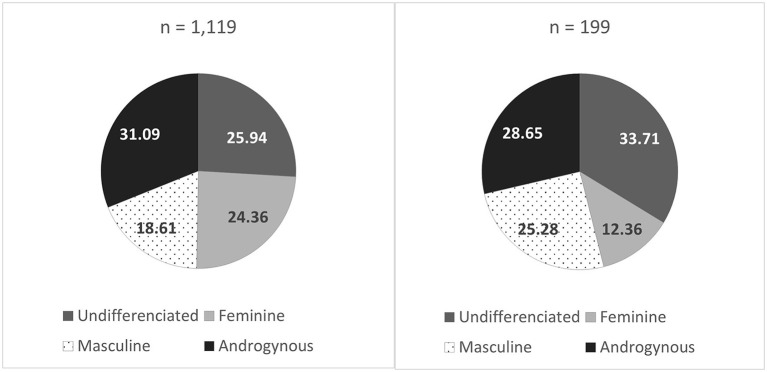
The analyses were conducted using the COPE Cohort, a dataset generated through a web-based recruitment of adults with CP. Participants were asked how they identified themselves (women, men, unknown, unspecified) and gender roles were measured using the Bem Sex-Role Inventory (subgroups were formed applying the median split method). Pain medication adverse effects were assessed using a standardized checklist (none/mild/moderate/severe). A zero-inflated Poisson model was used to assess gender identity, gender roles and their interaction as potential predictors of the number of pain medication adverse effects.
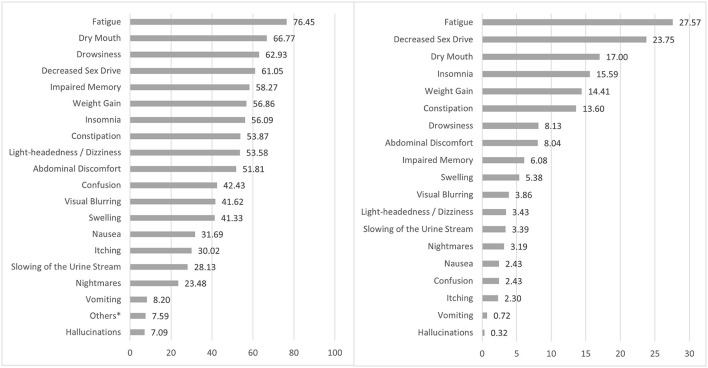
A total of 1,343 participants reported using pain medications. Adjusting for potential confounders, both gender identity (men vs. women: ß = -0.32, = 0.0024) and gender roles (androgynous vs. undifferentiated: ß = 0.26, = 0.0030) were associated with the number of pain medication adverse effects reported as severe, and they interacted with each other. The stratified analysis by gender roles showed that women reported a greater number of severe adverse effects than men among those classified as masculine and androgynous.
Although we are unable to confirm whether the associations can be explained by differences in the experience or in the reporting of effects, gender identity and gender roles should both be explored when studying pain medication adverse effects.
了解慢性疼痛(CP)结局研究中的性别差异对于优化治疗至关重要。本研究探讨了性别认同、性别角色与CP患者报告的严重非危及生命的止痛药物不良反应数量之间的关联。
分析使用COPE队列进行,该数据集通过网络招募CP成年患者生成。参与者被问及他们如何自我认同(女性、男性、未知、未指定),并使用贝姆性别角色量表测量性别角色(采用中位数分割法形成亚组)。使用标准化清单评估止痛药物不良反应(无/轻度/中度/重度)。使用零膨胀泊松模型评估性别认同、性别角色及其相互作用作为止痛药物不良反应数量的潜在预测因素。
共有1343名参与者报告使用了止痛药物。在调整潜在混杂因素后,性别认同(男性与女性:β = -0.32,P = 0.0024)和性别角色(双性化与未分化:β = 0.26,P = 0.0030)均与报告为严重的止痛药物不良反应数量相关,且它们相互作用。按性别角色进行的分层分析表明,在被归类为男性化和双性化的人群中,女性报告的严重不良反应数量多于男性。
尽管我们无法确定这些关联是否可以通过效应体验或报告差异来解释,但在研究止痛药物不良反应时,应同时探讨性别认同和性别角色。