Department of Oncology, Lausanne University Hospital, Lausanne, Switzerland.
Biomedical Engineering Department, Case Western Reserve University, Cleveland, OH, USA.
Virchows Arch. 2022 Oct;481(4):647-652. doi: 10.1007/s00428-022-03345-0. Epub 2022 May 27.
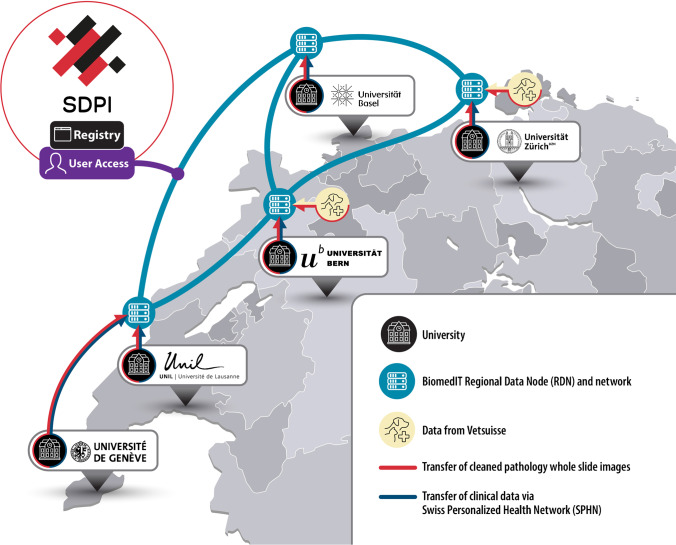
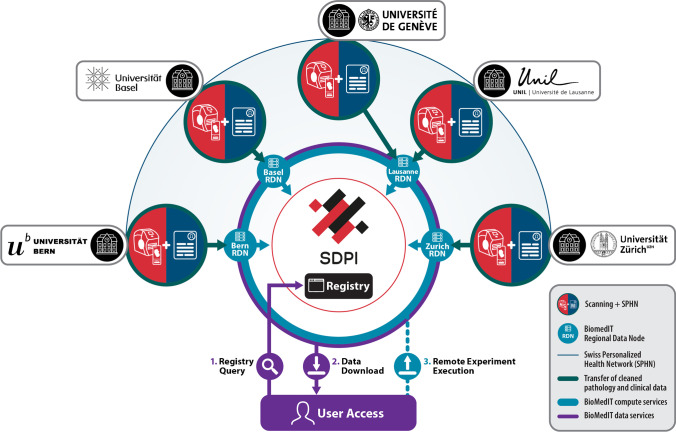
Precision medicine is entering a new era of digital diagnostics; the availability of integrated digital pathology (DP) and structured clinical datasets has the potential to become a key catalyst for biomedical research, education and business development. In Europe, national programs for sharing of this data will be crucial for the development, testing, and validation of machine learning-enabled tools supporting clinical decision-making. Here, the Swiss Digital Pathology Consortium (SDiPath) discusses the creation of a Swiss Digital Pathology Infrastructure (SDPI), which aims to develop a unified national DP network bringing together the Swiss Personalized Health Network (SPHN) with Swiss university hospitals and subsequent inclusion of cantonal and private institutions. This effort builds on existing developments for the national implementation of structured pathology reporting. Opening this national infrastructure and data to international researchers in a sequential rollout phase can enable the large-scale integration of health data and pooling of resources for research purposes and clinical trials. Therefore, the concept of a SDPI directly synergizes with the priorities of the European Commission communication on the digital transformation of healthcare on an international level, and with the aims of the Swiss State Secretariat for Economic Affairs (SECO) for advancing research and innovation in the digitalization domain. SDPI directly addresses the needs of existing national and international research programs in neoplastic and non-neoplastic diseases by providing unprecedented access to well-curated clinicopathological datasets for the development and implementation of novel integrative methods for analysis of clinical outcomes and treatment response. In conclusion, a SDPI would facilitate and strengthen inter-institutional collaboration in technology, clinical development, business and research at a national and international scale, promoting improved patient care via precision medicine.
精准医学正在进入数字诊断的新时代;集成数字病理学(DP)和结构化临床数据集的可用性有可能成为推动生物医学研究、教育和商业发展的关键催化剂。在欧洲,共享此类数据的国家计划对于开发、测试和验证支持临床决策的机器学习工具至关重要。在这里,瑞士数字病理学联合会(SDiPath)讨论了创建瑞士数字病理学基础设施(SDPI)的问题,该基础设施旨在开发一个统一的国家 DP 网络,将瑞士个性化健康网络(SPHN)与瑞士大学医院联系起来,并随后纳入州和私立机构。这项工作是在为国家实施结构化病理报告所做的现有开发的基础上进行的。分阶段逐步向国际研究人员开放这个国家基础设施和数据,可以实现大规模整合健康数据和资源共享,用于研究目的和临床试验。因此,SDPI 的概念直接符合欧洲委员会关于医疗保健数字化转型的国际通信以及瑞士经济事务国务秘书处(SECO)推进数字化领域研究和创新的优先事项。SDPI 通过为开发和实施用于分析临床结果和治疗反应的新型综合方法提供前所未有的、精心策划的临床病理数据集,直接满足现有国家和国际肿瘤学和非肿瘤学疾病研究计划的需求。总之,SDPI 将促进和加强国家和国际范围内在技术、临床开发、商业和研究方面的机构间合作,通过精准医学提高患者护理水平。