Faculty of Chemistry and Chemical Engineering, University of Maribor, Smetanova ulica 17, 2000 Maribor, Slovenia.
Biosensors (Basel). 2022 Apr 20;12(5):263. doi: 10.3390/bios12050263.
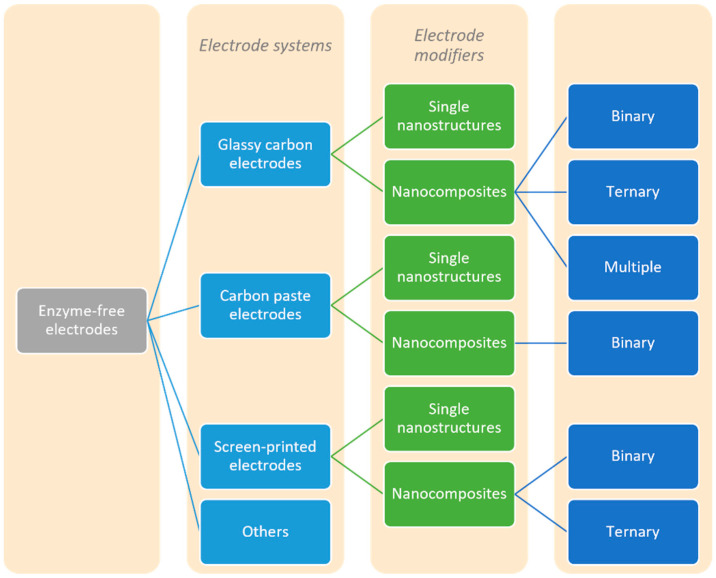
This review presents recent advances in the non-enzymatic electrochemical detection and quantification of pesticides, focusing on the use of nanomaterial-based electrode modifiers and their corresponding analytical response. The use of bare glassy carbon electrodes, carbon paste electrodes, screen-printed electrodes, and other electrodes in this research area is presented. The sensors were modified with single nanomaterials, a binary composite, or triple and multiple nanocomposites applied to the electrodes' surfaces using various application techniques. Regardless of the type of electrode used and the class of pesticides analysed, carbon-based nanomaterials, metal, and metal oxide nanoparticles are investigated mainly for electrochemical analysis because they have a high surface-to-volume ratio and, thus, a large effective area, high conductivity, and (electro)-chemical stability. This work demonstrates the progress made in recent years in the non-enzymatic electrochemical analysis of pesticides. The need for simultaneous detection of multiple pesticides with high sensitivity, low limit of detection, high precision, and high accuracy remains a challenge in analytical chemistry.
本文综述了近年来非酶电化学检测和定量农药的新进展,重点介绍了基于纳米材料的电极修饰剂及其相应的分析响应。介绍了在该研究领域中使用的裸玻碳电极、碳糊电极、丝网印刷电极和其他电极。传感器采用单一纳米材料、二元复合材料或三重和多重纳米复合材料进行修饰,并使用各种应用技术将其应用于电极表面。无论使用哪种类型的电极和分析的农药类别,基于碳的纳米材料、金属和金属氧化物纳米粒子主要用于电化学分析,因为它们具有高的表面积与体积比,从而具有大的有效面积、高导电性和(电)化学稳定性。这项工作展示了近年来在非酶电化学分析农药方面取得的进展。分析化学中仍然需要同时具有高灵敏度、低检测限、高精度和高准确性的用于同时检测多种农药的传感器。