Department of Environment Science and Engineering, Kyung Hee University, Yongin 446-701, Korea.
Center for Advanced Materials, Qatar University, Doha P.O. Box 2713, Qatar.
Biosensors (Basel). 2020 Oct 22;10(11):151. doi: 10.3390/bios10110151.
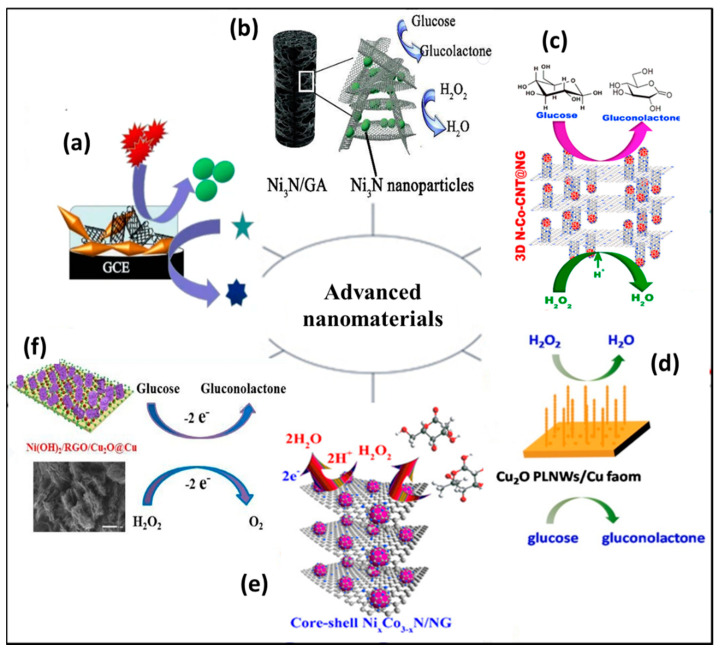
Non-enzymatic sensing has been in the research limelight, and most sensors based on nanomaterials are designed to detect single analytes. The simultaneous detection of analytes that together exist in biological organisms necessitates the development of effective and efficient non-enzymatic electrodes in sensing. In this regard, the development of sensing elements for detecting glucose and hydrogen peroxide (HO) is significant. Non-enzymatic sensing is more economical and has a longer lifetime than enzymatic electrochemical sensing, but it has several drawbacks, such as high working potential, slow electrode kinetics, poisoning from intermediate species and weak sensing parameters. We comprehensively review the recent developments in non-enzymatic glucose and HO (NEGH) sensing by focusing mainly on the sensing performance, electro catalytic mechanism, morphology and design of electrode materials. Various types of nanomaterials with metal/metal oxides and hybrid metallic nanocomposites are discussed. A comparison of glucose and HO sensing parameters using the same electrode materials is outlined to predict the efficient sensing performance of advanced nanomaterials. Recent innovative approaches to improve the NEGH sensitivity, selectivity and stability in real-time applications are critically discussed, which have not been sufficiently addressed in the previous reviews. Finally, the challenges, future trends, and prospects associated with advanced nanomaterials for NEGH sensing are considered. We believe this article will help to understand the selection of advanced materials for dual/multi non-enzymatic sensing issues and will also be beneficial for researchers to make breakthrough progress in the area of non-enzymatic sensing of dual/multi biomolecules.
非酶传感一直是研究的焦点,大多数基于纳米材料的传感器都被设计用于检测单一分析物。同时检测共同存在于生物体内的分析物需要在传感中开发有效的和高效的非酶电极。在这方面,开发用于检测葡萄糖和过氧化氢(HO)的传感元件是很重要的。与酶电化学传感相比,非酶传感更经济,寿命更长,但也有一些缺点,如工作电位高、电极动力学缓慢、中间物种中毒和传感参数弱。我们主要关注传感性能、电催化机制、电极材料的形态和设计,全面综述了非酶葡萄糖和 HO(NEGH)传感的最新进展。讨论了各种类型的纳米材料,包括金属/金属氧化物和混合金属纳米复合材料。概述了使用相同电极材料对葡萄糖和 HO 传感参数的比较,以预测先进纳米材料的有效传感性能。还批判性地讨论了最近在实时应用中提高 NEGH 灵敏度、选择性和稳定性的创新方法,这些方法在以前的综述中没有得到充分的讨论。最后,考虑了用于 NEGH 传感的先进纳米材料的挑战、未来趋势和前景。我们相信,这篇文章将有助于理解用于双/多非酶传感问题的先进材料的选择,也将有利于研究人员在双/多生物分子的非酶传感领域取得突破进展。