Farkas Valéria, Csitári Gábor, Menyhárt László, Such Nikoletta, Pál László, Husvéth Ferenc, Rawash Mohamed Ali, Mezőlaki Ákos, Dublecz Károly
Institute of Physiology and Nutrition, Department of Animal Nutrition and Nutritional Physiology, Georgikon Campus, Deák Ferenc Street 16, Hungarian University of Agriculture and Life Sciences, 8360 Keszthely, Hungary.
Institute of Mathematics and Basic Science, Georgikon Campus, Deák Ferenc Street 16, Hungarian University of Agriculture and Life Sciences, 8360 Keszthely, Hungary.
Animals (Basel). 2022 May 18;12(10):1296. doi: 10.3390/ani12101296.
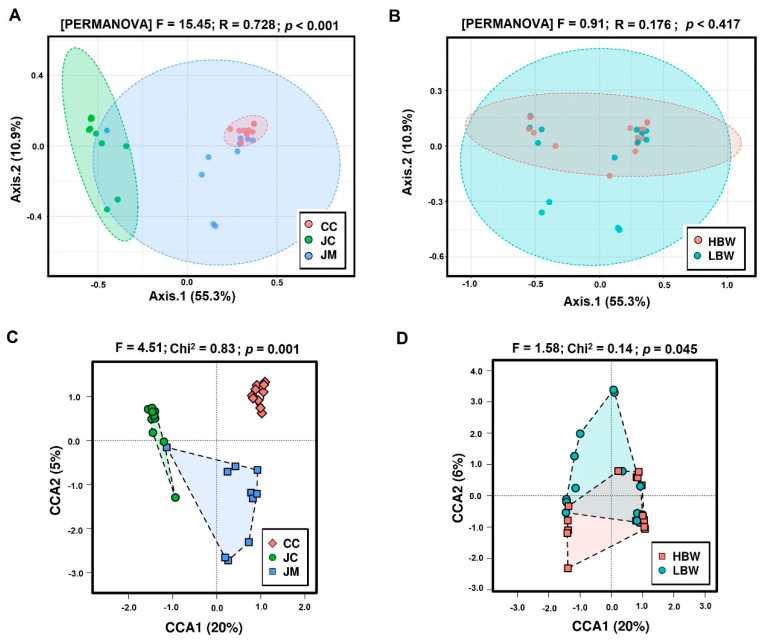
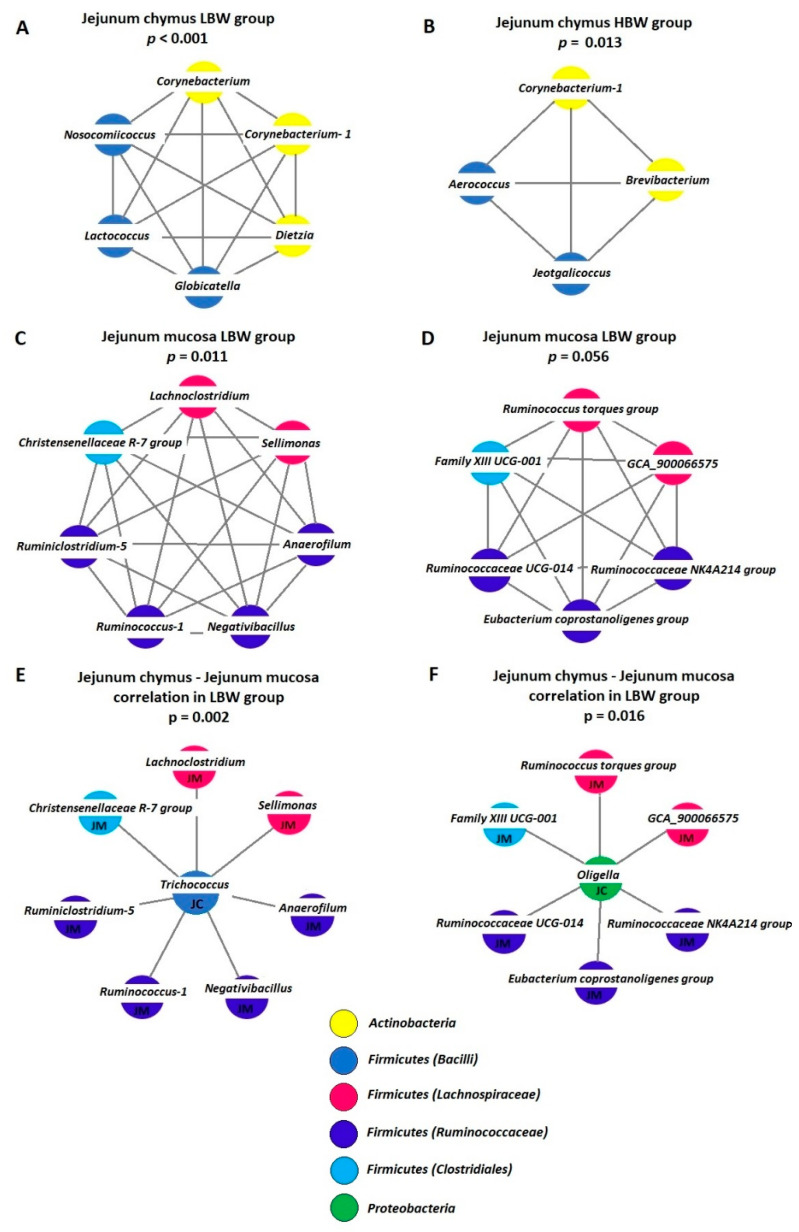
The study reported here aimed to determine whether correlations can be found between the intestinal segment-related microbiota composition and the different growing intensities of broiler chickens. The bacterial community structures of three intestinal segments (jejunum chymus-JC, jejunum mucosa-JM, caecum chymus-CC) from broiler chickens with low body weight (LBW) and high body weight (HBW) were investigated. Similar to the previous results in most cases, significant differences were found in the bacteriota diversity and composition between the different sampling places. However, fewer body weight (BW)-related differences were detected. In the JM of the HBW birds, the / ratio (B/F) was also higher. At the genus level significant differences were observed between the BW groups in the relative abundance of , mainly in the JC; and , mainly in the JM; and , , and in the CC. These genera and others (e.g., and in the JM; , -, and in the CC) showed a close correlation with BW. The co-occurrence interaction results in the JC revealed a correlation between the genera of (mainly with ) and classes with different patterns in the two BW groups. In the JM of LBW birds, two co-occurring communities were found that were not identifiable in HBW chickens and their members belonged to the families of and . In the frame of the co-occurrence evaluation between the jejunal content and mucosa, the two genera ( and in the JC were found to have a significant positive correlation with other genera of the JM only in LBW chickens.
本文报道的研究旨在确定肠道段相关微生物群组成与肉鸡不同生长强度之间是否存在相关性。对低体重(LBW)和高体重(HBW)肉鸡的三个肠道段(空肠食糜-JC、空肠黏膜-JM、盲肠食糜-CC)的细菌群落结构进行了研究。在大多数情况下,与之前的结果相似,不同采样部位之间的细菌多样性和组成存在显著差异。然而,检测到的体重(BW)相关差异较少。在高体重鸡的空肠黏膜中,/比率(B/F)也较高。在属水平上,体重组之间在相对丰度方面存在显著差异,主要在空肠食糜中为;在空肠黏膜中为和;在盲肠食糜中为、和。这些属以及其他属(例如,空肠黏膜中的和;盲肠食糜中的、-和)与体重密切相关。空肠食糜中的共现相互作用结果显示,两个体重组中属(主要与)和类之间存在不同模式的相关性。在低体重鸡的空肠黏膜中,发现了两个共现群落,在高体重鸡中无法识别,其成员属于和科。在空肠内容物和黏膜之间的共现评估框架内,发现空肠食糜中的两个属(和)仅在低体重鸡中与空肠黏膜的其他属存在显著正相关。