Filik Karolina, Szermer-Olearnik Bożena, Oleksy Sabina, Brykała Jan, Brzozowska Ewa
Hirszfeld Institute of Immunology and Experimental Therapy, Polish Academy of Sciences, St. R. Weigl 12, 51-167 Wroclaw, Poland.
Antibiotics (Basel). 2022 Apr 21;11(5):555. doi: 10.3390/antibiotics11050555.
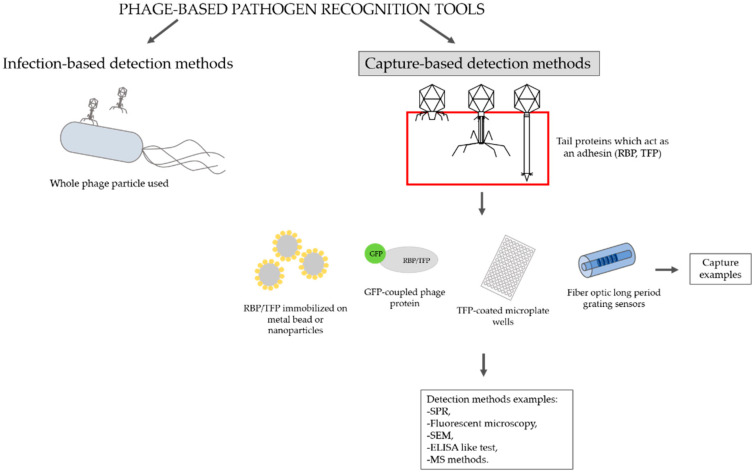
In recent years, a number of bacterial detection methods have been developed to replace time-consuming culture methods. One interesting approach is to mobilize the ability of phage tail proteins to recognize and bind to bacterial hosts. In this paper, the authors provide an overview of the current methodologies in which phage proteins play major roles in detecting pathogenic bacteria. Authors focus on proteins capable of recognizing highly pathogenic strains, such as , spp., , , , , spp., spp., and . These pathogens may be diagnosed by capture-based detection methods involving the use of phage protein-coated nanoparticles, ELISA (enzyme-linked immunosorbent assay)-based methods, or biosensors. The reviewed studies show that phage proteins are becoming an important diagnostic tool due to the discovery of new phages and the increasing knowledge of understanding the specificity and functions of phage tail proteins.
近年来,已经开发了许多细菌检测方法来取代耗时的培养方法。一种有趣的方法是利用噬菌体尾部蛋白识别和结合细菌宿主的能力。在本文中,作者概述了当前噬菌体蛋白在检测病原菌中起主要作用的方法。作者重点关注能够识别高致病性菌株的蛋白质,如 、 属、 、 、 、 、 属、 属和 。这些病原体可以通过基于捕获的检测方法进行诊断,包括使用噬菌体蛋白包被的纳米颗粒、基于酶联免疫吸附测定(ELISA)的方法或生物传感器。综述研究表明,由于新噬菌体的发现以及对噬菌体尾部蛋白特异性和功能的认识不断增加,噬菌体蛋白正成为一种重要的诊断工具。