da Silva-Neto Pedro V, do Valle Valéria B, Fuzo Carlos A, Fernandes Talita M, Toro Diana M, Fraga-Silva Thais F C, Basile Patrícia A, de Carvalho Jonatan C S, Pimentel Vinícius E, Pérez Malena M, Oliveira Camilla N S, Rodrigues Lilian C, Bastos Victor A F, Tella Sandra O C, Martins Ronaldo B, Degiovani Augusto M, Ostini Fátima M, Feitosa Marley R, Parra Rogerio S, Vilar Fernando C, Gaspar Gilberto G, Rocha José J R da, Feres Omar, Arruda Eurico, Maruyama Sandra R, Russo Elisa M S, Viana Angelina L, Santos Isabel K F M, Bonato Vânia L D, Cardoso Cristina R B, Tanus-Santos Jose E, Donadi Eduardo A, Faccioli Lucia H, Dias-Baruffi Marcelo, Fernandes Ana P M, Gerlach Raquel F, Sorgi Carlos A
Departamento de Análises Clínicas, Toxicológicas e Bromatológicas, Faculdade de Ciências Farmacêuticas de Ribeirão Preto-FCFRP, Universidade de São Paulo-USP, Ribeirão Preto 14040-903, Brazil.
Programa de Pós-Graduação em Imunologia Básica e Aplicada-PPGIBA, Instituto de Ciências Biológicas, Universidade Federal do Amazonas-UFAM, Manaus 69080-900, Brazil.
Biomolecules. 2022 Apr 19;12(5):604. doi: 10.3390/biom12050604.
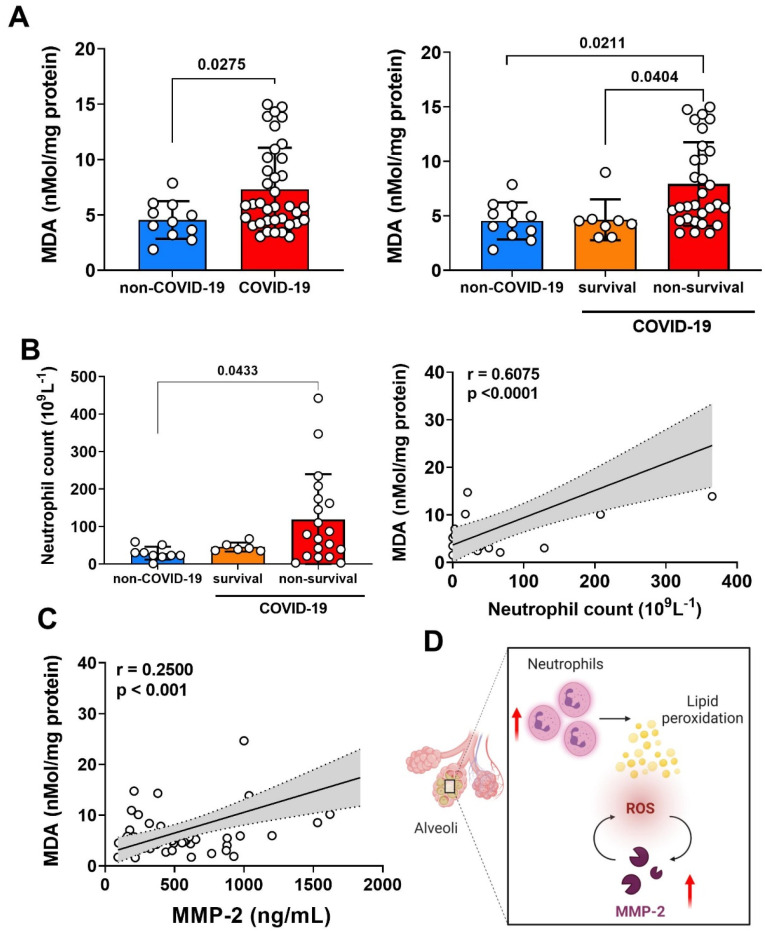
Patients with COVID-19 predominantly have a respiratory tract infection and acute lung failure is the most severe complication. While the molecular basis of SARS-CoV-2 immunopathology is still unknown, it is well established that lung infection is associated with hyper-inflammation and tissue damage. Matrix metalloproteinases (MMPs) contribute to tissue destruction in many pathological situations, and the activity of MMPs in the lung leads to the release of bioactive mediators with inflammatory properties. We sought to characterize a scenario in which MMPs could influence the lung pathogenesis of COVID-19. Although we observed high diversity of MMPs in lung tissue from COVID-19 patients by proteomics, we specified the expression and enzyme activity of MMP-2 in tracheal-aspirate fluid (TAF) samples from intubated COVID-19 and non-COVID-19 patients. Moreover, the expression of MMP-8 was positively correlated with MMP-2 levels and possible shedding of the immunosuppression mediator sHLA-G and sTREM-1. Together, overexpression of the MMP-2/MMP-8 axis, in addition to neutrophil infiltration and products, such as reactive oxygen species (ROS), increased lipid peroxidation that could promote intensive destruction of lung tissue in severe COVID-19. Thus, the inhibition of MMPs can be a novel target and promising treatment strategy in severe COVID-19.
新冠病毒病(COVID-19)患者主要表现为呼吸道感染,急性肺衰竭是最严重的并发症。虽然严重急性呼吸综合征冠状病毒2(SARS-CoV-2)免疫病理学的分子基础尚不清楚,但肺部感染与炎症反应过度及组织损伤之间的关联已得到充分证实。基质金属蛋白酶(MMPs)在许多病理情况下会导致组织破坏,肺部MMPs的活性会促使具有炎症特性的生物活性介质释放。我们试图描述一种MMPs可能影响COVID-19肺部发病机制的情况。尽管通过蛋白质组学我们观察到COVID-19患者肺组织中MMPs具有高度多样性,但我们明确了插管的COVID-19患者和非COVID-19患者气管抽吸液(TAF)样本中MMP-2的表达及酶活性。此外,MMP-8的表达与MMP-2水平以及免疫抑制介质可溶性人类白细胞抗原G(sHLA-G)和可溶性触发受体表达于髓样细胞-1(sTREM-1)的可能释放呈正相关。总之,除中性粒细胞浸润和活性氧(ROS)等产物外,MMP-2/MMP-8轴的过表达会增加脂质过氧化,这可能会促进重症COVID-19患者肺组织的严重破坏。因此,抑制MMPs可能是重症COVID-19的一个新靶点和有前景的治疗策略。