Lee Dong-Hun, Lee Ji-Young, Hong Dong-Yong, Lee Eun-Chae, Park Sang-Won, Lee Man-Ryul, Oh Jae-Sang
Department of Neurosurgery, College of Medicine, Soonchunhyang University, Cheonan Hospital, Cheonan 31151, Korea.
Soonchunhyang Institute of Medi-Bio Science (SIMS), Soon Chun Hyang University, Cheonan 31151, Korea.
Biomedicines. 2022 Apr 20;10(5):953. doi: 10.3390/biomedicines10050953.
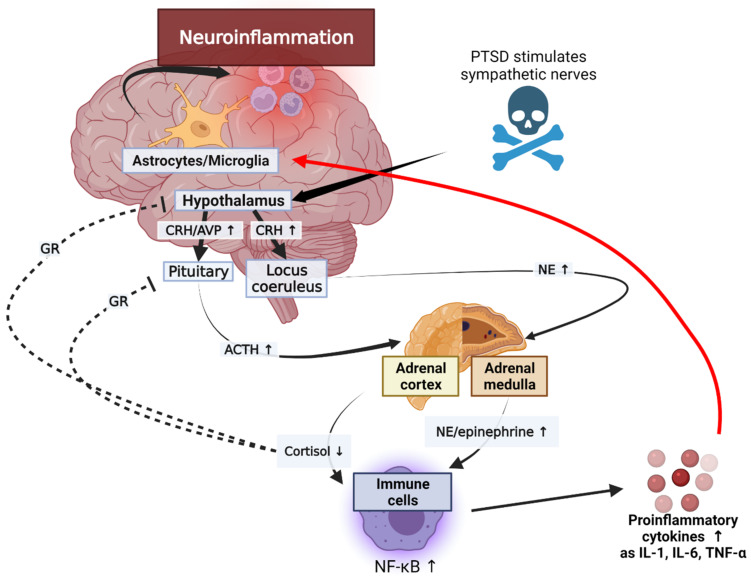
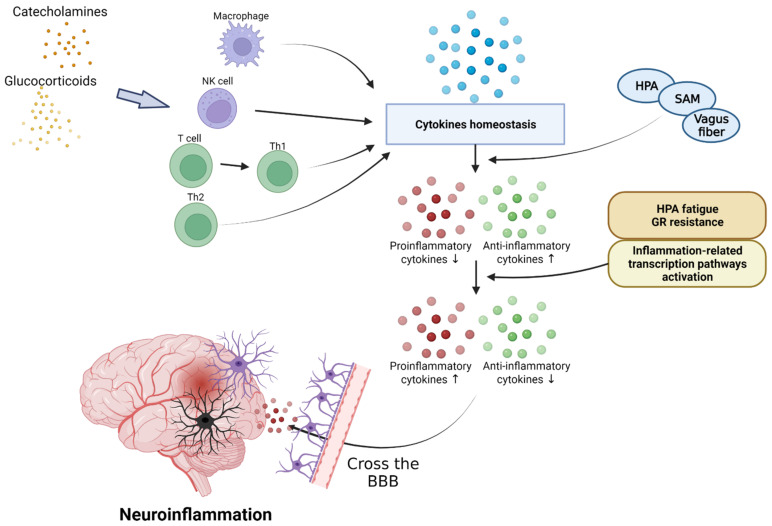
Post-traumatic stress disorder (PTSD) is a well-known mental illness, which is caused by various stressors, including memories of past physical assaults and psychological pressure. It is diagnosed as a mental and behavioral disorder, but increasing evidence is linking it to the immune system and inflammatory response. Studies on the relationship between inflammation and PTSD revealed that patients with PTSD had increased levels of inflammatory cytokine biomarkers, such as interleukin-1, interleukin-6, tumor necrosis factor-α, nuclear factor-κB, and C-reactive protein, compared with healthy controls. In addition, animal model experiments imitating PTSD patients suggested the role of inflammation in the pathogenesis and pathophysiology of PTSD. In this review, we summarize the definition of PTSD and its association with increased inflammation, its mechanisms, and future predictable diseases and treatment possibilities. We also discuss anti-inflammatory treatments to address inflammation in PTSD.
创伤后应激障碍(PTSD)是一种广为人知的精神疾病,由各种应激源引起,包括过去身体攻击的记忆和心理压力。它被诊断为一种精神和行为障碍,但越来越多的证据表明它与免疫系统和炎症反应有关。关于炎症与PTSD之间关系的研究表明,与健康对照组相比,PTSD患者的炎症细胞因子生物标志物水平升高,如白细胞介素-1、白细胞介素-6、肿瘤坏死因子-α、核因子-κB和C反应蛋白。此外,模仿PTSD患者的动物模型实验表明炎症在PTSD的发病机制和病理生理学中的作用。在这篇综述中,我们总结了PTSD的定义及其与炎症增加的关联、其机制、未来可预测的疾病和治疗可能性。我们还讨论了针对PTSD炎症的抗炎治疗。