Li Weidan, Li Junjie, Qin Zhen, Wang Yang, Zhao Pengyu, Gao Haiyan
School of Life Sciences, Shanghai University, Shanghai 200444, China.
School of Environmental and Chemical Engineering, Shanghai University, Shanghai 200444, China.
Foods. 2022 May 12;11(10):1402. doi: 10.3390/foods11101402.
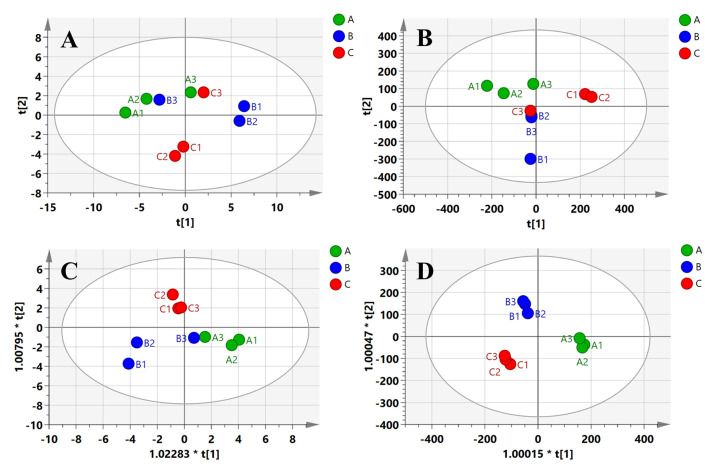
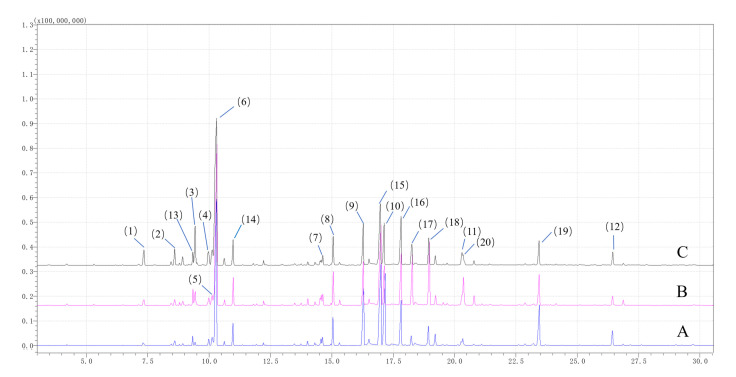
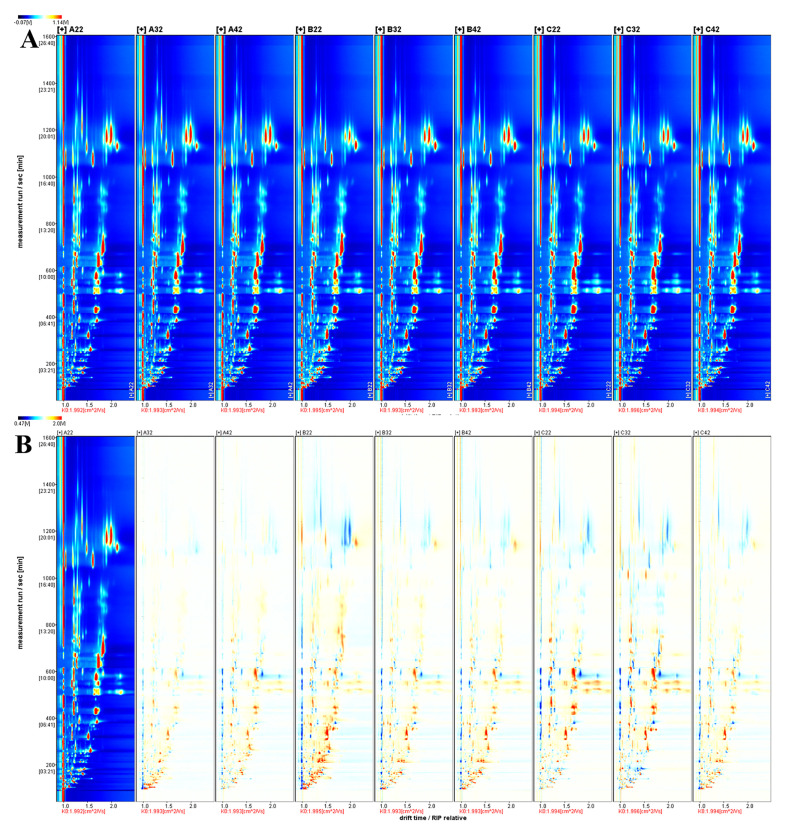
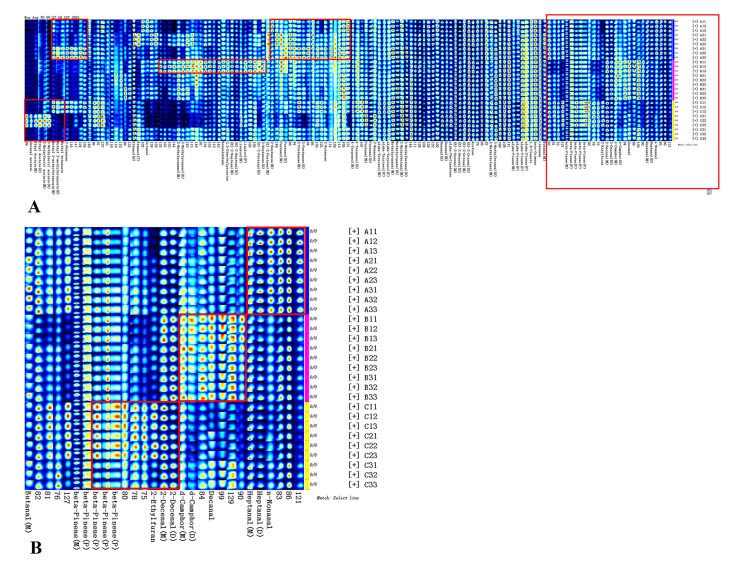
Chemical components are one of the most significant traits and attributes of plant tissues, and lead to their different functions. In this study, the composition of essential oils (AEOs) from different regions was first determined by a combination of gas chromatography-mass spectrometry (GC-MS) and gas chromatography-ion mobility spectrometry (GC-IMS). In total, 141 compounds were identified, of which terpenes and aldehydes were the main groups. Orthogonal partial least square discriminant analysis (OPLS-DA) distinguished the samples from different regions clearly, and the main differences were terpenes, aldehydes, and esters. Meanwhile, AEOs showed strong antibacterial activity against (), and the minimum inhibitory concentration (MIC) and minimum bactericidal concentration (MBC) reached 0.20 mg/mL and 0.39-0.78 mg/mL, respectively. From correlation analysis, 1,8-cineole, (E)-dec-2-enal, citral, α-pinene, and α-terpineol were determined to be the potential antibacterial compounds. This study provides the basis for the variety optimization of and its application as a natural food preservative.
化学成分是植物组织最重要的特征和属性之一,并导致其具有不同的功能。在本研究中,首先通过气相色谱 - 质谱联用(GC-MS)和气相色谱 - 离子迁移谱(GC-IMS)相结合的方法测定了不同地区的精油(AEOs)成分。总共鉴定出141种化合物,其中萜类和醛类是主要类别。正交偏最小二乘判别分析(OPLS-DA)清晰地区分了不同地区的样品,主要差异在于萜类、醛类和酯类。同时,AEOs对()表现出较强的抗菌活性,最小抑菌浓度(MIC)和最小杀菌浓度(MBC)分别达到0.20 mg/mL和0.39 - 0.78 mg/mL。通过相关性分析,确定1,8-桉叶素、(E)-癸-2-烯醛、柠檬醛、α-蒎烯和α-松油醇为潜在的抗菌化合物。本研究为()的品种优化及其作为天然食品防腐剂的应用提供了依据。