Feng Ying, Ming Tinghong, Zhou Jun, Lu Chenyang, Wang Rixin, Su Xiurong
State Key Laboratory for Managing Biotic and Chemical Threats to the Quality and Safety of Agro-Products, Ningbo University, Ningbo 315211, China.
College of Life Sciences, Tonghua Normal University, Tonghua 134000, China.
Foods. 2022 May 22;11(10):1503. doi: 10.3390/foods11101503.
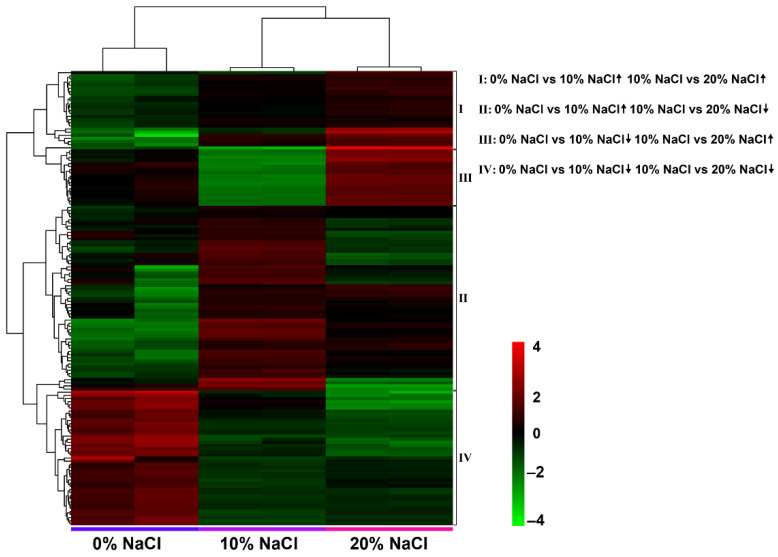
() has a strong tolerance to high salt stress. It is a major reason as to why the contamination of in salted food cannot be eradicated. To elucidate its response and survival mechanisms, changes in the morphology, biofilm formation, virulence, transcriptome, and metabolome of were investigated. positively regulates and participates in the formation of biofilm. Virulence was downregulated to reduce the depletion of nonessential cellular functions. Inositol phosphate metabolism was downregulated to reduce the conversion of functional molecules. The MtsABC transport system was downregulated to reduce ion transport and signaling. Aminoacyl-tRNA biosynthesis was upregulated to improve cellular homeostasis. The betaine biosynthesis pathway was upregulated to protect the active structure of proteins and nucleic acids. Within a 10% NaCl concentration, the L-proline content was upregulated to increase osmotic stability. In addition, 20 hub genes were identified through an interaction analysis. The findings provide theoretical support for the prevention and control of salt-tolerant bacteria in salted foods.
(某菌)对高盐胁迫具有很强的耐受性。这是腌制食品中该菌污染无法根除的一个主要原因。为阐明其响应和存活机制,研究了该菌在形态、生物膜形成、毒力、转录组和代谢组方面的变化。(某菌)正向调节并参与生物膜的形成。毒力被下调以减少非必需细胞功能的消耗。肌醇磷酸代谢被下调以减少功能分子的转化。MtsABC转运系统被下调以减少离子运输和信号传导。氨酰 - tRNA生物合成被上调以改善细胞内稳态。甜菜碱生物合成途径被上调以保护蛋白质和核酸的活性结构。在10%的NaCl浓度范围内,L - 脯氨酸含量被上调以增加渗透稳定性。此外,通过相互作用分析鉴定出20个枢纽基因。这些发现为腌制食品中耐盐细菌的防控提供了理论支持。