Department of Orthopaedics and Traumatology, IRCCS Fondazione Policlinico San Matteo, University of Pavia, 27100 Pavia, Italy.
Unit of Clinical Epidemiology and Biometry, IRCCS Fondazione Policlinico San Matteo Foundation, 27100 Pavia, Italy.
Int J Environ Res Public Health. 2022 May 12;19(10):5891. doi: 10.3390/ijerph19105891.
Musculoskeletal disorders (MSKDs) are the most common class of complaints among patients presenting for care in the Emergency Department (ED). There is a non-urgent patient population with musculoskeletal complaints attending ED services that creates a burgeoning waiting list and contributes to overcrowding in Emergency Departments (EDs), which is a major concern worldwide. The recent (Coronavirus disease-19) COVID-19 pandemic is an unprecedented challenge that is revealing the structural and situational strengths and weaknesses of healthcare systems.
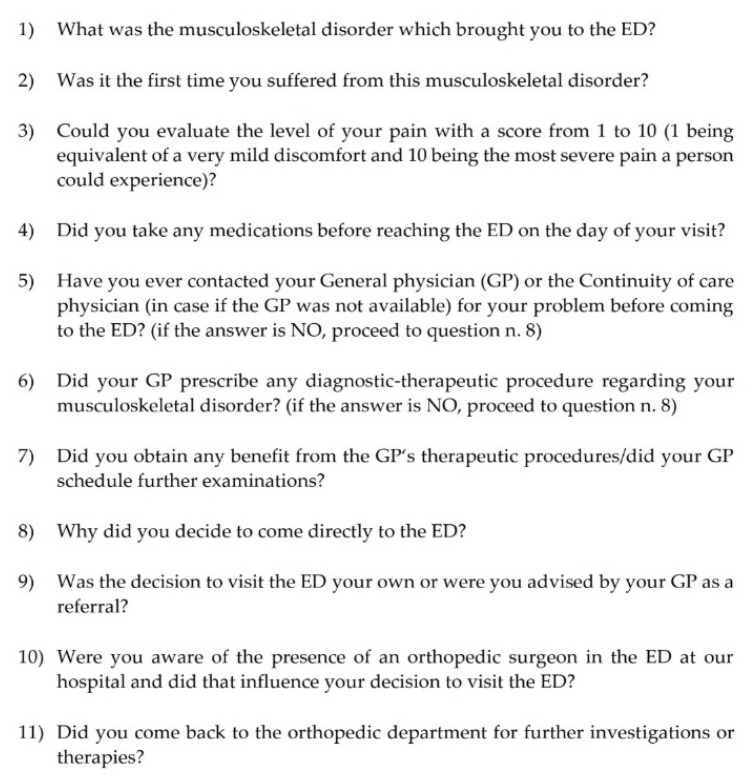
This study retrospectively and prospectively assessed patients presenting to the Emergency Department before and after the COVID-19 outbreak (from 21 February 2019 to 3 May 2019 and from 21 February 2020 to 3 May 2020) with non-traumatic or low-severity musculoskeletal conditions to test the hypothesis that these patients should have access to care outside the ED and that the COVID-19 outbreak has changed patients' care and health perception.
A total of 613 patients were identified, and 542 of them (87.56%) participated in a personalized survey. From this number, 81.73% of the total accesses took place in 2019, and only 18.27% of the accesses took place during the first outbreak and lockdown. More than 90% of patients admitted to the ED accessed care during the day shift in both periods. A total of 87.30% of patients presenting to the ED with a MSKD followed their general practitioner's (GP) advice/referral in 2019, and 73.87% did so in 2020. The differences in the means of transport to the ED was statistically significant (-value 0.002).
The outbreak and lockdown period confirmed that there is an inappropriate use of the ED related to patients with MSKD. However, the ED appears to be the only available solution for these patients. New services and pathways are therefore needed to enhance MSKD management and reduce ED crowding. Additional observational studies shall be developed to confirm and compare our findings with those of various EDs. The main limit of the inferential part of the study is probably due to the small sample of patients in 2020.
肌肉骨骼疾病(MSKDs)是急诊科就诊患者最常见的疾病类别。有一类非紧急的肌肉骨骼疾病患者在急诊科就诊,这导致了不断增加的候诊名单,并导致急诊科人满为患,这是全球范围内的一个主要关注点。最近的(冠状病毒病-19)COVID-19 大流行是一个前所未有的挑战,它揭示了医疗保健系统的结构和情况的优势和劣势。
本研究回顾性和前瞻性评估了在 COVID-19 爆发前后(2019 年 2 月 21 日至 5 月 3 日和 2020 年 2 月 21 日至 5 月 3 日)到急诊科就诊的非创伤性或低严重程度的肌肉骨骼疾病患者,以检验这些患者应该能够在急诊科之外获得治疗的假设,以及 COVID-19 爆发改变了患者的治疗和健康感知。
共确定了 613 名患者,其中 542 名(87.56%)参加了个性化调查。从这个数字中,总共有 81.73%的就诊发生在 2019 年,只有 18.27%的就诊发生在第一次爆发和封锁期间。两个时期,超过 90%的急诊科就诊患者在白天就诊。在 2019 年,急诊科就诊的肌肉骨骼疾病患者中有 87.30%的人听从了他们的全科医生(GP)的建议/转诊,2020 年有 73.87%的人听从了建议。前往急诊科的交通工具的平均值存在统计学差异(-值 0.002)。
爆发和封锁期间证实,急诊科与肌肉骨骼疾病患者的使用不当有关。然而,急诊科似乎是这些患者唯一的解决方案。因此,需要新的服务和途径来加强肌肉骨骼疾病的管理,减少急诊科的拥挤。应开展额外的观察性研究,以确认和比较我们的发现与其他急诊科的发现。研究的推断部分的主要限制可能是 2020 年患者的样本量较小。