
新冠疫情期间,米兰和伦巴第大区一家三级医院的急诊手术量及急诊科就诊情况的变化
Variations in volume of emergency surgeries and emergency department access at a third level hospital in Milan, Lombardy, during the COVID-19 outbreak.
作者信息
Castoldi Laura, Solbiati Monica, Costantino Giorgio, Casiraghi Elena
机构信息
Fondazione IRCCS Ca' Granda Ospedale Maggiore Policlinico, UOSD Chirurgia d'Urgenza,, Milano, Italy.
Fondazione IRCCS Ca' Granda Ospedale Maggiore Policlinico, UOC Pronto Soccorso e Medicina d'Urgenza, Milan, Italy.
出版信息
BMC Emerg Med. 2021 May 10;21(1):59. doi: 10.1186/s12873-021-00445-z.
BACKGROUND
During the recent outbreak of COVID-19 (coronavirus disease 2019), Lombardy was the most affected region in Italy, with 87,000 patients and 15,876 deaths up to May 26, 2020. Since February 22, 2020, well before the Government declared a state of emergency, there was a huge reduction in the number of emergency surgeries performed at hospitals in Lombardy. A general decrease in attendance at emergency departments (EDs) was also observed. The aim of our study is to report the experience of the ED of a third-level hospital in downtown Milan, Lombardy, and provide possible explanations for the observed phenomena.
METHODS
This retrospective, observational study assessed the volume of emergency surgeries and attendance at an ED during the course of the pandemic, i.e. immediately before, during and after a progressive community lockdown in response to the COVID-19 pandemic. These data were compared with data from the same time periods in 2019. The results are presented as means, standard error (SE), and 95% studentized confidence intervals (CI). The Wilcoxon rank signed test at a 0.05 significance level was used to assess differences in per-day ED access distributions.
RESULTS
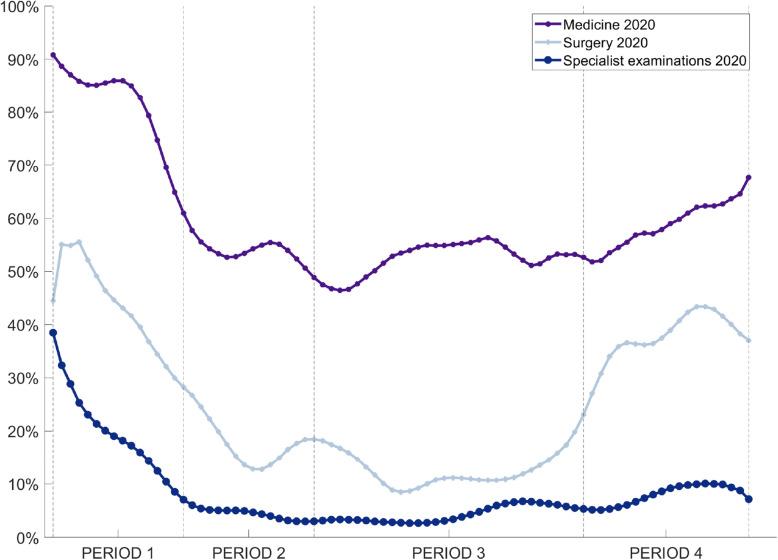
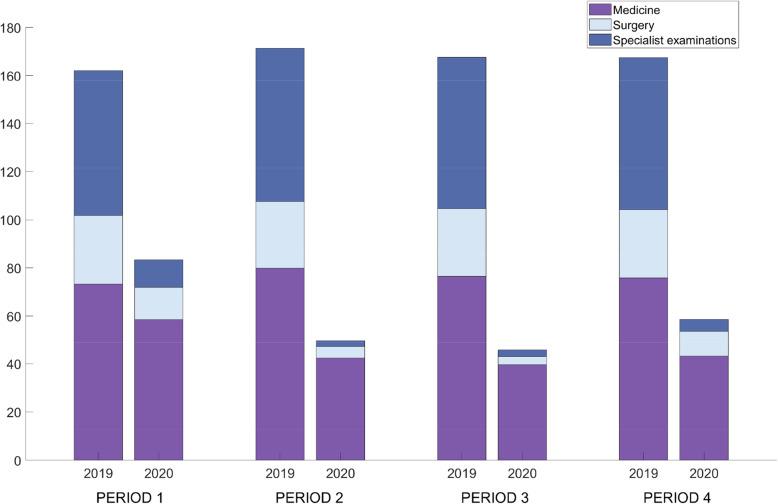
Compared to 2019, a significant overall drop in emergency surgeries (60%, p < 0.002) and in ED admittance (66%, p ≅ 0) was observed in 2020. In particular, there were significant decreases in medical (40%), surgical (74%), specialist (ophthalmology, otolaryngology, traumatology, and urology) (92%), and psychiatric (60%) cases. ED admittance due to domestic violence (59%) and individuals who left the ED without being seen (76%) also decreased. Conversely, the number of deaths increased by 196%.
CONCLUSIONS
During the COVID-19 outbreak the volume of urgent surgeries and patients accessing our ED dropped. Currently, it is not known if mortality of people who did not seek care increased during the pandemic. Further studies are needed to understand if such reductions during the COVID-19 pandemic will result in a rebound of patients left untreated or in unwanted consequences for population health.
背景
在近期新型冠状病毒肺炎(COVID-19)疫情期间,伦巴第是意大利受影响最严重的地区,截至2020年5月26日,有87000名患者,15876人死亡。自2020年2月22日起,远在政府宣布紧急状态之前,伦巴第地区医院进行的急诊手术数量就大幅减少。急诊部门(ED)的就诊人数也普遍下降。我们研究的目的是报告伦巴第大区米兰市中心一家三级医院急诊部门的经验,并对观察到的现象提供可能的解释。
方法
这项回顾性观察研究评估了疫情期间,即因COVID-19疫情而逐步实施社区封锁之前、期间和之后,急诊手术量和急诊部门的就诊人数。这些数据与2019年同期的数据进行了比较。结果以均值、标准误差(SE)和95%学生化置信区间(CI)表示。采用0.05显著性水平的Wilcoxon秩和检验来评估每日急诊就诊分布的差异。
结果
与2019年相比,2020年急诊手术量(60%,p<0.002)和急诊入院人数(66%,p≅0)总体显著下降。特别是,内科(40%)、外科(74%)、专科(眼科、耳鼻喉科、创伤科和泌尿科)(92%)和精神科(60%)病例显著减少。因家庭暴力导致的急诊入院人数(59%)和未就诊就离开急诊部门的人数(76%)也有所下降。相反,死亡人数增加了196%。
结论
在COVID-19疫情期间,急诊手术量和来我们急诊部门就诊的患者数量下降。目前尚不清楚在疫情期间未寻求治疗的人群死亡率是否上升。需要进一步研究以了解COVID-19疫情期间的这种减少是否会导致未治疗患者数量反弹或对人群健康产生不良后果。
 Zotero 插件