Department of Emergency Medicine, Singapore General Hospital, 1 Outram Road, Singapore City, 169608, Singapore.
Department of Emergency Medicine, Sengkang General Hospital, Sengkang, Singapore.
Scand J Trauma Resusc Emerg Med. 2020 Dec 17;28(1):118. doi: 10.1186/s13049-020-00809-7.
The current COVID-19 pandemic is highlighting gaps around the world in the design and workflow of Emergency Departments (ED). These gaps have an impact on both patient care and staff safety and represent a risk to public health. There is a need for a conceptual framework to guide ED design and workflow to address these challenges. Such a framework is important as the ED environment will always remain vulnerable to infectious diseases outbreaks in the future.
This paper aims to address issues and principles around ED design and workflow amidst the COVID-19 pandemic. We propose a conceptual framework and checklist for EDs to be prepared for future outbreaks as well.
A scoping literature review was conducted, of the experiences of EDs in managing outbreaks such as SARS, H1N1 and COVID-19. The combined experiences of the authors and the experiences from the literature were grouped under common themes to develop the conceptual framework.
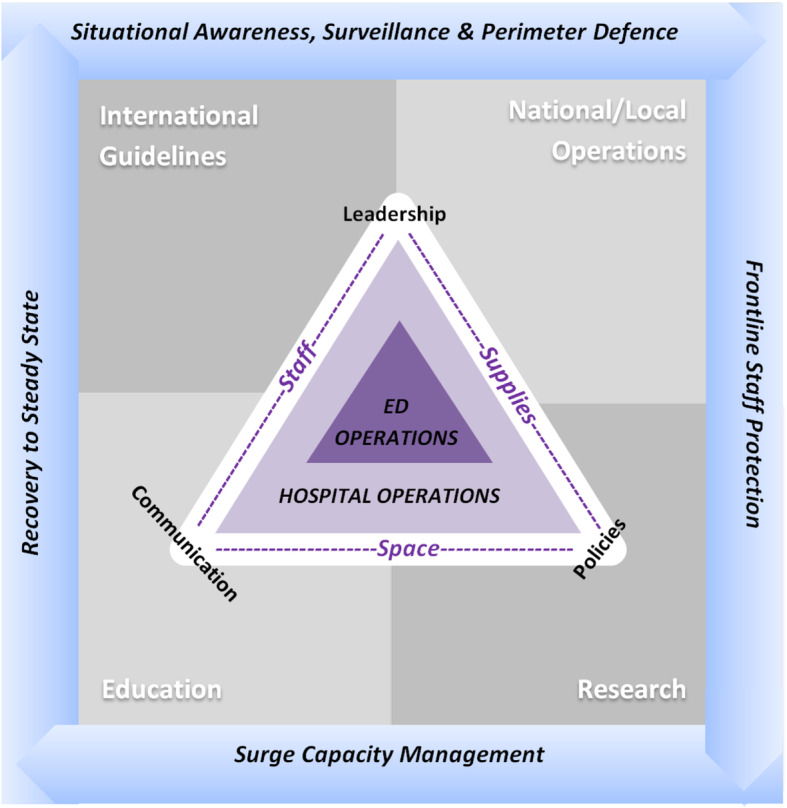
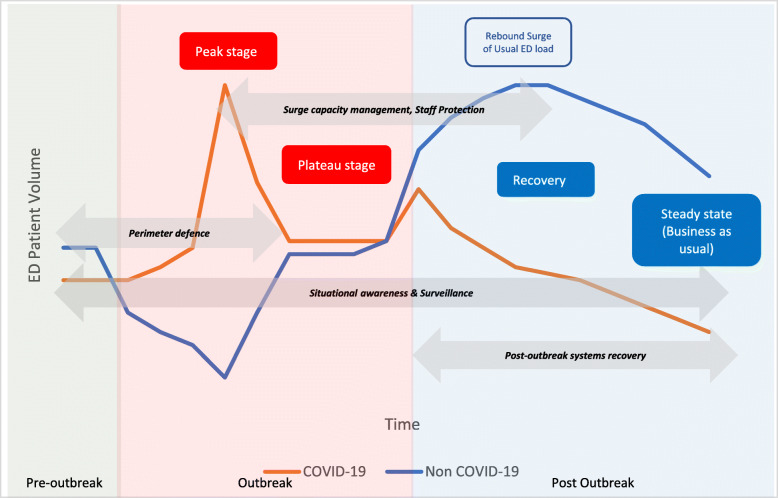
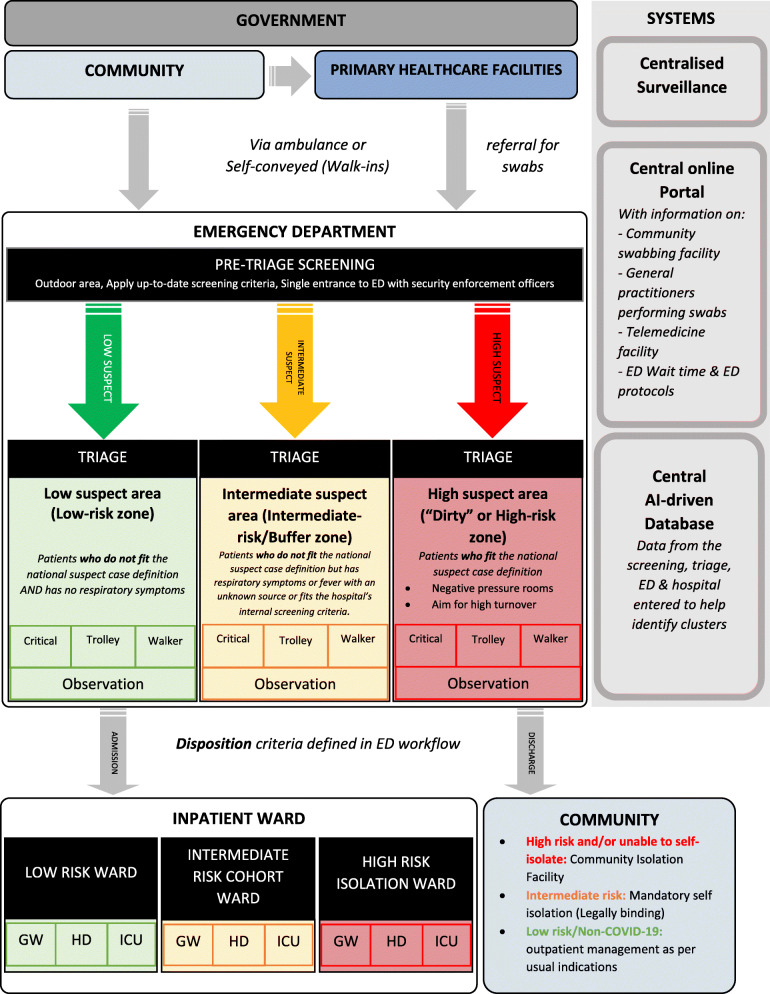
Four key principles were derived- (1) situational awareness, surveillance and perimeter defence, (2) ED staff protection, (3) surge capacity management and (4) ED recovery. The findings were integrated in a proposed conceptual framework to guide ED design in response to an infectious disease outbreak. There are various elements which need to be considered at ED input, throughput and output. These elements can be categorised into (1) system (workflow, protocols and communication), (2) staff (human resources), (3) space (infrastructure), and (4) supply (logistics) and are placed in a checklist for pragmatic use.
The ED needs to be in a constant state of preparedness. A framework can be useful to guide ED design and workflow to achieve this. As all ED systems are different with varying capabilities, our framework may help EDs across the world prepare for infectious disease outbreaks.
当前的 COVID-19 大流行凸显了全球在急诊部(ED)的设计和工作流程方面存在的差距。这些差距不仅对患者护理和员工安全产生影响,而且对公共卫生构成威胁。需要有一个概念框架来指导 ED 的设计和工作流程,以应对这些挑战。由于 ED 环境在未来仍将容易受到传染病爆发的影响,因此这样的框架非常重要。
本文旨在解决 COVID-19 大流行期间 ED 设计和工作流程方面的问题和原则。我们还提出了一个概念框架和检查表,以供 ED 为未来的爆发做好准备。
对 SARS、H1N1 和 COVID-19 等暴发期间 ED 管理经验进行了范围广泛的文献回顾。作者的综合经验和文献中的经验被归纳为共同主题,以制定概念框架。
得出了四项关键原则-(1)了解情况、监测和周边防御,(2)保护 ED 工作人员,(3)管理浪涌能力,以及(4)ED 恢复。这些发现被整合到一个建议的概念框架中,以指导 ED 设计,以应对传染病暴发。在 ED 的输入、通过量和输出方面需要考虑各种要素。这些要素可以分为(1)系统(工作流程、协议和沟通)、(2)员工(人力资源)、(3)空间(基础设施)和(4)供应(物流),并放在一个检查表中供实际使用。
ED 需要时刻做好准备。框架可以有助于指导 ED 的设计和工作流程,以实现这一目标。由于所有 ED 系统都具有不同的能力,因此我们的框架可能有助于全球的 ED 为传染病爆发做好准备。