Department of Pharmaceutical Chemistry, Faculty of Pharmaceutical Sciences in Sosnowiec, Medical University of Silesia in Katowice, Jagiellońska 4, 41-200 Sosnowiec, Poland.
Int J Mol Sci. 2022 May 17;23(10):5621. doi: 10.3390/ijms23105621.
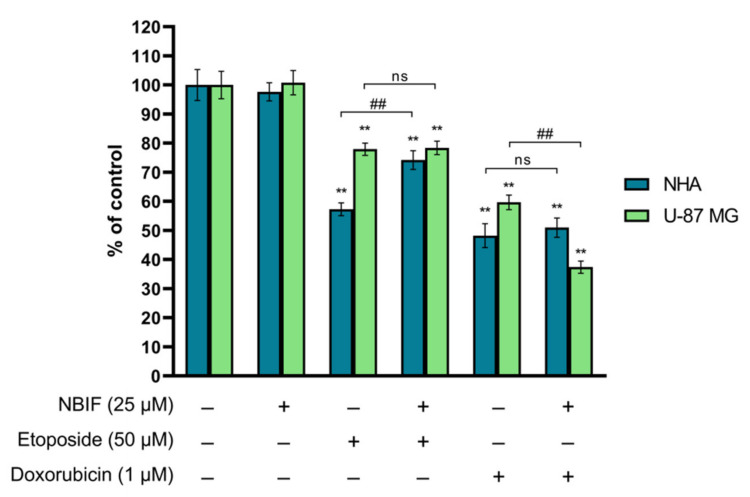
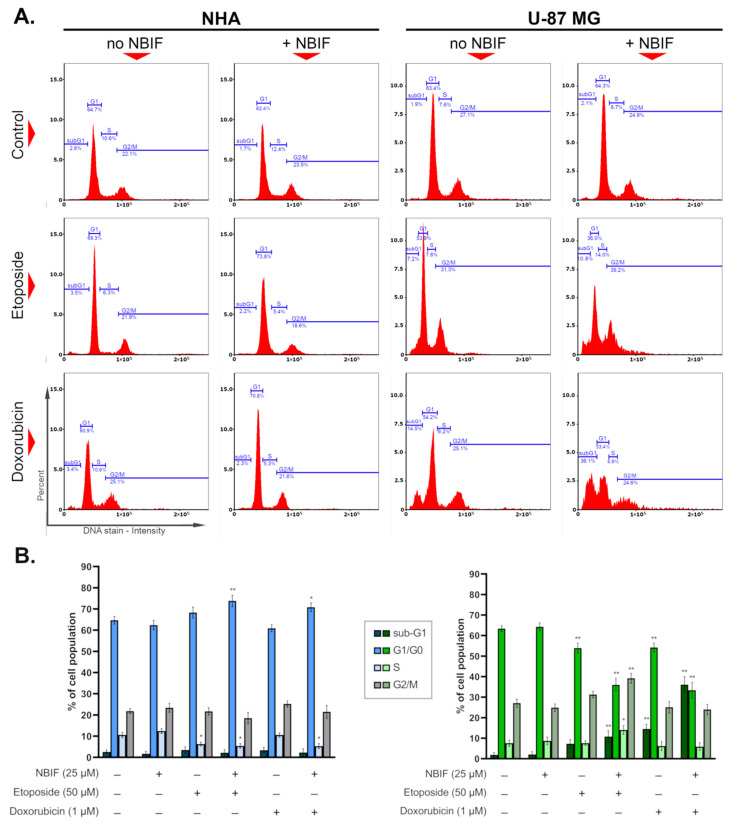
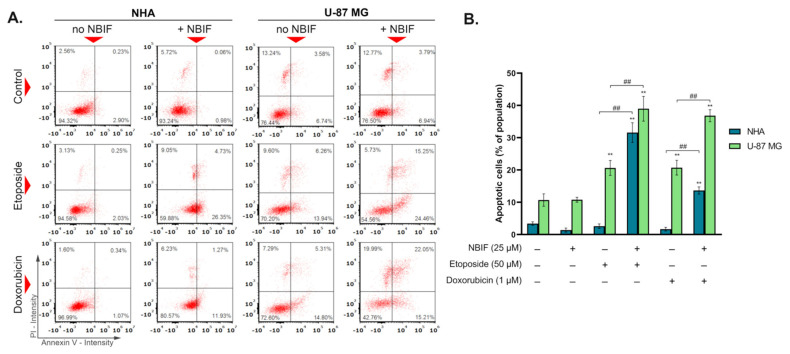
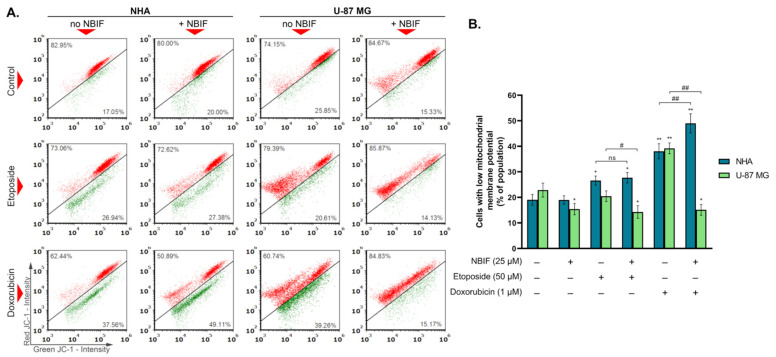
Glioblastoma (GB) is the most common type of glioma, which is distinguished by high mortality. Due to the rapid progression of the tumor and drug resistance, the treatment is often ineffective. The development of novel therapies in a big part concerns the application of anti-cancer agents already used in clinical practice, unfortunately often with limited effects. This could be overcome through the use of compounds that possess chemosensitizing properties. In our previous work, it has been shown that neobavaisoflavone (NBIF) enhances the in vitro activity of doxorubicin in GB cells. The aim of this study was a further investigation of the possible chemosensitizing effects of this isoflavone. The experimental panel involving image cytometry techniques, such as count assay, examination of mitochondrial membrane potential, Annexin V assay, and cell cycle analysis, was performed in human glioblastoma U-87 MG cells and normal human astrocytes (NHA) treated with NBIF, doxorubicin, etoposide, and their mixes with NBIF. NBIF in co-treatment with etoposide or doxorubicin caused an increase in the population of apoptotic cells and prompted alterations in the cell cycle. NBIF enhances the pro-apoptotic activity of etoposide and doxorubicin in U-87 MG cells, which could be a sign of the chemosensitizing properties of the isoflavone.
胶质母细胞瘤(GB)是最常见的神经胶质瘤类型,其死亡率很高。由于肿瘤的快速进展和耐药性,治疗往往效果不佳。新型疗法的发展在很大程度上涉及到已经在临床实践中使用的抗癌药物的应用,不幸的是,这些药物的效果往往有限。这可以通过使用具有化疗增敏特性的化合物来克服。在我们之前的工作中,已经表明新贝甲素(NBIF)增强了多柔比星在 GB 细胞中的体外活性。本研究的目的是进一步研究这种异黄酮可能的化疗增敏作用。实验小组采用图像细胞术技术,如计数测定、线粒体膜电位检查、Annexin V 测定和细胞周期分析,在 NBIF、多柔比星、依托泊苷处理的人胶质母细胞瘤 U-87 MG 细胞和正常人类星形胶质细胞(NHA)中进行。NBIF 与依托泊苷或多柔比星联合治疗导致凋亡细胞群体增加,并促使细胞周期发生改变。NBIF 增强了依托泊苷和多柔比星在 U-87 MG 细胞中的促凋亡活性,这可能是该异黄酮具有化疗增敏特性的标志。