Gong Yingdi, Fu Yanping, Xie Jiatao, Li Bo, Chen Tao, Lin Yang, Chen Weidong, Jiang Daohong, Cheng Jiasen
State Key Laboratory of Agricultural Microbiology, Huazhong Agricultural University, Wuhan 430070, China.
The Provincial Key Lab of Plant Pathology of Hubei Province, College of Plant Science and Technology, Huazhong Agricultural University, Wuhan 430070, China.
J Fungi (Basel). 2022 May 20;8(5):526. doi: 10.3390/jof8050526.
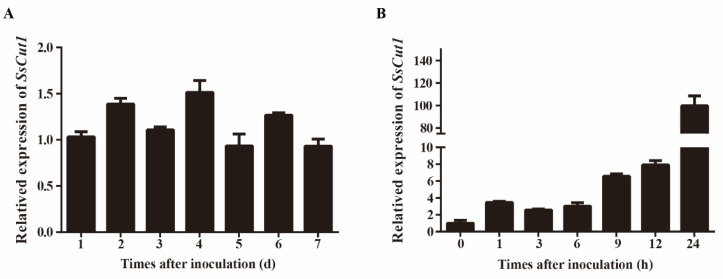
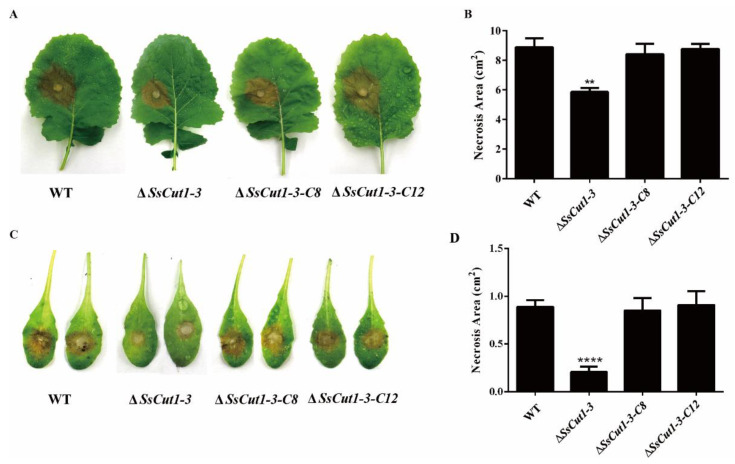
The plant cuticle is one of the protective layers of the external surface of plant tissues. Plants use the cuticle layer to reduce water loss and resist pathogen infection. Fungi release cell wall-degrading enzymes to destroy the epidermis of plants to achieve the purpose of infection. secretes a large amount of cutinase to disrupt the cuticle layer of plants during the infection process. In order to further understand the role of cutinase in the pathogenic process of , the cutinsae 1 () gene was cloned and analyzed. The protein SsCut1 contains the conserved cutinase domain and a fungal cellulose-binding domain. RT-qPCR results showed that the expression of SsCut1 was significantly upregulated during infection. Split-Marker recombination was utilized for the deletion of the gene, Δ mutants showed reduced cutinase activity and virulence, but the deletion of the gene had no effect on the growth rate, colony morphology, oxalic acid production, infection cushion formation and sclerotial development. Complementation with the wild-type allele restored the cutinase activity and virulence to the wild-type level. Interestingly, expression of in plants can trigger defense responses, but it also enhanced plant susceptibility to gene knock-out mutants. Taken together, our finding demonstrated that the gene promotes the virulence of by enhancing its cutinase activity.
植物角质层是植物组织外表面的保护层之一。植物利用角质层来减少水分流失并抵抗病原体感染。真菌释放细胞壁降解酶来破坏植物表皮以达到感染目的。在感染过程中分泌大量角质酶来破坏植物的角质层。为了进一步了解角质酶在致病过程中的作用,克隆并分析了角质酶1()基因。蛋白质SsCut1包含保守的角质酶结构域和真菌纤维素结合结构域。RT-qPCR结果表明,SsCut1的表达在感染期间显著上调。利用分裂标记重组技术缺失该基因,Δ突变体的角质酶活性和毒力降低,但缺失该基因对生长速率、菌落形态、草酸产生、侵染垫形成和菌核发育没有影响。用野生型等位基因互补可将角质酶活性和毒力恢复到野生型水平。有趣的是,在植物中的表达可以触发防御反应,但它也增强了植物对基因敲除突变体的易感性。综上所述,我们的研究结果表明该基因通过增强其角质酶活性来促进的毒力。