Tsai Meng-Ko, Hung Kuang-Chen, Liao Chun-Cheng, Pan Lung-Fa, Hung Chia-Lien, Yang Deng-Ho
Department of Internal Medicine, Taichung Armed Forces General Hospital, Taichung 41152, Taiwan.
Division of Rheumatology/Immunology/Allergy, Department of Internal Medicine, Tri-Service General Hospital, National Defense Medical Center, Taipei 11490, Taiwan.
J Clin Med. 2022 May 12;11(10):2743. doi: 10.3390/jcm11102743.
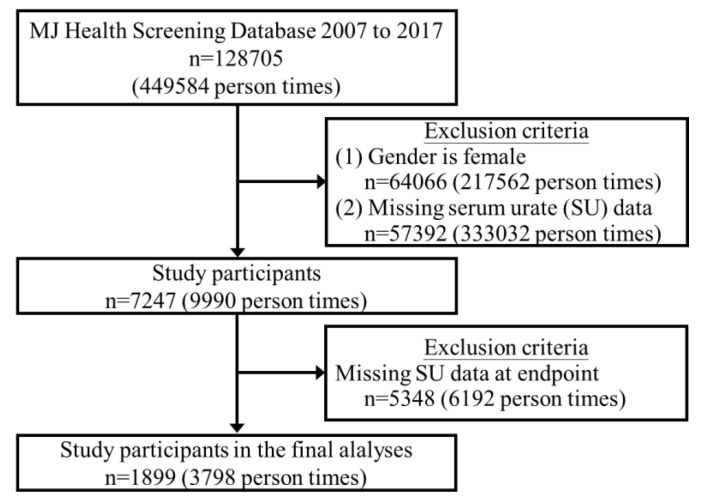
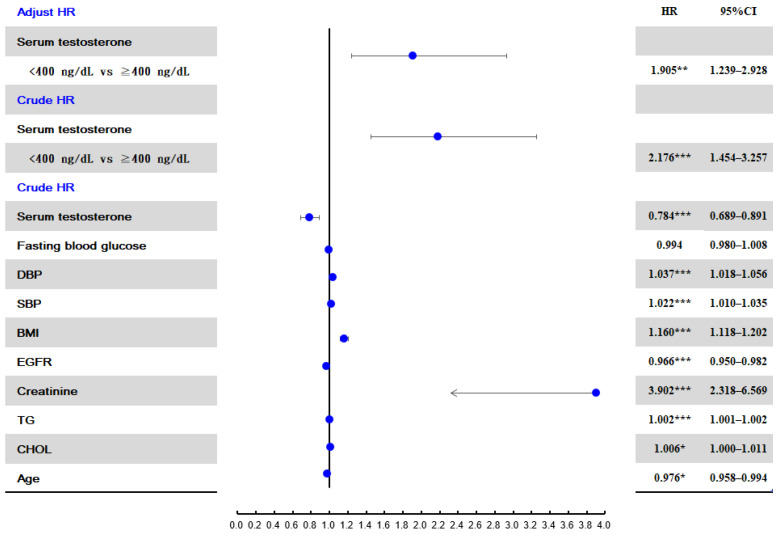
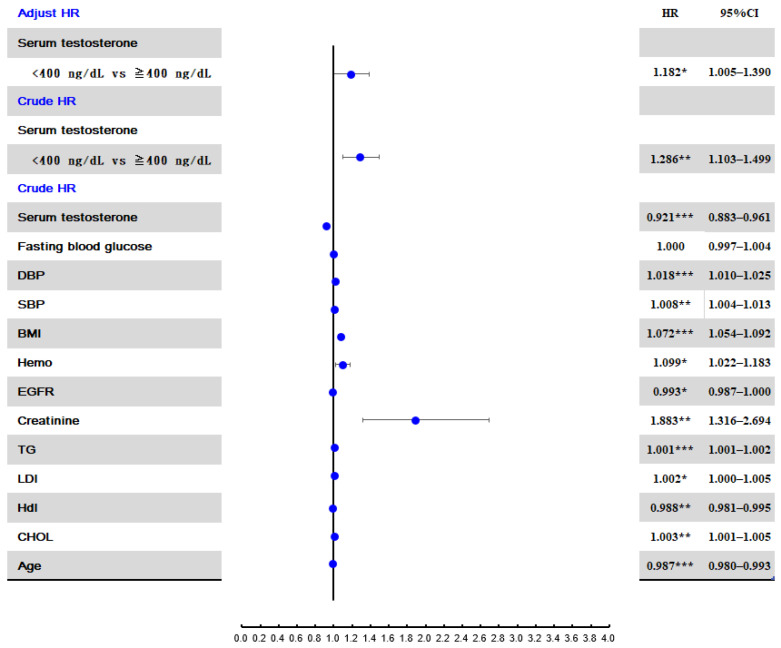
Gout is a common systemic inflammatory disease with a male predominance. This study aimed to determine the relationship between serum total testosterone level and hyperuricemia. Data on 1899 men, collected from 2007 to 2017, were included in the analysis. Serum testosterone and urate (SU) were measured on enrolment. The primary endpoints were SU levels ≥ 7 mg/dL and ≥9 mg/dL. On enrolment, participants had a mean age of 45.6 years and mean total testosterone and SU levels of 510 ng/dL and 6.6 mg/dL, respectively. The mean total testosterone levels were 533 and 470 ng/dL in patients with SU levels < 7 mg/dL and ≥7 mg/dL, respectively (p < 0.001); and 515 and 425 ng/dL in patients with SU levels < 9 mg/dL and ≥9 mg/dL, respectively (p < 0.001). After adjusting for age, body mass index, creatinine, serum lipid, fasting blood glucose, systolic blood pressure, and diastolic blood pressure, low testosterone level (<400 ng/dL) was significantly associated with an SU level ≥ 7 mg/dL (hazard ratio: 1.182, 95% confidence interval: 1.005−1.39) and ≥9 mg/dL (hazard ratio: 1.905, 95% confidence interval: 1.239−2.928). In men, a low testosterone level may be associated with an increased risk of hyperuricemia.
痛风是一种常见的以男性为主的全身性炎症性疾病。本研究旨在确定血清总睾酮水平与高尿酸血症之间的关系。分析纳入了2007年至2017年收集的1899名男性的数据。入组时测量血清睾酮和尿酸盐(SU)。主要终点是SU水平≥7mg/dL和≥9mg/dL。入组时,参与者的平均年龄为45.6岁,平均总睾酮和SU水平分别为510ng/dL和6.6mg/dL。SU水平<7mg/dL和≥7mg/dL的患者平均总睾酮水平分别为533和470ng/dL(p<0.001);SU水平<9mg/dL和≥9mg/dL的患者分别为515和425ng/dL(p<0.001)。在调整年龄、体重指数、肌酐、血脂、空腹血糖、收缩压和舒张压后,低睾酮水平(<400ng/dL)与SU水平≥7mg/dL(风险比:1.182,95%置信区间:1.005−1.39)和≥9mg/dL(风险比:1.905,95%置信区间:1.239−2.928)显著相关。在男性中,低睾酮水平可能与高尿酸血症风险增加有关。