Bernal-Jiménez María Ángeles, Calle-Pérez Germán, Gutiérrez-Barrios Alejandro, Gheorghe Livia, Solano-Mulero Ana María, Trujillo-Garrido Nuria, Rodríguez-Martín Amelia, Tur Josep A, Vázquez-García Rafael, Santi-Cano María José
Faculty of Nursing and Physiotherapy, University of Cádiz, 11003 Cádiz, Spain.
Institute of Biomedical Research and Innovation of Cádiz (INiBICA), 11009 Cádiz, Spain.
J Clin Med. 2022 May 14;11(10):2773. doi: 10.3390/jcm11102773.
It is important for health professionals to have tools available to assess patients' knowledge of lifestyle and cardiovascular risk factors after they have suffered a coronary event and determine whether educational interventions are effective. This study aims to design and validate a scale to evaluate this knowledge.
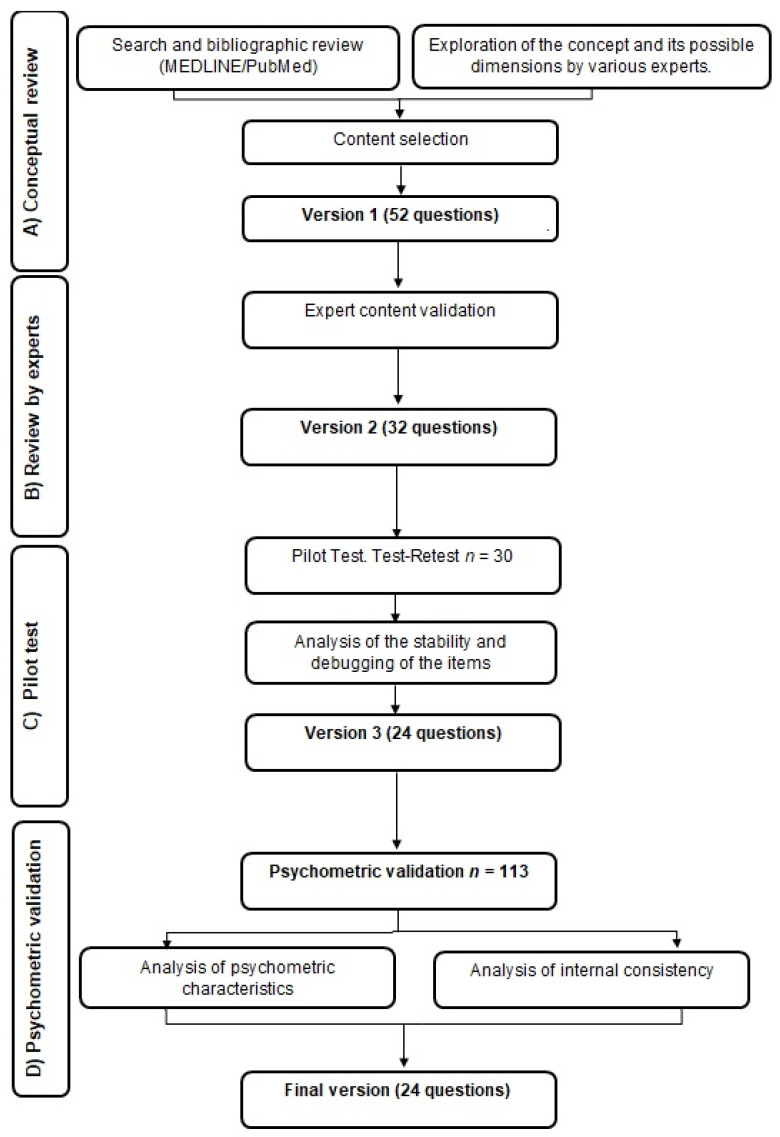
Four-phase instrument design: (A) Conceptual review. (B) Review by experts. (C) Pilot test-retest. (D) Psychometric validation of the final version of the questionnaire with 24 items. A panel of experts performed the content validity. The reliability of the scale was measured using Cronbach's alpha score and criterion validity was evaluated by comparing the total scores for knowledge obtained by the participants among the three education level groups. The construct and dimensional structure validity were assessed using exploratory factor analysis.
A total of 143 people participated, 30 in the pilot study and 113 (68% male, 60.2 ± 9 years) in the psychometric validation of version 3 of the scale. A Cronbach's alpha score of 0.887 was reached for this version. The factor analysis showed that the items were distributed into five factors that explained 57% of the variance. Significant differences were observed in the level of knowledge among the patients of the three levels of education (low, moderate and high) (99.20 ± 11.93, 105.92 ± 7.85, 109.78 ± 8.76 points, = 0.003), as there was a negative correlation between age and knowledge level (r = -0.213, = 0.024).
The scale presents psychometric properties that are evidence of its reliability and validity. The relationship demonstrated between the level of knowledge and age, sex and level of education shows the importance of emphasizing educational interventions for elderly people and those with a lower level of education.
对于医疗保健专业人员而言,在患者发生冠状动脉事件后,拥有评估其生活方式和心血管危险因素知识的工具,并确定教育干预措施是否有效,这很重要。本研究旨在设计并验证一个用于评估此类知识的量表。
四阶段工具设计:(A)概念性审查。(B)专家评审。(C)预试验-重测。(D)对包含24个条目的问卷最终版本进行心理测量学验证。一个专家小组进行了内容效度评估。使用克朗巴赫α系数来衡量量表的信度,并通过比较参与者在三个教育水平组中获得的知识总分来评估效标效度。使用探索性因素分析评估结构效度和维度结构效度。
共有143人参与,其中30人参与预试验,113人(68%为男性,年龄60.2±9岁)参与量表第3版的心理测量学验证。该版本的克朗巴赫α系数达到0.887。因素分析表明,这些条目被分为五个因素,解释了57%的方差。在三个教育水平(低、中、高)的患者中观察到知识水平存在显著差异(99.20±11.93、105.92±7.85、109.78±8.76分,P = 0.003),因为年龄与知识水平之间存在负相关(r = -0.213,P = 0.024)。
该量表呈现出心理测量学特性,证明了其信度和效度。知识水平与年龄、性别和教育水平之间的关系表明,强调针对老年人和教育水平较低者的教育干预措施很重要。