Łanocha Aleksandra, Łanocha-Arendarczyk Natalia, Wilczyńska Dominika, Zdziarska Barbara, Kosik-Bogacka Danuta
Department of Hematology with Bone Marrow Transplantation Unit, Pomeranian Medical University in Szczecin, 71-242 Szczecin, Poland.
Department of Biology and Medical Parasitology, Pomeranian Medical University in Szczecin, 70-111 Szczecin, Poland.
J Clin Med. 2022 May 18;11(10):2847. doi: 10.3390/jcm11102847.
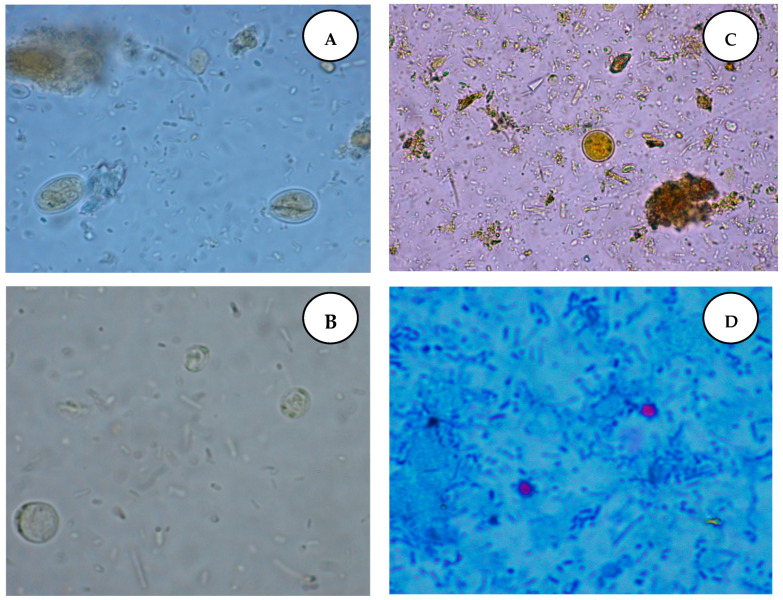
The aim of this study was to evaluate the frequency of gastrointestinal protozoan infection in patients with hematological malignancies (HMs) undergoing intensive hemato-oncological treatment and to determine the influence of certain biological factors on the incidence of intestinal parasite infection. Stool samples were collected from hematological malignancy patients ( = 50) hospitalized at the Department of Hematology and Transplantology of the Pomeranian Medical University in Szczecin. The control group consisted of 50 healthy participants. We used a direct smear examination and a commercial immunoenzymatic test. Intestinal protozoans were detected in 16% of patients with hematological malignancies and in 6% of individuals in the control group. In stool samples from patients with HM, cysts of (2%), oocysts of spp. (10%), vacuolar forms of potentially pathogenic spp. (2%), and cysts of nonpathogenic (2%) were found. spp. and coproantigens were detected in 5 (10%) and 1 (2%) patients with HM, respectively. In three participants from the control group, vacuolar forms of spp. were found. In the patients with HM, a significantly higher prevalence of intestinal parasite infection was found in individuals working in the garden without protective gloves and those in contact with animals. In patients with hematological malignancies, intestinal parasites should be excluded, even during intensive chemotherapy treatment.
本研究的目的是评估接受强化血液肿瘤治疗的血液系统恶性肿瘤(HM)患者胃肠道原生动物感染的频率,并确定某些生物学因素对肠道寄生虫感染发生率的影响。从什切青波美拉尼亚医科大学血液学与移植学系住院的血液系统恶性肿瘤患者(n = 50)中采集粪便样本。对照组由50名健康参与者组成。我们采用了直接涂片检查和商业免疫酶试验。在16%的血液系统恶性肿瘤患者和6%的对照组个体中检测到肠道原生动物。在HM患者的粪便样本中,发现了蓝氏贾第鞭毛虫囊肿(2%)、等孢球虫属卵囊(10%)、潜在致病性芽囊原虫属的液泡型(2%)和非致病性微小内蜒阿米巴囊肿(2%)。分别在5名(10%)和1名(2%)HM患者中检测到芽囊原虫属和隐孢子虫属粪便抗原。在对照组的三名参与者中发现了芽囊原虫属的液泡型。在HM患者中,未戴防护手套从事园艺工作的个体和接触动物的个体肠道寄生虫感染患病率显著更高。在血液系统恶性肿瘤患者中,即使在强化化疗期间也应排除肠道寄生虫感染。