Department of Histology and Embryology, Poznan University of Medical Sciences, 60-701 Poznan, Poland.
Doctoral School, Poznan University of Medical Sciences, 60-701 Poznan, Poland.
Nutrients. 2022 May 12;14(10):2025. doi: 10.3390/nu14102025.
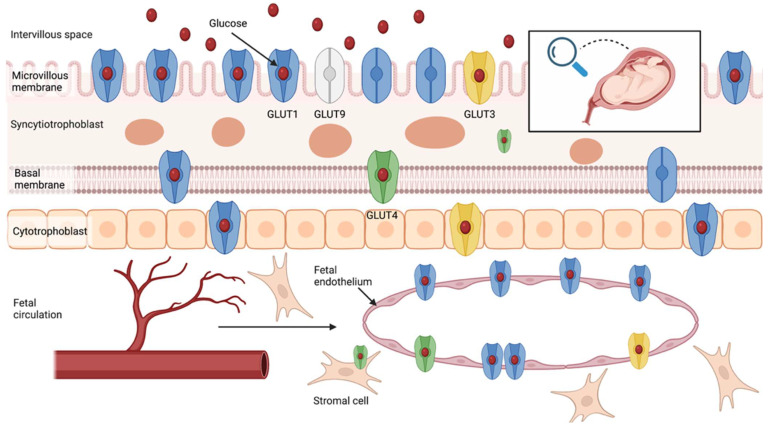
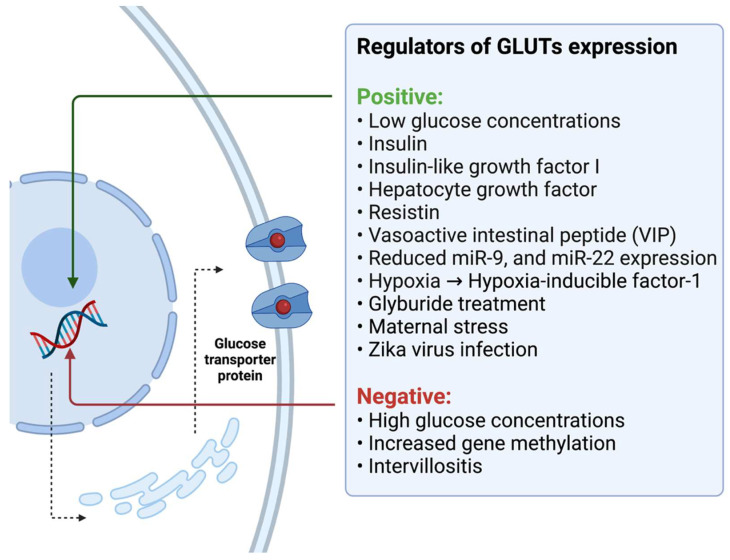
Several types of specialized glucose transporters (GLUTs) provide constant glucose transport from the maternal circulation to the developing fetus through the placental barrier from the early stages of pregnancy. GLUT1 is a prominent protein isoform that regulates placental glucose transfer via glucose-facilitated diffusion. The GLUT1 membrane protein density and permeability of the syncytial basal membrane (BM) are the main factors limiting the rate of glucose diffusion in the fetomaternal compartment in physiological conditions. Besides GLUT1, the GLUT3 and GLUT4 isoforms are widely expressed across the human placenta. Numerous medical conditions and molecules, such as hormones, adipokines, and xenobiotics, alter the GLUT's mRNA and protein expression. Diabetes upregulates the BM GLUT's density and promotes fetomaternal glucose transport, leading to excessive fetal growth. However, most studies have found no between-group differences in GLUTs' placental expression in macrosomic and normal control pregnancies. The fetomaternal GLUTs expression may also be influenced by several other conditions, such as chronic hypoxia, preeclampsia, and intrahepatic cholestasis of pregnancy.
几种类型的葡萄糖转运蛋白(GLUTs)通过胎盘屏障从妊娠早期开始为胎儿提供从母体循环到发育中胎儿的持续葡萄糖转运。GLUT1 是一种重要的蛋白同工型,通过葡萄糖促进扩散调节胎盘葡萄糖转运。GLUT1 膜蛋白密度和合体滋养层基底膜(BM)的通透性是生理条件下限制胎母腔葡萄糖扩散速率的主要因素。除 GLUT1 外,GLUT3 和 GLUT4 同工型在人胎盘内广泛表达。许多医学条件和分子,如激素、脂肪因子和外源性化学物质,改变 GLUT 的 mRNA 和蛋白表达。糖尿病会增加 BM GLUT 的密度并促进胎母葡萄糖转运,导致胎儿过度生长。然而,大多数研究并未发现巨大儿和正常对照组妊娠中 GLUTs 在胎盘表达上的组间差异。胎母 GLUTs 的表达也可能受到其他几种情况的影响,如慢性缺氧、子痫前期和妊娠肝内胆汁淤积症。