Amin Muhammad Nasir, Iqbal Mudassir, Jamal Arshad, Ullah Shahid, Khan Kaffayatullah, Abu-Arab Abdullah M, Al-Ahmad Qasem M S, Khan Sikandar
Department of Civil and Environmental Engineering, College of Engineering, King Faisal University, Al-Hofuf 31982, Saudi Arabia.
Shanghai Key Laboratory for Digital Maintenance of Buildings and Infrastructure, State Key Laboratory of Ocean Engineering, School of Naval Architecture, Ocean & Civil Engineering, Shanghai Jiao Tong University, Shanghai 200240, China.
Polymers (Basel). 2022 May 16;14(10):2016. doi: 10.3390/polym14102016.
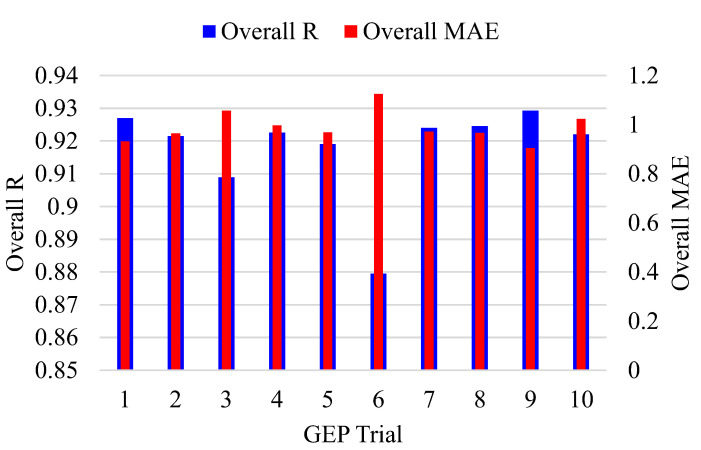
Reinforced concrete structures are subjected to frequent maintenance and repairs due to steel reinforcement corrosion. Fiber-reinforced polymer (FRP) laminates are widely used for retrofitting beams, columns, joints, and slabs. This study investigated the non-linear capability of artificial intelligence (AI)-based gene expression programming (GEP) modelling to develop a mathematical relationship for estimating the interfacial bond strength (IBS) of FRP laminates on a concrete prism with grooves. The model was based on five input parameters, namely axial stiffness (), width of FRP plate (), concrete compressive strength ('), width of groove (), and depth of the groove (), and IBS was considered the target variable. Ten trials were conducted based on varying genetic parameters, namely the number of chromosomes, head size, and number of genes. The performance of the models was evaluated using the correlation coefficient (R), mean absolute error (MAE), and root mean square error (RMSE). The genetic variation revealed that optimum performance was obtained for 30 chromosomes, 11 head sizes, and 4 genes. The values of R, MAE, and RMSE were observed as 0.967, 0.782 kN, and 1.049 kN for training and 0.961, 1.027 kN, and 1.354 kN. The developed model reflected close agreement between experimental and predicted results. This implies that the developed mathematical equation was reliable in estimating IBS based on the available properties of FRPs. The sensitivity and parametric analysis showed that the axial stiffness and width of FRP are the most influential parameters in contributing to IBS.
由于钢筋腐蚀,钢筋混凝土结构需要频繁维护和修复。纤维增强聚合物(FRP)层压板被广泛用于梁、柱、节点和楼板的加固。本研究调查了基于人工智能(AI)的基因表达编程(GEP)建模的非线性能力,以建立一种数学关系,用于估计带有凹槽的混凝土棱柱体上FRP层压板的界面粘结强度(IBS)。该模型基于五个输入参数,即轴向刚度()、FRP板宽度()、混凝土抗压强度(')、凹槽宽度()和凹槽深度(),并将IBS视为目标变量。基于不同的遗传参数,即染色体数量、头部大小和基因数量,进行了十次试验。使用相关系数(R)、平均绝对误差(MAE)和均方根误差(RMSE)对模型的性能进行评估。遗传变异表明,当染色体数量为30、头部大小为11、基因数量为4时,可获得最佳性能。训练时观察到的R、MAE和RMSE值分别为0.967、0.782 kN和1.049 kN,测试时分别为0.961、1.027 kN和1.354 kN。所开发的模型反映了实验结果与预测结果之间的密切一致性。这意味着所开发的数学方程在基于FRP的可用特性估计IBS方面是可靠的。敏感性和参数分析表明,轴向刚度和FRP宽度是影响IBS的最主要参数。