Markewitz Robert Daniel Heinrich, Juhl David, Pauli Daniela, Görg Siegfried, Junker Ralf, Rupp Jan, Engel Sarah, Steinhagen Katja, Herbst Victor, Zapf Dorinja, Krüger Christina, Brockmann Christian, Leypoldt Frank, Dargvainiene Justina, Schomburg Benjamin, Sharifzadeh Shahpour Reza, Salek Nejad Lukas, Wandinger Klaus-Peter, Ziemann Malte
Institute of Clinical Chemistry, University Hospital of Schleswig-Holstein, Arnold-Heller-Straße 3, 24105 Kiel, Germany.
Institute for Transfusion Medicine, University Hospital of Schleswig-Holstein, 23538 Lübeck, Germany.
Vaccines (Basel). 2022 Apr 20;10(5):649. doi: 10.3390/vaccines10050649.
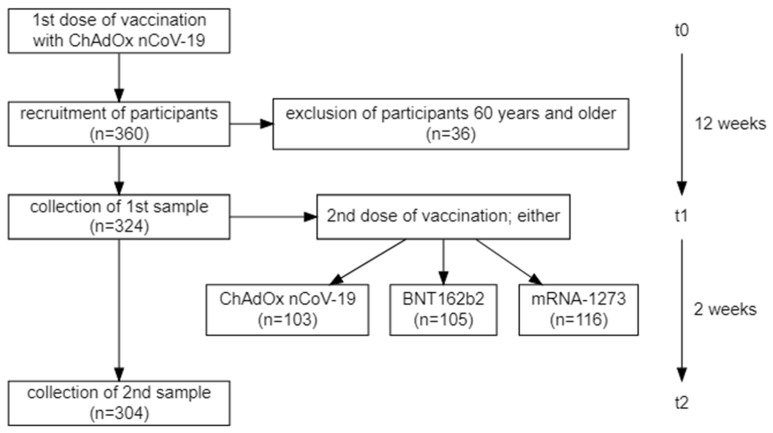
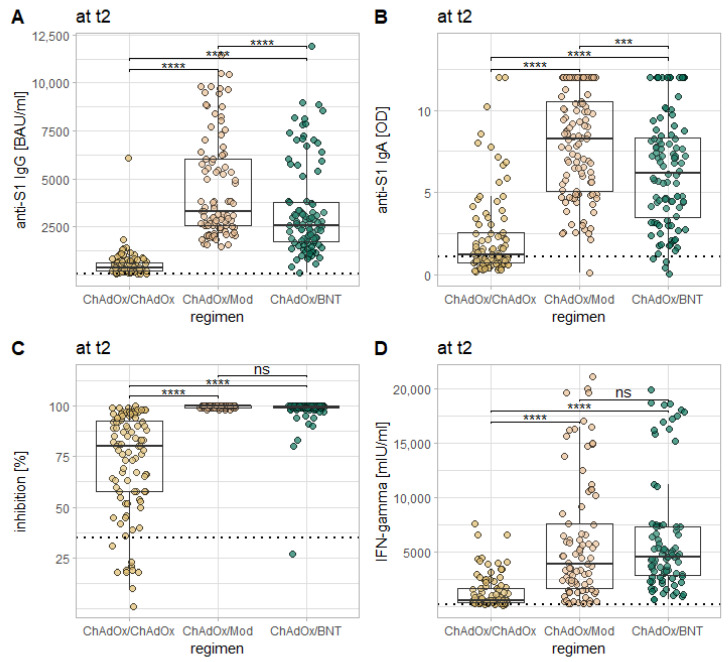
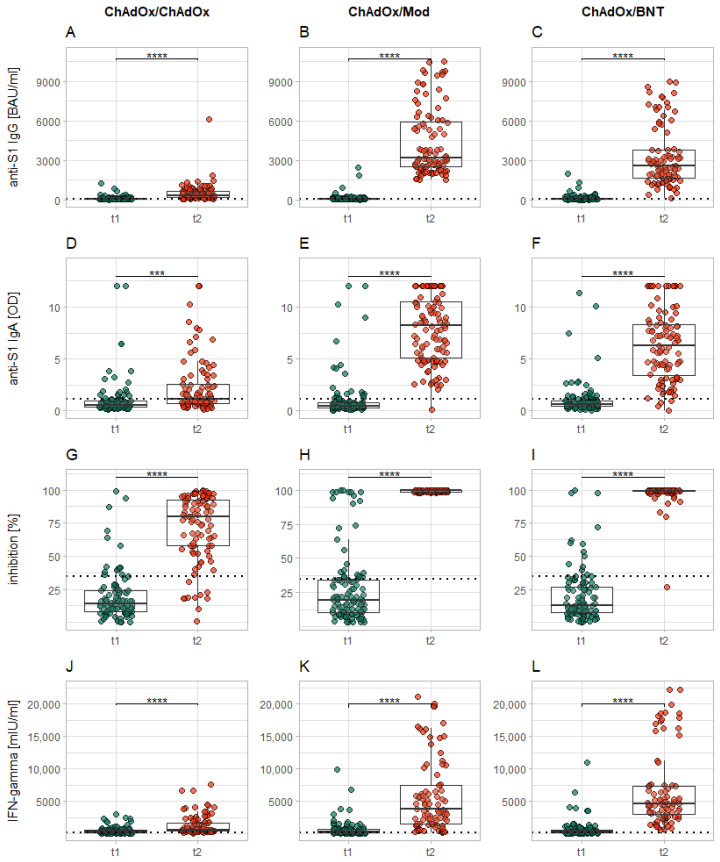
: Due to findings on adverse reactions and clinical efficacy of different vaccinations against SARS-CoV-2, the administration of vaccination regimens containing both adenoviral vector vaccines and mRNA-based vaccines has become common. Data are still needed on the direct comparison of immunogenicity for these different regimens. : We compared markers for immunogenicity (anti-S1 IgG/IgA, neutralizing antibodies, and T-cell response) with three different vaccination regimens (homologous ChAdOx1 nCoV-19 (n = 103), or mixture of ChAdOx1 nCoV-19 with mRNA-1273 (n = 116) or BNT162b2 (n = 105)) at two time points: the day of the second vaccination as a baseline and 14 days later. : All examined vaccination regimens elicited measurable immune responses that were significantly enhanced after the second dose. Homologous ChAdOx1 nCoV-19 was markedly inferior in immunogenicity to all other examined regimens after administration of the second dose. Between the heterologous regimens, mRNA-1273 as second dose induced greater antibody responses than BNT162b2, with no difference found for neutralizing antibodies and T-cell response. : While these findings allow no prediction about clinical protection, from an immunological point of view, vaccination against SARS-CoV-2 with an mRNA-based vaccine at one or both time points appears preferable to homologous vaccination with ChAdOx1 nCoV-19. Whether or not the demonstrated differences between the heterologous regimens are of clinical significance will be subject to further research.
由于针对严重急性呼吸综合征冠状病毒2(SARS-CoV-2)的不同疫苗的不良反应和临床疗效的研究结果,同时包含腺病毒载体疫苗和基于信使核糖核酸(mRNA)的疫苗的接种方案已变得普遍。对于这些不同方案的免疫原性的直接比较仍需要数据。
我们在两个时间点比较了三种不同接种方案(同源的ChAdOx1 nCoV-19(n = 103),或ChAdOx1 nCoV-19与mRNA-1273的混合物(n = 116)或BNT162b2(n = 105))的免疫原性标志物(抗S1 IgG/IgA、中和抗体和T细胞反应):第二次接种当天作为基线,以及14天后。
所有检测的接种方案均引发了可测量的免疫反应,在第二剂后显著增强。同源的ChAdOx1 nCoV-19在接种第二剂后免疫原性明显低于所有其他检测方案。在异源方案之间,作为第二剂的mRNA-1273诱导的抗体反应比BNT162b2更强,中和抗体和T细胞反应未发现差异。
虽然这些发现无法预测临床保护情况,但从免疫学角度来看,在一个或两个时间点用基于mRNA的疫苗接种SARS-CoV-2似乎比用ChAdOx1 nCoV-19进行同源接种更可取。异源方案之间所显示的差异是否具有临床意义将有待进一步研究。