Jeon Byeonghwa, Saisom Tunchanok, Sasipreeyajan Jiroj, Luangtongkum Taradon
School of Public Health, University of Alberta, Edmonton, AB T6G 2R3, Canada.
Department of Veterinary Public Health, Faculty of Veterinary Science, Chulalongkorn University, Bangkok 10330, Thailand.
Vaccines (Basel). 2022 Apr 27;10(5):685. doi: 10.3390/vaccines10050685.
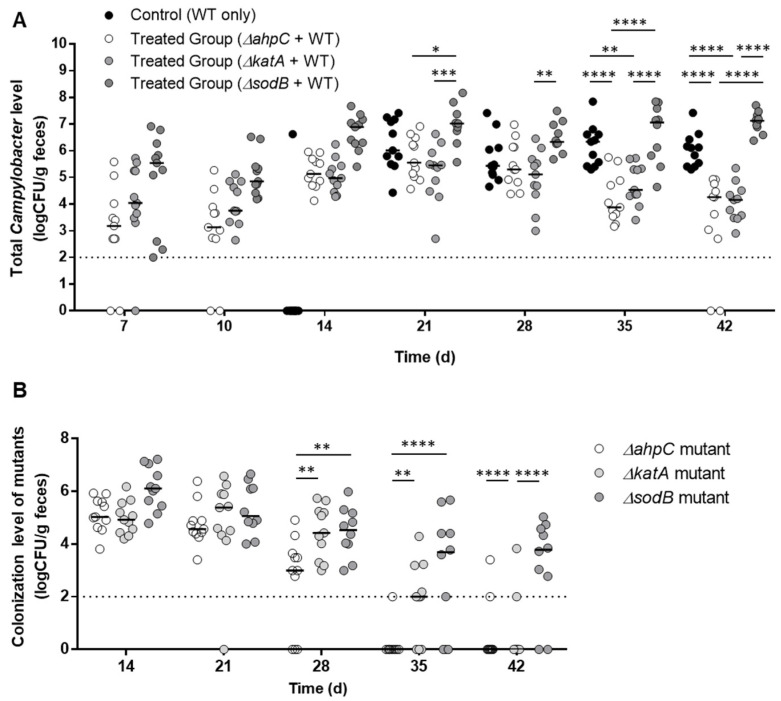
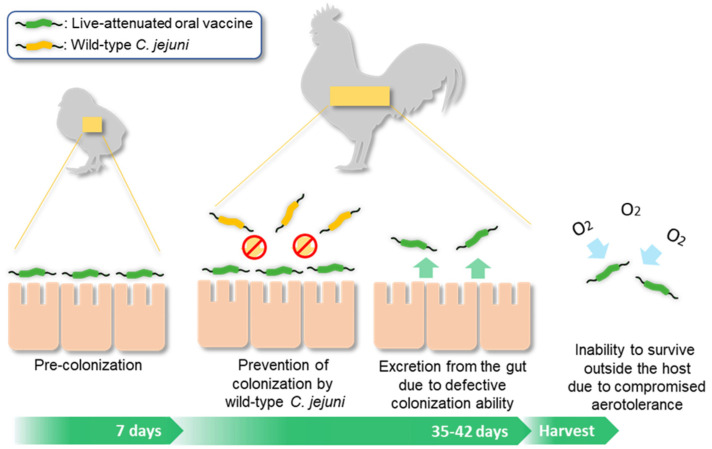
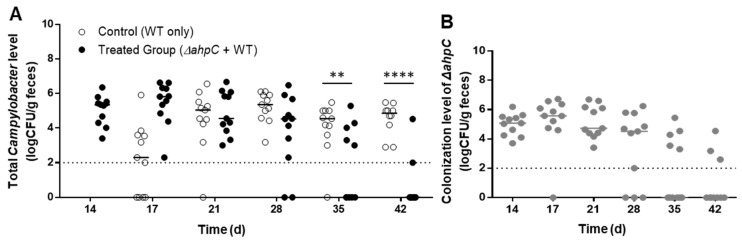
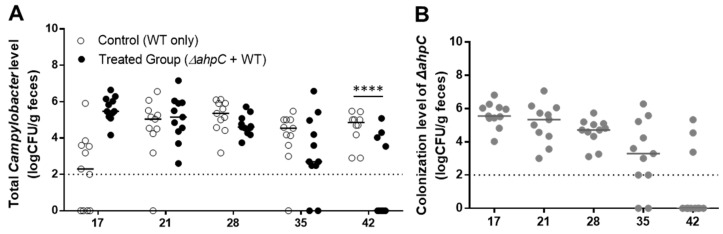
The control of in poultry at the pre-harvest level is critical to reducing foodborne infections with since the consumption of contaminated poultry is the most frequent cause of human campylobacteriosis. Although poultry vaccination is suggested as useful intervention measures, no vaccines are currently available. To develop live-attenuated oral vaccines, in this study, we evaluated the efficacy of pre-colonization by oxidative stress defense mutants, including knockout mutants of , , and , in preventing from colonizing poultry. Interestingly, when chickens were pre-colonized with and mutants, rather than the mutant, the level of colonization was significantly reduced within 35 days. Further studies demonstrated when chickens were pre-colonized with the mutant by oral challenge with a high dose (ca., 5 × 10 CFU/bird) and a low dose (ca., 5 × 10 CFU/bird), it twice reduced the level of by 3.9 logCFU/g feces and 3 logCFU/g feces after 42 days, respectively, compared to the untreated control. Due to a colonization defect, the mutant was removed from chickens within 42 days. After excretion from the host, moreover, the mutant cannot survive in aerobic environments because of compromised aerotolerance. Our findings suggest that the mutant has a great potential for on-farm application to control at the pre-harvest level.
在收获前阶段控制家禽体内的[病原体名称未明确]对于减少食源性感染至关重要,因为食用受污染的家禽是人类弯曲杆菌病最常见的病因。尽管家禽疫苗接种被认为是有用的干预措施,但目前尚无[病原体名称未明确]疫苗。为了开发减毒活口服[病原体名称未明确]疫苗,在本研究中,我们评估了氧化应激防御突变体(包括[基因名称未明确]、[基因名称未明确]和[基因名称未明确]的敲除突变体)预定植在预防[病原体名称未明确]定殖家禽方面的效果。有趣的是,当鸡用[基因名称未明确]和[基因名称未明确]突变体而非[基因名称未明确]突变体进行预定植时,在35天内[病原体名称未明确]的定殖水平显著降低。进一步的研究表明,当鸡通过口服高剂量(约5×10⁸CFU/只)和低剂量(约5×10⁴CFU/只)的[病原体名称未明确]对[基因名称未明确]突变体进行预定植时,与未处理的对照相比,42天后它分别使[病原体名称未明确]的水平降低了3.9 logCFU/g粪便和3 logCFU/g粪便。由于定殖缺陷,[基因名称未明确]突变体在42天内从鸡体内清除。此外,从宿主排出后,[基因名称未明确]突变体由于耐氧性受损而无法在有氧环境中存活。我们的研究结果表明,[基因名称未明确]突变体在农场应用以在收获前水平控制[病原体名称未明确]方面具有巨大潜力。