Meloni Dionigia, Franzoni Giulia, Oggiano Annalisa
Department of Animal Health, Istituto Zooprofilattico Sperimentale della Sardegna, 07100 Sassari, Italy.
Vaccines (Basel). 2022 Apr 29;10(5):707. doi: 10.3390/vaccines10050707.
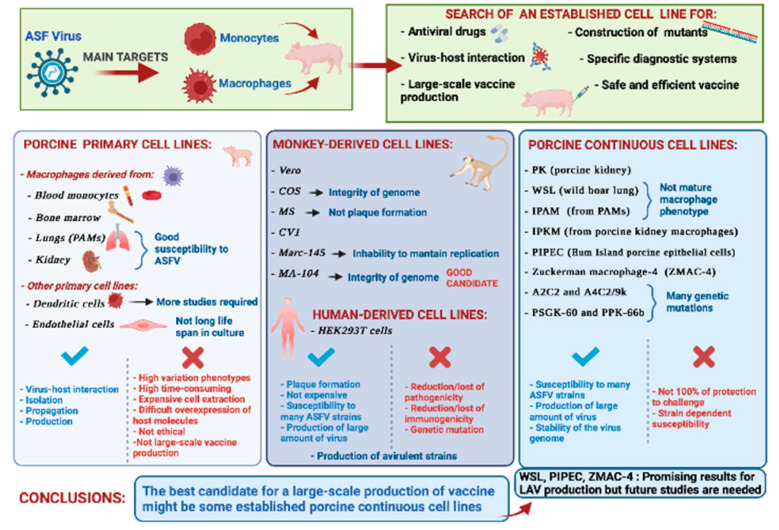
African swine fever virus (ASFV) is the etiological agent of a highly lethal disease in both domestic and wild pigs. The virus has rapidly spread worldwide and has no available licensed vaccine. An obstacle to the construction of a safe and efficient vaccine is the lack of a suitable cell line for ASFV isolation and propagation. Macrophages are the main targets for ASFV, and they have been widely used to study virus-host interactions; nevertheless, obtaining these cells is time-consuming and expensive, and they are not ethically suitable for the production of large-scale vaccines. To overcome these issues, different virulent field isolates have been adapted on monkey or human continuous cells lines; however, several culture passages often lead to significant genetic modifications and the loss of immunogenicity of the adapted strain. Thus, several groups have attempted to establish a porcine cell line able to sustain ASFV growth. Preliminary data suggested that some porcine continuous cell lines might be an alternative to primary macrophages for ASFV research and for large-scale vaccine production, although further studies are still needed. In this review, we summarize the research to investigate the most suitable cell line for ASFV isolation and propagation.
非洲猪瘟病毒(ASFV)是家猪和野猪中一种高致死性疾病的病原体。该病毒已在全球迅速传播,且尚无可用的许可疫苗。构建安全高效疫苗的一个障碍是缺乏适合ASFV分离和增殖的细胞系。巨噬细胞是ASFV的主要靶标,它们已被广泛用于研究病毒与宿主的相互作用;然而,获取这些细胞既耗时又昂贵,而且从伦理角度来看,它们不适合用于大规模疫苗生产。为克服这些问题,不同的强毒力野外分离株已在猴或人连续细胞系上进行适应性培养;然而,多次传代培养往往会导致显著的基因修饰以及适应性毒株免疫原性的丧失。因此,多个研究团队试图建立能够支持ASFV生长的猪细胞系。初步数据表明,一些猪连续细胞系可能是用于ASFV研究和大规模疫苗生产的原代巨噬细胞的替代选择,不过仍需要进一步研究。在本综述中,我们总结了为研究最适合ASFV分离和增殖的细胞系所开展的研究。