Lee Chae Won, Sa Soonok, Hong Myunghee, Kim Jihyun, Shim Sung Ryul, Han Hyun Wook
Department of Biomedical Informatics, CHA University School of Medicine, CHA University, Seongnam 13488, Korea.
Institute of Basic Medical Sciences, School of Medicine, CHA University, Seongnam 13488, Korea.
Vaccines (Basel). 2022 May 9;10(5):744. doi: 10.3390/vaccines10050744.
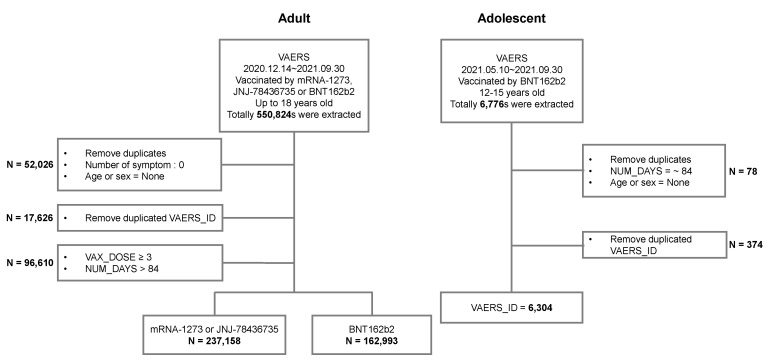
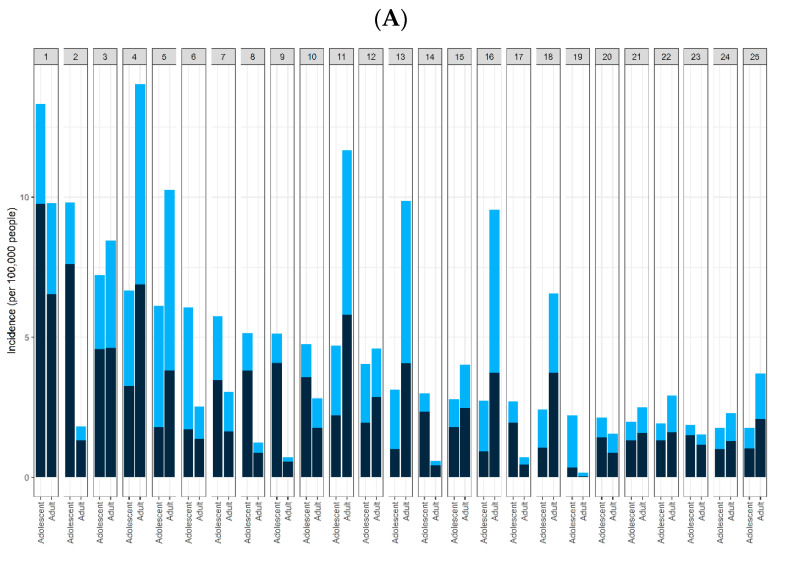
A COVID-19 vaccine BNT162b2 (Pfizer-BioNTech) has recently been authorized for adolescents in the US. However, the impact of adverse events on adolescents after vaccination has not been fully investigated. To assess the safety of the COVID-19 vaccine in adolescents, the incidence of adverse events (AEs) in adolescents and adults was compared after vaccination. We included 6304 adolescents (68.14 per 100,000 people) who reported adverse events using vaccine adverse event reporting system (VAERS) data from 10 May 2021 to 30 September 2021. The mean age was 13.6 ± 1.1 years and women (52.7%) outnumbered men. We analyzed severe and common adverse events in response to the COVID-19 vaccine among 6304 adolescents (68.14 per 100,000 people; 52% female; mean age, 13.6 ± 1.1 years). The risk of myocarditis or pericarditis among adolescents was significantly higher in men than in women (OR = 6.61, 95% CI = 4.43 to 9.88; p < 0.001), with a higher frequency after the second dose of the vaccine (OR = 8.52, 95% CI = 5.79 to 12.54; p < 0.001). In addition, severe adverse events such as multisystem inflammatory syndromes, where the incidence rate per 100,000 people was 0.11 (n = 10), and the relative risk was 244.3 (95% CI = 31.27 to 1908.38; p < 0.001), were significantly higher in adolescents than in adults. The risk of the inflammatory response to the COVID-19 vaccine, including myocarditis, pericarditis, or multisystem inflammatory syndromes, was significantly higher in men than in women, with a higher frequency in adolescents than in adults. The inflammation-related AEs may require close monitoring and management in adolescents.
一种新冠病毒疫苗BNT162b2(辉瑞-生物科技公司)最近在美国已被批准用于青少年。然而,疫苗接种后不良事件对青少年的影响尚未得到充分调查。为评估新冠病毒疫苗在青少年中的安全性,对青少年和成年人接种疫苗后的不良事件(AE)发生率进行了比较。我们纳入了6304名青少年(每10万人中有68.14人),他们使用2021年5月10日至2021年9月30日的疫苗不良事件报告系统(VAERS)数据报告了不良事件。平均年龄为13.6±1.1岁,女性(52.7%)人数多于男性。我们分析了6304名青少年(每10万人中有68.14人;52%为女性;平均年龄13.6±1.1岁)接种新冠病毒疫苗后的严重和常见不良事件。青少年中心肌炎或心包炎的风险在男性中显著高于女性(比值比=6.61,95%置信区间=4.43至9.88;p<0.001),在接种第二剂疫苗后频率更高(比值比=8.52,95%置信区间=5.79至12.54;p<0.001)。此外,多系统炎症综合征等严重不良事件,每10万人中的发生率为0.11(n=10),相对风险为244.3(95%置信区间=31.27至1908.38;p<0.001),在青少年中显著高于成年人。青少年对新冠病毒疫苗的炎症反应风险,包括心肌炎、心包炎或多系统炎症综合征,在男性中显著高于女性,在青少年中的频率高于成年人。与炎症相关的不良事件在青少年中可能需要密切监测和管理。