Lyu Tianying, Zhu Jinyong, Yang Xianming, Yang Wen, Zheng Zhongming
School of Marine Science, Ningbo University, Ningbo, China.
Front Microbiol. 2022 May 13;13:906278. doi: 10.3389/fmicb.2022.906278. eCollection 2022.
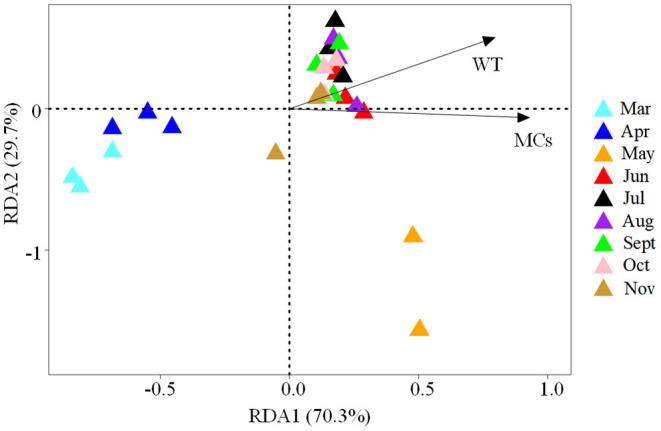
Freshwater gastropods are widely distributed and play an important role in aquatic ecosystems. Symbiotic microorganisms represented by gut microbes can affect the physiological and biochemical activities of their hosts. However, few studies have investigated the response of the gut microbial community of snails to environmental stress. In this study, the dynamics of the gut microbiota of the gastropod were tracked to explore their responses in terms of their composition and function to cyanobacterial bloom. Differences in gut microbial community structures during periods of non-cyanobacterial bloom and cyanobacterial bloom were determined. Results showed that the alpha diversity of the gut microbiota exposed to cyanobacterial bloom was lower than that of the gut microbiota exposed to non-cyanobacterial bloom. The main genera differentiating the two periods were , and . Microcystins (MCs) and water temperature (WT) were the primary factors influencing the gut microbial community of ; between them, the influence of MCs was greater than that of WT. Fourteen pathways (level 2) were notably different between the two periods. The pathways of carbohydrate metabolism, immune system, environmental adaptation, and xenobiotics biodegradation and metabolism in these differential pathways exhibited a strong linear regression relationship with MCs and WT. Changes in the functions of the gut microbiota may help meet its immunity and energy needs during cyanobacterial bloom stress. These results provide key information for understanding the response pattern of freshwater snail intestinal flora to cyanobacterial blooms and reveal the underlying environmental adaptation mechanism of gastropods from the perspective of intestinal flora.
淡水腹足类动物分布广泛,在水生生态系统中发挥着重要作用。以肠道微生物为代表的共生微生物会影响其宿主的生理和生化活动。然而,很少有研究调查蜗牛肠道微生物群落对环境压力的反应。在本研究中,追踪了腹足类动物肠道微生物群的动态变化,以探究它们在组成和功能方面对蓝藻水华的反应。确定了非蓝藻水华期和蓝藻水华期肠道微生物群落结构的差异。结果表明,暴露于蓝藻水华的肠道微生物群的α多样性低于暴露于非蓝藻水华的肠道微生物群。区分这两个时期的主要属为 、 和 。微囊藻毒素(MCs)和水温(WT)是影响 肠道微生物群落的主要因素;其中,MCs的影响大于WT。两个时期之间有14条途径(二级)存在显著差异。这些差异途径中的碳水化合物代谢、免疫系统、环境适应以及异生物质生物降解和代谢途径与MCs和WT呈现出很强的线性回归关系。肠道微生物群功能的变化可能有助于 在蓝藻水华胁迫期间满足其免疫和能量需求。这些结果为理解淡水蜗牛肠道菌群对蓝藻水华的反应模式提供了关键信息,并从肠道菌群的角度揭示了腹足类动物潜在的环境适应机制。