Kolen Martin, Ripepi Davide, Smith Wilson A, Burdyny Thomas, Mulder Fokko M
Materials for Energy Conversion and Storage (MECS), Department of Chemical Engineering, Faculty of Applied Sciences, Delft University of Technology, van der Maasweg 9, 2629 HZ Delft, The Netherlands.
ACS Catal. 2022 May 20;12(10):5726-5735. doi: 10.1021/acscatal.2c00888. Epub 2022 Apr 28.
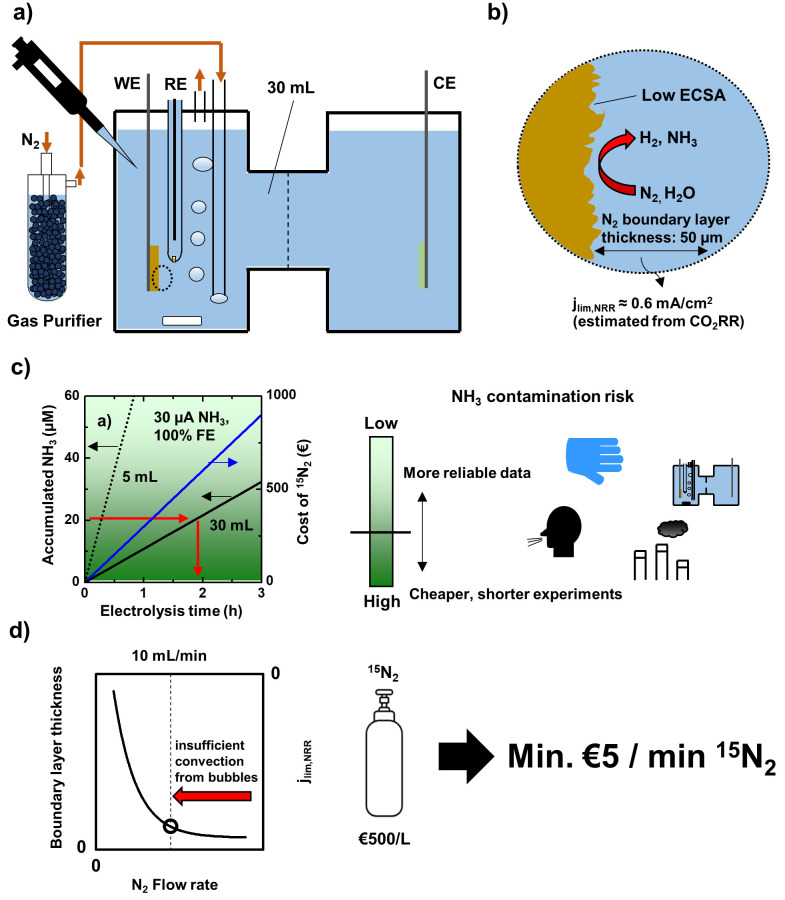
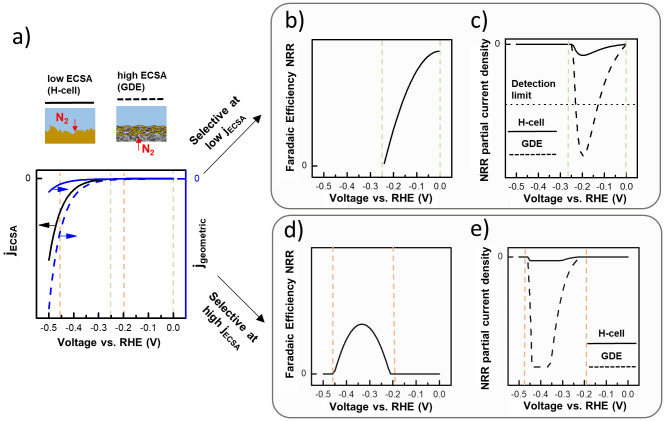
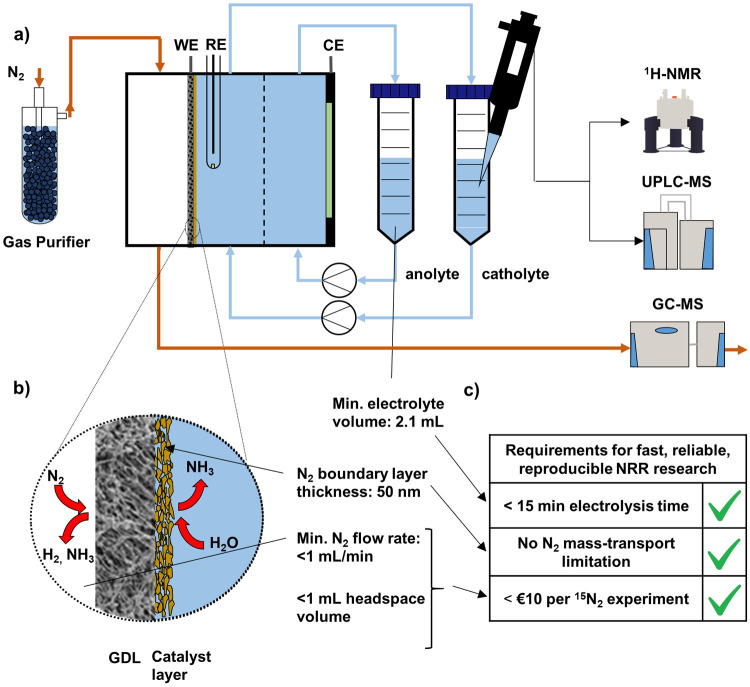
The nitrogen reduction reaction (NRR) is a promising pathway toward the decarbonization of ammonia (NH) production. However, unless practical challenges related to the detection of NH are removed, confidence in published data and experimental throughput will remain low for experiments in aqueous electrolyte. In this perspective, we analyze these challenges from a system and instrumentation perspective. Through our analysis we show that detection challenges can be strongly reduced by switching from an H-cell to a gas diffusion electrode (GDE) cell design as a catalyst testing platform. Specifically, a GDE cell design is anticipated to allow for a reduction in the cost of crucial N control experiments from €100-2000 to less than €10. A major driver is the possibility to reduce the N flow rate to less than 1 mL/min, which is prohibited by an inevitable drop in mass-transport at low flow rates in H-cells. Higher active surface areas and improved mass transport can further circumvent losses of NRR selectivity to competing reactions. Additionally, obstacles often encountered when trying to transfer activity and selectivity data recorded at low current density in H-cells to commercial device level can be avoided by testing catalysts under conditions close to those in commercial devices from the start.
氮还原反应(NRR)是实现氨(NH₃)生产脱碳的一条有前景的途径。然而,除非消除与NH₃检测相关的实际挑战,否则对于在水性电解质中的实验,已发表数据的可信度和实验通量仍将较低。从这个角度来看,我们从系统和仪器的角度分析了这些挑战。通过我们的分析表明,通过从H型电池切换到气体扩散电极(GDE)电池设计作为催化剂测试平台,可以大大降低检测挑战。具体而言,预计GDE电池设计可将关键的N₂控制实验成本从100 - 2000欧元降低到10欧元以下。一个主要驱动因素是将N₂流速降低到小于1 mL/min的可能性,这在H型电池中由于低流速下传质的不可避免下降而受到限制。更高的活性表面积和改善的传质可以进一步避免NRR选择性因竞争反应而损失。此外,通过从一开始就在接近商业设备的条件下测试催化剂,可以避免在尝试将H型电池中低电流密度下记录的活性和选择性数据转换到商业设备水平时经常遇到的障碍。