Department of Fundamental Neurosciences, University of Lausanne, Lausanne, Switzerland.
Department of Neuroscience, University of Torino, Torino, Italy.
Glia. 2022 Sep;70(9):1585-1604. doi: 10.1002/glia.24221. Epub 2022 May 30.
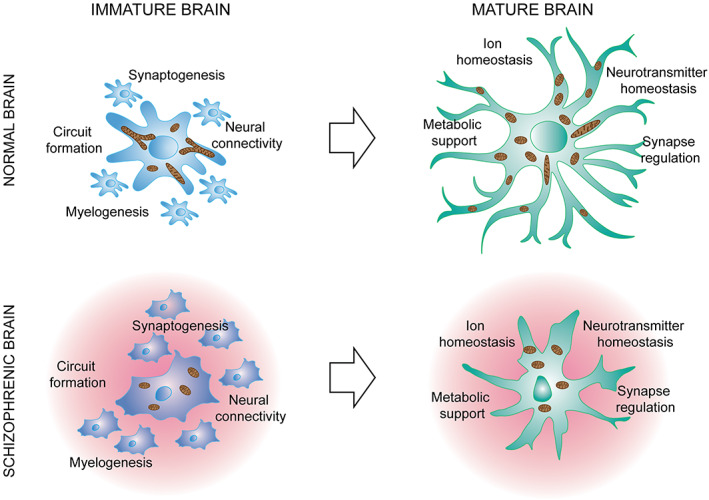
Schizophrenia is a complex, chronic mental health disorder whose heterogeneous genetic and neurobiological background influences early brain development, and whose precise etiology is still poorly understood. Schizophrenia is not characterized by gross brain pathology, but involves subtle pathological changes in neuronal populations and glial cells. Among the latter, astrocytes critically contribute to the regulation of early neurodevelopmental processes, and any dysfunctions in their morphological and functional maturation may lead to aberrant neurodevelopmental processes involved in the pathogenesis of schizophrenia, such as mitochondrial biogenesis, synaptogenesis, and glutamatergic and dopaminergic transmission. Studies of the mechanisms regulating astrocyte maturation may therefore improve our understanding of the cellular and molecular mechanisms underlying the pathogenesis of schizophrenia.
精神分裂症是一种复杂的、慢性的精神健康障碍,其异质的遗传和神经生物学背景影响早期大脑发育,其确切病因仍知之甚少。精神分裂症的特征不是大脑的大体病理学,而是涉及神经元群体和神经胶质细胞的微妙病理变化。在后者中,星形胶质细胞对早期神经发育过程的调节起着至关重要的作用,它们在形态和功能成熟方面的任何功能障碍都可能导致异常的神经发育过程,这些过程与精神分裂症的发病机制有关,如线粒体生物发生、突触发生以及谷氨酸能和多巴胺能传递。因此,研究调节星形胶质细胞成熟的机制可能有助于我们理解精神分裂症发病机制的细胞和分子机制。