Division of Neurology, Children's Hospital of Philadelphia, Philadelphia, PA, USA.
Department of Neurology, Perelman School of Medicine, 14640University of Pennsylvania, Philadelphia, PA, USA.
ASN Neuro. 2022 Jan-Dec;14:17590914221097510. doi: 10.1177/17590914221097510.
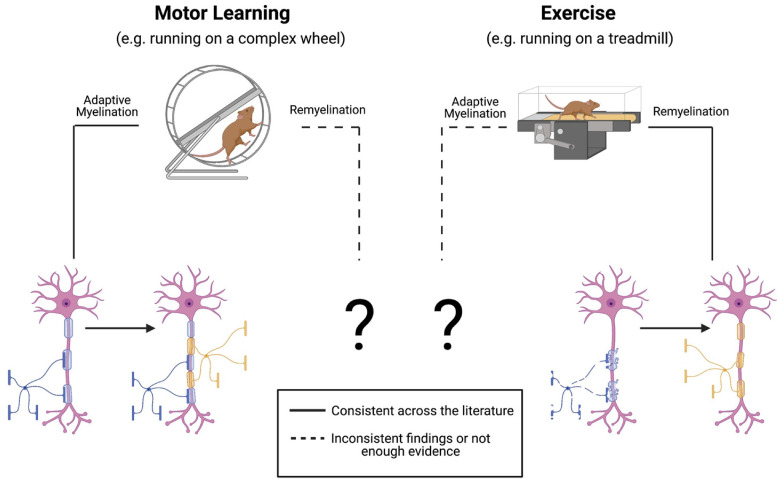
The idea that myelination is driven by both intrinsic and extrinsic cues has gained much traction in recent years. Studies have demonstrated that myelination occurs in an intrinsic manner during early development and continues through adulthood in an activity-dependent manner called adaptive myelination. Motor learning, the gradual acquisition of a specific novel motor skill, promotes adaptive myelination in both the healthy and demyelinated central nervous system (CNS). On the other hand, exercise, a physical activity that involves planned, structured and repetitive bodily movements that expend energy and benefits one's fitness, promotes remyelination in pathology, but it is less clear whether it promotes adaptive myelination in healthy subjects. Studies on these topics have also investigated whether the timing of motor learning or physical exercise is important for successful addition of myelin. Here we review our current understanding of the relationship of motor skill learning and physical exercise on myelination.
髓鞘形成既受内在因素又受外在因素驱动的观点近年来得到了广泛关注。研究表明,髓鞘形成在早期发育过程中以内在方式发生,并在成年期以活动依赖性方式(称为适应性髓鞘形成)继续进行。运动学习是指逐渐获得特定的新运动技能,它可以促进健康和脱髓鞘中枢神经系统(CNS)中的适应性髓鞘形成。另一方面,运动是一种涉及计划、结构和重复身体运动的体力活动,需要消耗能量并有益于身体健康,它可以促进病理学中的髓鞘再生,但在健康受试者中是否促进适应性髓鞘形成尚不清楚。关于这些主题的研究还探讨了运动学习或体育锻炼的时间是否对髓鞘成功添加重要。在这里,我们回顾了我们对运动技能学习和体育锻炼与髓鞘形成之间关系的理解。