Division of Rheumatology, Department of Medicine, Johns Hopkins University School of Medicine, Baltimore, MD, USA.
Division of Rheumatology, Inflammation, and Immunity, Brigham and Women's Hospital and Harvard Medical School, Boston, MA, USA.
Curr Opin Pharmacol. 2022 Aug;65:102243. doi: 10.1016/j.coph.2022.102243. Epub 2022 May 2.
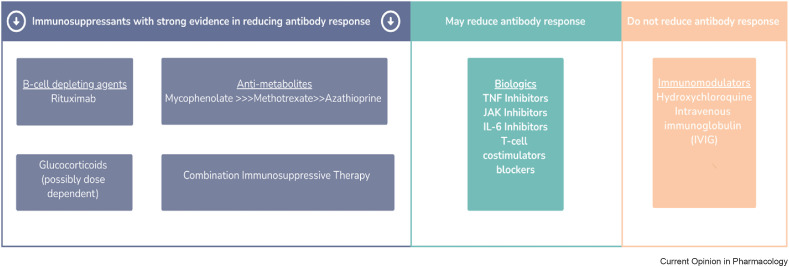
Many patients with systemic autoimmune rheumatic diseases (SARDs) require immunosuppression to reduce disease activity, but this also has important possible detrimental impacts on immune responses following vaccination. The phase III clinical trials for severe acute respiratory syndrome coronavirus 2 (SARS-CoV-2) vaccines did not include those who are immunosuppressed. Fortunately, we now have a clearer idea of how immune responses following SARS-CoV-2 vaccination has for the immunosuppressed, with much of the data being within a year of its introduction. Here, we summarize what is known in this rapidly evolving field about the impact immunosuppression has on humoral immunogenicity including waning immunity and additional doses, breakthrough infection rates and severity, disease flare rates, along with additional considerations and remaining unanswered questions.
许多患有系统性自身免疫性风湿病(SARDs)的患者需要免疫抑制来降低疾病活动度,但这也会对疫苗接种后的免疫反应产生重要的潜在不利影响。严重急性呼吸综合征冠状病毒 2(SARS-CoV-2)疫苗的 III 期临床试验并未包括免疫抑制者。幸运的是,我们现在对 SARS-CoV-2 疫苗接种后的免疫反应有了更清晰的认识,其中大部分数据是在其推出后的一年内获得的。在这里,我们总结了在这个快速发展的领域中,关于免疫抑制对体液免疫原性的影响,包括免疫衰减和追加剂量、突破性感染率和严重程度、疾病复发率,以及其他需要考虑的问题和尚未解决的问题。