Kawano Yumeko, Patel Naomi J, Wang Xiaosong, Cook Claire E, Vanni Kathleen M M, Kowalski Emily N, Banasiak Emily P, Qian Grace, DiIorio Michael, Hsu Tiffany Y T, Weinblatt Michael E, Todd Derrick J, Wallace Zachary S, Sparks Jeffrey A
Division of Rheumatology, Inflammation, and Immunity, Brigham and Women's Hospital, Boston, MA, USA.
Harvard Medical School, Boston, MA, USA.
medRxiv. 2022 Jun 20:2022.06.19.22276599. doi: 10.1101/2022.06.19.22276599.
To investigate temporal trends in incidence and severity of COVID-19 among patients with systemic autoimmune rheumatic diseases (SARDs) from the first wave through the Omicron wave.
We conducted a retrospective cohort study investigating COVID-19 outcomes among SARD patients systematically identified to have confirmed COVID-19 from March 1, 2020 to January 31, 2022 at a large healthcare system in Massachusetts. We tabulated COVID-19 counts of total and severe cases (hospitalizations or deaths) and compared the proportion with severe COVID-19 by calendar period and by vaccination status. We used logistic regression to estimate the ORs for severe COVID-19 for each period compared to the early COVID-19 period (reference group).
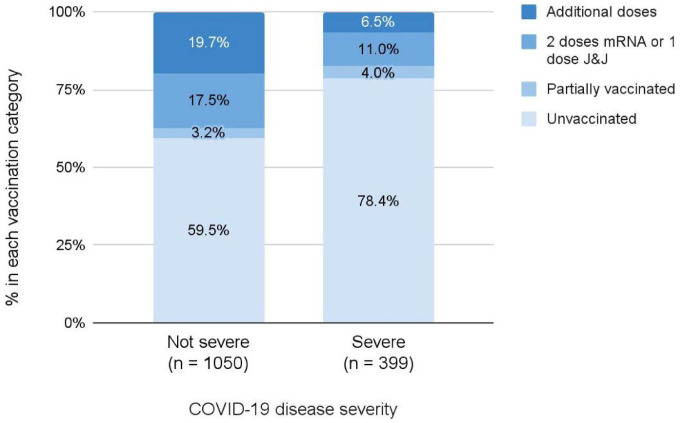
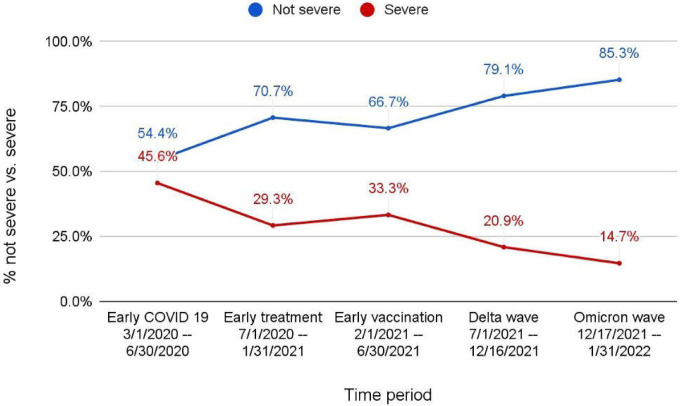
We identified 1449 SARD patients with COVID-19 (mean age 58.4 years, 75.2% female, 33.9% rheumatoid arthritis). There were 399 (27.5%) cases of severe COVID-19. The proportion of severe COVID-19 outcomes declined over calendar time (p for trend <0.001); 45.6% of cases were severe in the early COVID-19 period (March 1-June 30, 2020) vs. 14.7% in the Omicron wave (December 17, 2021-January 31, 2022; adjusted odds ratio 0.29, 95%CI 0.19-0.43). A higher proportion of those unvaccinated were severe compared to not severe cases (78.4% vs. 59.5%).
The proportion of SARD patients with severe COVID-19 has diminished since early in the pandemic, particularly during the most recent time periods, including the Omicron wave. Advances in prevention, diagnosis, and treatment of COVID-19 may have improved outcomes among SARD patients.
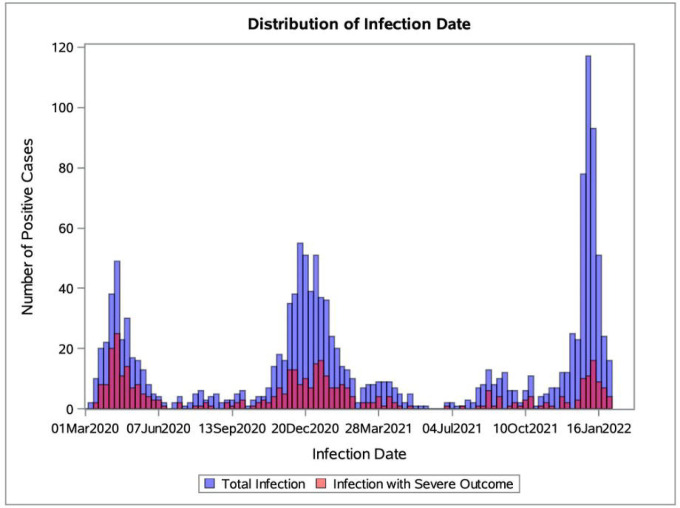
Patients with systemic autoimmune rheumatic diseases (SARDs) may be at increased risk for severe COVID-19, defined as hospitalization or death.Previous studies of SARD patients suggested improving COVID-19 outcomes over calendar time, but most were performed prior to the wide availability of COVID-19 vaccines or the Omicron wave that was characterized by high infectivity. The proportion of SARD patients with severe COVID-19 outcomes was lower over calendar timeThe adjusted odds ratio of severe COVID-19 in the Omicron wave was 0.29 (95%CI 0.19-0.43) compared to early COVID-19 period.The absolute number of severe COVID-19 cases during the peak of the Omicron variant wave was similar to the peaks of other waves.SARD patients with severe vs. not severe COVID-19 were more likely to be unvaccinated. These findings suggest that advances in COVID-19 prevention, diagnosis, and treatment have contributed to improved outcomes among SARD patients over calendar time.Future studies should extend findings into future viral variants and consider the roles of waning immunity after vaccination or natural infection among SARD patients who may still be vulnerable to severe COVID-19.
调查从新冠疫情第一波到奥密克戎波期间,系统性自身免疫性风湿病(SARDs)患者中新冠病毒病(COVID-19)的发病率和严重程度的时间趋势。
我们进行了一项回顾性队列研究,调查2020年3月1日至2022年1月31日期间,在马萨诸塞州一个大型医疗系统中,经系统识别确诊感染COVID-19的SARD患者的COVID-19结局。我们将COVID-19总病例数和重症病例数(住院或死亡)制成表格,并按日历时间段和疫苗接种状况比较重症COVID-19的比例。我们使用逻辑回归来估计与早期COVID-19时期(参照组)相比,每个时期重症COVID-19的比值比(OR)。
我们识别出1449例感染COVID-19的SARD患者(平均年龄58.4岁,75.2%为女性,33.9%为类风湿关节炎患者)。有399例(27.5%)为重症COVID-19。重症COVID-19结局的比例随时间推移而下降(趋势p<0.001);在早期COVID-19时期(2020年3月1日至6月30日),45.6%的病例为重症,而在奥密克戎波期间(2021年12月17日至2022年1月31日)这一比例为14.7%(调整后的比值比为0.29,95%置信区间为0.19 - 0.43)。与非重症病例相比,未接种疫苗者中重症的比例更高(78.4%对59.5%)。
自疫情早期以来,尤其是在包括奥密克戎波在内的最近时间段,SARD患者中重症COVID-19的比例有所下降。COVID-19预防、诊断和治疗方面的进展可能改善了SARD患者的结局。
系统性自身免疫性风湿病(SARDs)患者发生重症COVID-19(定义为住院或死亡)的风险可能增加。先前对SARD患者的研究表明,随着时间推移COVID-19结局有所改善,但大多数研究是在COVID-19疫苗广泛可用之前或在以高传染性为特征的奥密克戎波之前进行的。随着时间推移,SARD患者中重症COVID-19结局的比例较低。与早期COVID-19时期相比,奥密克戎波期间重症COVID-19的调整后比值比为0.29(95%置信区间为0.19 - 0.43)。奥密克戎变异株波高峰期的重症COVID-19病例绝对数与其他波的高峰期相似。重症与非重症COVID-19的SARD患者更有可能未接种疫苗。这些发现表明,COVID-19预防、诊断和治疗方面的进展促使SARD患者的结局随时间推移得到改善。未来的研究应将研究结果扩展到未来的病毒变异株,并考虑在可能仍易发生重症COVID-19的SARD患者中,疫苗接种或自然感染后免疫力下降的作用。