Institute for Cardiovascular Prevention (IPEK), Ludwig-Maximilians-University, Munich, Germany.
Institute of Medical Biochemistry and Molecular Biology, University Medicine Greifswald, Greifswald, Germany.
Mol Metab. 2022 Aug;62:101518. doi: 10.1016/j.molmet.2022.101518. Epub 2022 May 28.
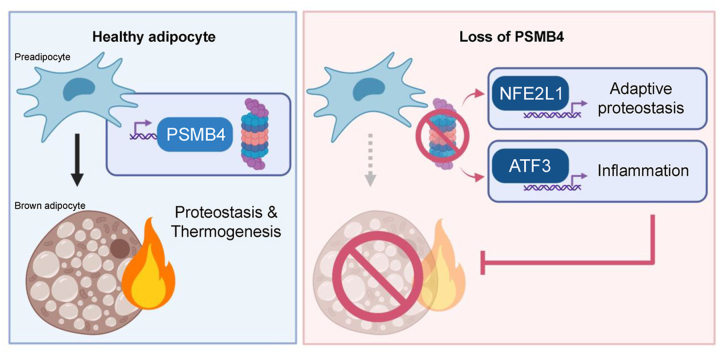
Regulation of proteasomal activity is an essential component of cellular proteostasis and function. This is evident in patients with mutations in proteasome subunits and associated regulators, who suffer from proteasome-associated autoinflammatory syndromes (PRAAS). These patients display lipodystrophy and fevers, which may be partly related to adipocyte malfunction and abnormal thermogenesis in adipose tissue. However, the cell-intrinsic pathways that could underlie these symptoms are unclear. Here, we investigate the impact of two proteasome subunits implicated in PRAAS, Psmb4 and Psmb8, on differentiation, function and proteostasis of brown adipocytes.
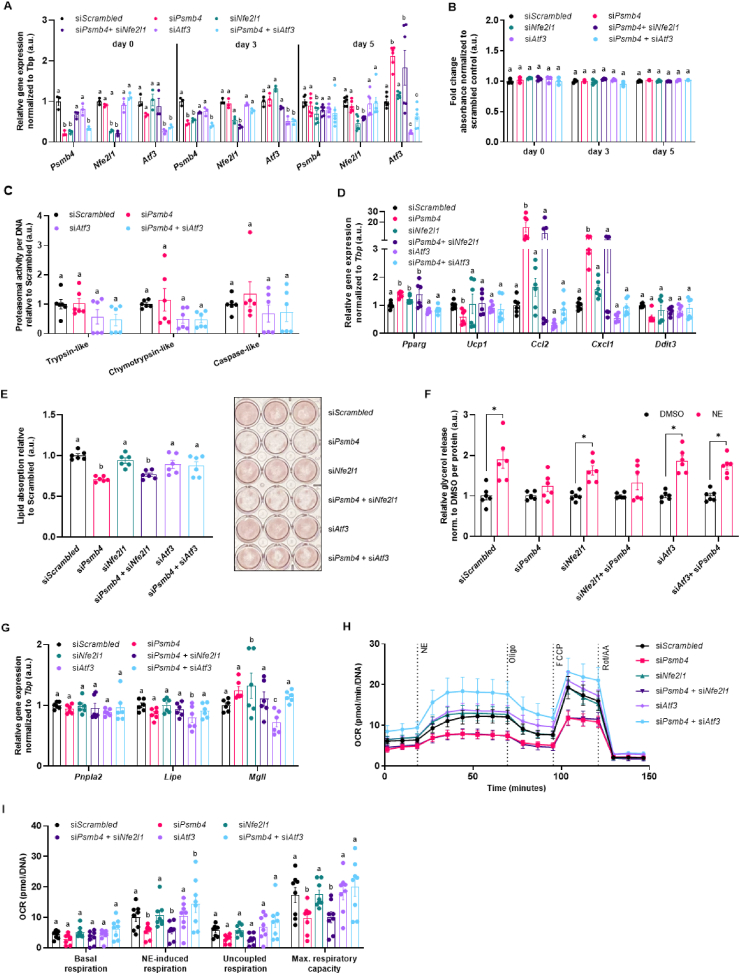
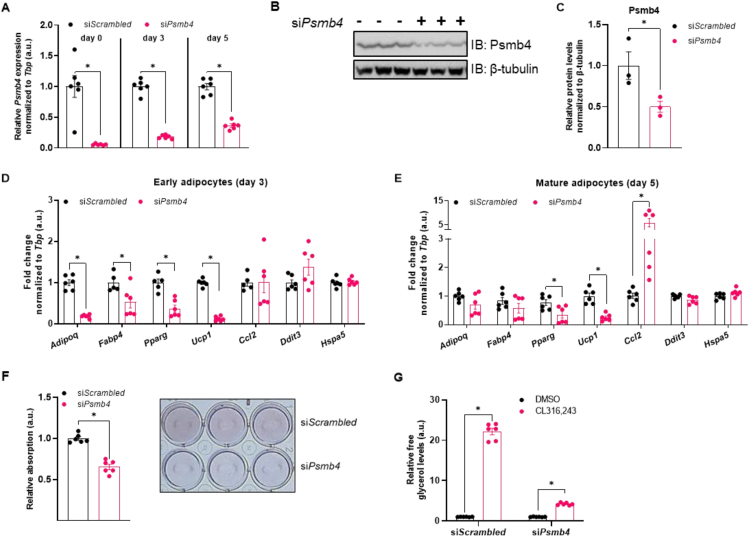
In immortalized mouse brown pre-adipocytes, levels of Psmb4, Psmb8, and downstream effectors genes were downregulated through reverse transfection with siRNA. Adipocytes were differentiated and analyzed with various assays of adipogenesis, lipogenesis, lipolysis, inflammation, and respiration.
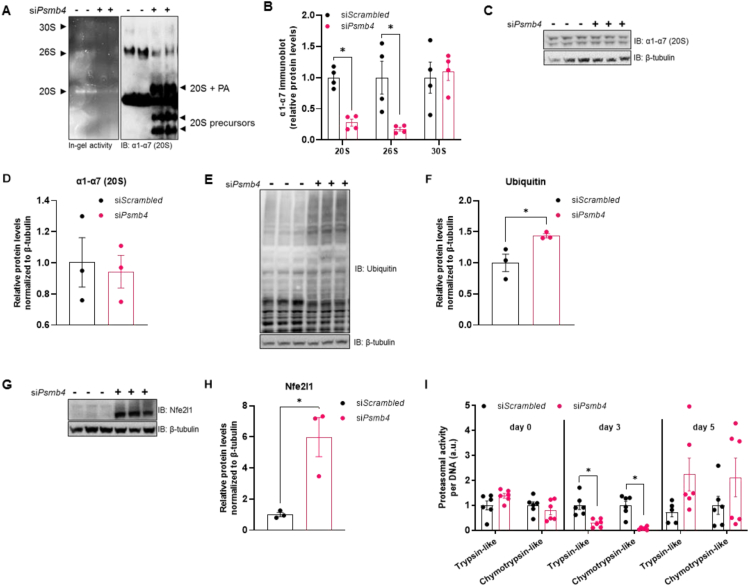
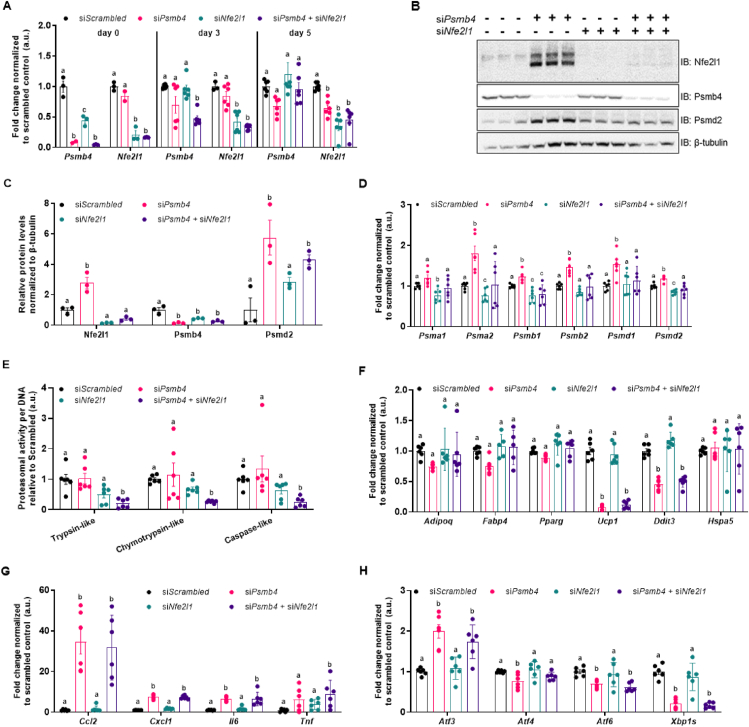
Loss of Psmb4, but not Psmb8, disrupted proteostasis and adipogenesis. Proteasome function was reduced upon Psmb4 loss, but partly recovered by the activation of Nuclear factor, erythroid-2, like-1 (Nfe2l1). In addition, cells displayed higher levels of surrogate inflammation and stress markers, including Activating transcription factor-3 (Atf3). Simultaneous silencing of Psmb4 and Atf3 lowered inflammation and restored adipogenesis.
Our study shows that Psmb4 is required for adipocyte development and function in cultured adipocytes. These results imply that in humans with PSMB4 mutations, PRAAS-associated lipodystrophy is partly caused by disturbed adipogenesis. While we uncover a role for Nfe2l1 in the maintenance of proteostasis under these conditions, Atf3 is a key effector of inflammation and blocking adipogenesis. In conclusion, our work highlights how proteasome dysfunction is sensed and mitigated by the integrated stress response in adipocytes with potential relevance for PRAAS patients and beyond.
蛋白酶体活性的调节是细胞蛋白质稳态和功能的重要组成部分。这在蛋白酶体亚基和相关调节剂突变的患者中显而易见,他们患有蛋白酶体相关自身炎症综合征(PRAAS)。这些患者表现出脂肪营养不良和发热,这可能部分与脂肪细胞功能障碍和脂肪组织异常产热有关。然而,潜在这些症状的细胞内途径尚不清楚。在这里,我们研究了两种与 PRAAS 相关的蛋白酶体亚基 Psmb4 和 Psmb8 对棕色脂肪细胞分化、功能和蛋白质稳态的影响。
在永生化的小鼠棕色前脂肪细胞中,通过反向转染 siRNA 下调 Psmb4、Psmb8 和下游效应子基因的水平。分化脂肪细胞并通过各种脂肪生成、脂肪生成、脂肪分解、炎症和呼吸测定进行分析。
Psmb4 的缺失而不是 Psmb8 的缺失破坏了蛋白质稳态和脂肪生成。蛋白酶体功能在 Psmb4 缺失后降低,但通过核因子,红细胞 2 样 1(Nfe2l1)的激活部分恢复。此外,细胞显示出更高水平的替代炎症和应激标志物,包括激活转录因子 3(Atf3)。Psmb4 和 Atf3 的同时沉默降低了炎症并恢复了脂肪生成。
我们的研究表明 Psmb4 是培养脂肪细胞中脂肪细胞发育和功能所必需的。这些结果表明,在具有 PSMB4 突变的人中,PRAAS 相关的脂肪营养不良部分是由于脂肪生成紊乱引起的。虽然我们揭示了 Nfe2l1 在这些条件下维持蛋白质稳态中的作用,但 Atf3 是炎症和阻止脂肪生成的关键效应物。总之,我们的工作强调了蛋白酶体功能障碍如何被应激反应感知和减轻,这对 PRAAS 患者及其他患者具有潜在意义。