Fan Xiaojiao, Chen Jing, Zhang Yajun, Wang Siyi, Zhong Wenqian, Yuan Huipu, Wu Xia, Wang Chaochen, Zheng Yixin, Wei Yuan, Xiao Ying
School of Pharmacy, Jiangsu University, 301 Xuefu Road, Zhenjiang, 212013, Jiangsu, China.
Zhejiang University - University of Edinburgh Institute, International Campus, Zhejiang University, Haining, Zhejiang, China.
Chin Med. 2022 May 31;17(1):63. doi: 10.1186/s13020-022-00619-2.
Alopecia affects millions of individuals globally, with hair loss becoming more common among young people. Various traditional Chinese medicines (TCM) have been used clinically for treating alopecia, however, the effective compounds and underlying mechanism are less known. We sought to investigate the effect of Alpinetin (AP), a compound extracted from Fabaceae and Zingiberaceae herbs, in hair regeneration.
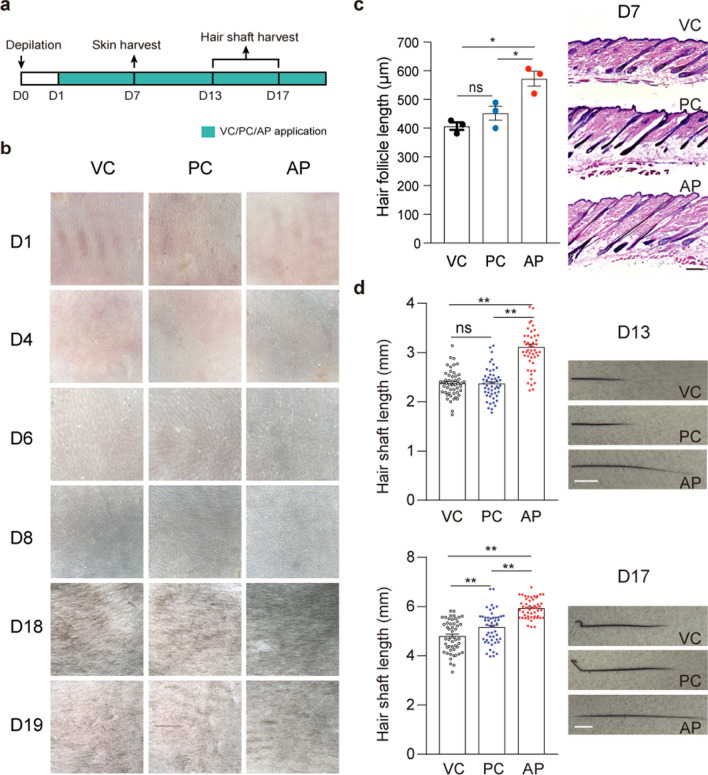
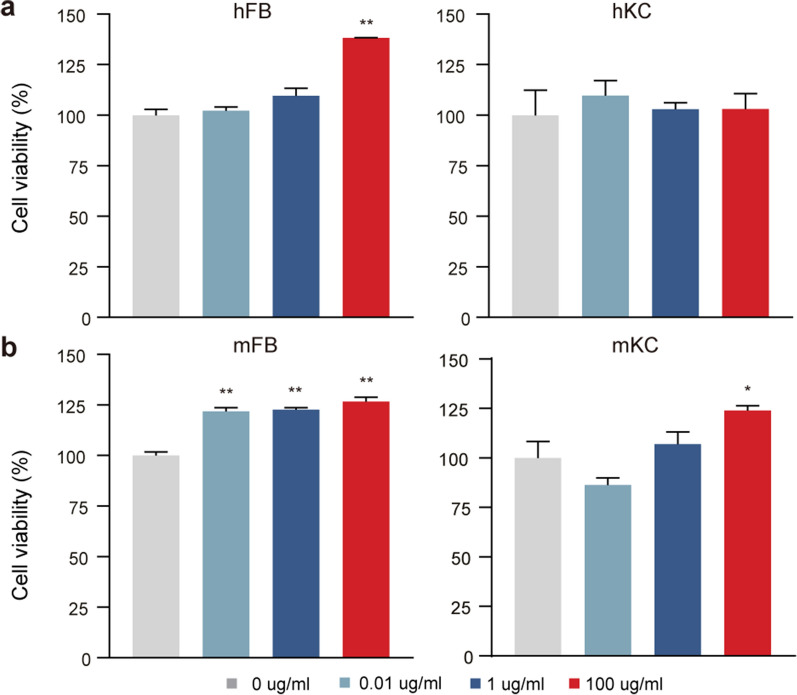
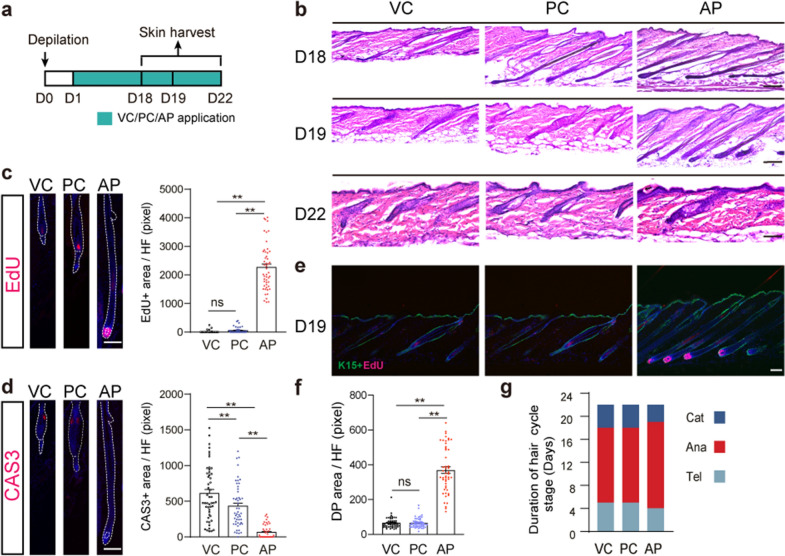
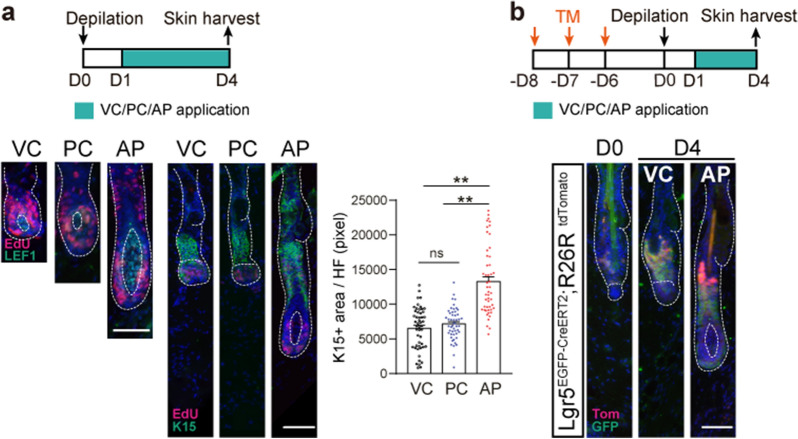
Animal model for hair regeneration was mimicked by depilation in C57BL/6J mice. The mice were then topically treated with 3 mg/ml AP, minoxidil as positive control (PC), or solvent ethanol as vehicle control (VC) on the dorsal skin. Skin color changes which reflected the hair growth stages were monitored and pictured, along with H&E staining and hair shaft length measurement. RNA-seq analysis combined with immunofluorescence staining and qPCR analysis were used for mechanism study. Meanwhile, Gli1; R26R and Lgr5; R26R transgenic mice were used to monitor the activation and proliferation of Gli1+ and Lgr5+ HFSCs after treatment. Furthermore, the toxicity of AP was tested in keratinocytes and fibroblasts from both human and mouse skin to assess the safety.
When compared to minoxidil-treated and vehicle-treated control mice, topical application of AP promoted anagen initiation and delayed catagen entry, resulting in a longer anagen phase and hair shaft length. Mechanistically, RNA-seq analysis combined with immunofluorescence staining of Lef1 suggested that Lgr5+ HFSCs in lower bulge were activated by AP via Wnt signaling. Other HFSCs, including K15+, Lef1+, and Gli1+ cells, were also promoted into proliferating upon AP treatment. In addition, AP inhibited cleaved caspase 3-dependent apoptosis at the late anagen stage to postpone regression of hair follicles. More importantly, AP showed no cytotoxicity in keratinocytes and fibroblasts from both human and mouse skin.
This study clarified the effect of AP in promoting hair regeneration by activating HFSCs via Wnt signaling. Our findings may contribute to the development of a new generation of pilatory that is more efficient and less cytotoxic for treating alopecia.
脱发影响着全球数百万人,脱发在年轻人中变得越来越普遍。各种中药已在临床上用于治疗脱发,然而,其有效成分和潜在机制尚鲜为人知。我们旨在研究从豆科和姜科草药中提取的化合物高山黄芩素(AP)在毛发再生中的作用。
通过拔毛在C57BL/6J小鼠中模拟毛发再生动物模型。然后在小鼠背部皮肤局部涂抹3mg/ml的AP、作为阳性对照(PC)的米诺地尔或作为载体对照(VC)的溶剂乙醇。监测并拍摄反映毛发生长阶段的皮肤颜色变化,同时进行苏木精-伊红(H&E)染色和毛干长度测量。采用RNA测序分析结合免疫荧光染色和定量聚合酶链反应(qPCR)分析进行机制研究。同时,使用Gli1;R26R和Lgr5;R26R转基因小鼠监测治疗后Gli1+和Lgr5+毛囊干细胞(HFSCs)的激活和增殖。此外,在人和小鼠皮肤的角质形成细胞和成纤维细胞中测试AP的毒性以评估安全性。
与米诺地尔治疗组和载体治疗组对照小鼠相比,局部应用AP可促进生长期起始并延迟退行期进入,导致生长期延长和毛干长度增加。机制上,RNA测序分析结合Lef1免疫荧光染色表明,AP通过Wnt信号通路激活下膨出部的Lgr5+HFSCs。其他HFSCs,包括K15+、Lef1+和Gli1+细胞,在AP处理后也被促进增殖。此外,AP在生长期后期抑制半胱天冬酶3切割依赖性凋亡,以推迟毛囊退化。更重要的是,AP在人和小鼠皮肤的角质形成细胞和成纤维细胞中均未显示出细胞毒性。
本研究阐明了AP通过Wnt信号通路激活HFSCs促进毛发再生的作用。我们的研究结果可能有助于开发新一代更有效且细胞毒性更小的治疗脱发的生发剂。