Department of Geography and Geosciences, Faculty of Science, University of Helsinki, Helsinki, Finland.
Andalusian Earth Sciences Institute (IACT, CSIC-UGR), Armilla, Granada, Spain.
Sci Rep. 2022 May 31;12(1):9050. doi: 10.1038/s41598-022-12047-1.
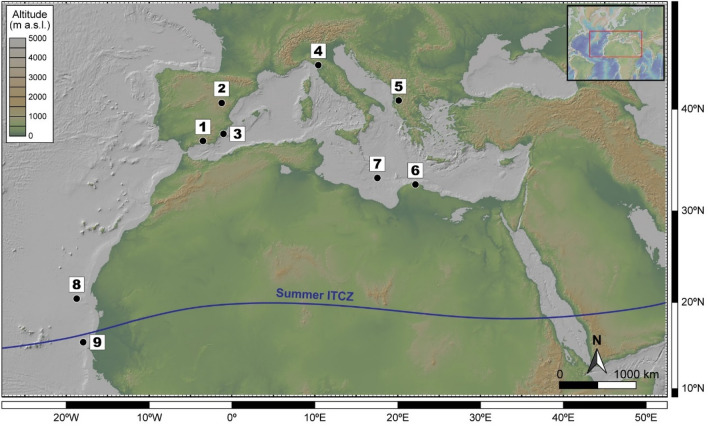
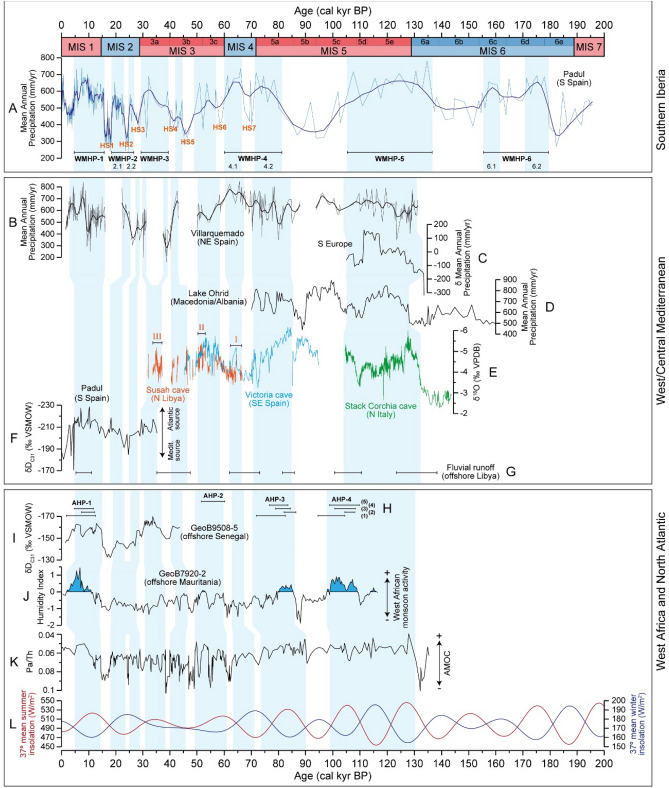
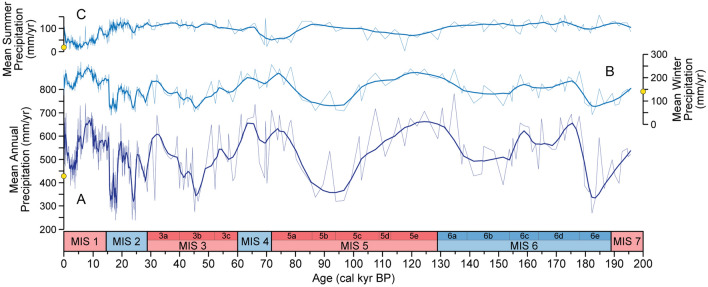
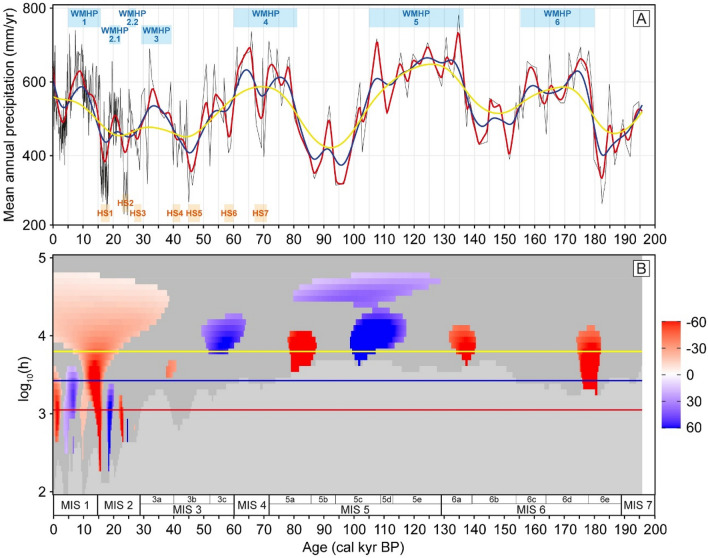
The Iberian Peninsula is located at the intersection between the subtropical and temperate climate zones and the paleoclimate records from this region are key to elucidate the varying humidity and changing dominance of atmospheric circulation patterns in the Mediterranean-North African region in the past. Here we present a quantitative hydroclimate reconstruction for the last ca. 200 kyr from southern Iberian Peninsula based on pollen data from the Padul lake sediment record. We use the newly developed Scale-normalized Significant Zero crossing (SnSiZer) method to detect not only the statistically significant precipitation changes but also to estimate the relative magnitude of these oscillations in our reconstruction. We identify six statistically significant main humid phases, termed West Mediterranean Humid Periods (WMHP 1-6). These humid periods correlate with other West/Central Mediterranean paleohydrological records, suggesting that similar climatic factors affected different areas of the Mediterranean. In addition, the WMPHs are roughly coeval with the African Humid Periods (AHPs) during high seasonality, suggesting the same North Atlantic ocean-atmospheric dynamics and orbital forcing as main drivers of both areas. In contrast, during low seasonality periods, the West Mediterranean still appears to be affected by the westerlies and the local Mediterranean rainfall systems with moderate-to-high precipitation, whereas West Africa was characterized by droughts.
伊比利亚半岛位于亚热带和温带气候带的交汇处,该地区的古气候记录对于阐明过去地中海-北非地区湿度的变化和大气环流模式的变化具有重要意义。本研究基于帕杜尔湖沉积记录中的花粉数据,为过去约 20 万年的伊比利亚半岛南部提供了定量水文气候重建。我们使用新开发的标准化显著零交叉(SnSiZer)方法来检测不仅统计显著的降水变化,而且还估计我们重建中这些波动的相对幅度。我们确定了六个具有统计学意义的主要湿润阶段,称为西地中海湿润期(WMHP1-6)。这些湿润期与其他西/中地中海古水文记录相关,表明相似的气候因素影响了地中海的不同地区。此外,WMHP 与高季节性的非洲湿润期(AHPs)大致同时发生,这表明北大西洋海洋-大气动力和轨道强迫是这两个地区的主要驱动因素。相比之下,在低季节性时期,西地中海似乎仍然受到西风和当地地中海降雨系统的影响,降水适中到较高,而西非则以干旱为特征。