Institute for Health Metrics and Evaluation, University of Washington, 3980 15th Ave. NE, Seattle, WA 98195, USA.
Institute for Health Metrics and Evaluation, University of Washington, 3980 15th Ave. NE, Seattle, WA 98195, USA.
Vaccine. 2022 Jun 21;40(28):3903-3917. doi: 10.1016/j.vaccine.2022.05.042. Epub 2022 May 25.
Rotavirus caused an estimated 151,714 deaths from diarrhea among children under 5 in 2019. To reduce mortality, countries are considering adding rotavirus vaccination to their routine immunization program. Cost-effectiveness analyses (CEAs) to inform these decisions are not available in every setting, and where they are, results are sensitive to modeling assumptions, especially about vaccine efficacy. We used advances in meta-regression methods and estimates of vaccine efficacy by location to estimate incremental cost-effectiveness ratios (ICERs) for rotavirus vaccination in 195 countries.
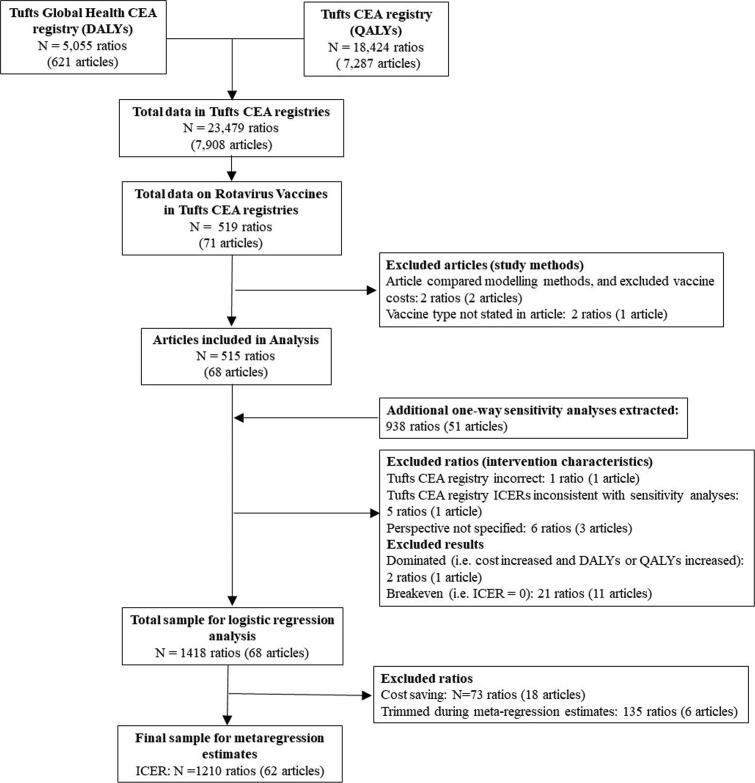
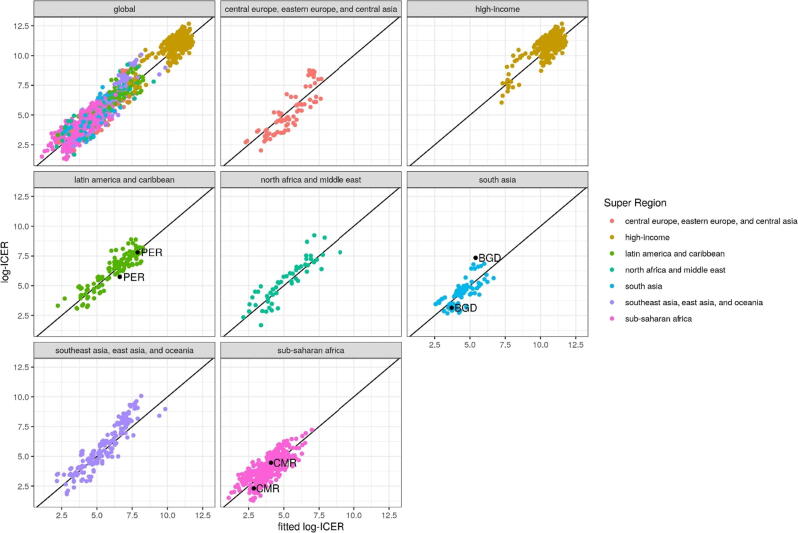
Beginning with Tufts University CEA and Global Health CEA registries we used 515 ICERs from 68 articles published through 2017, extracted 938 additional one-way sensitivity analyses, and excluded 33 ICERs for a sample of 1,418. We used a five-stage, mixed-effects, Bayesian metaregression framework to predict ICERs, and logistic regression model to predict the probability that the vaccine was cost-saving. For both models, covariates were vaccine characteristics including efficacy, study methods, and country-specific rotavirus disability-adjusted life-years (DALYs) and gross domestic product (GDP) per capita. All results are reported in 2017 United States dollars.
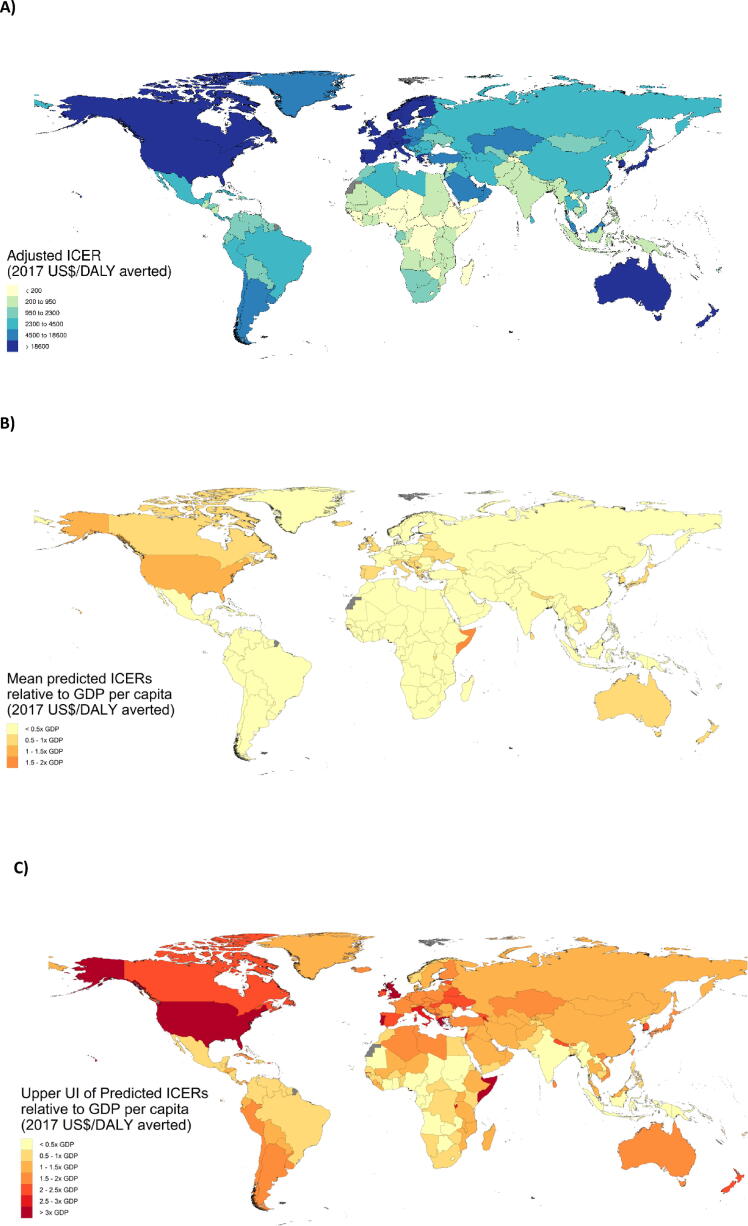
Vaccine efficacy, vaccine cost, GDP per capita and rotavirus DALYs were important drivers of variability in ICERs. Globally, the median ICER was $2,289 (95% uncertainty interval (UI): $147-$38,993) and ranged from $85 per DALY averted (95% UI: $13-$302) in Central African Republic to $70,599 per DALY averted (95% UI: $11,030-$263,858) in the United States. Among countries eligible for support from Gavi, The Vaccine Alliance, the mean ICER was $255 per DALY averted (95% UI: $39-$918), and among countries eligible for the PAHO revolving fund, the mean ICER was $2,464 per DALY averted (95% UI: $382-$3,118).
Our findings incorporate recent evidence that vaccine efficacy differs across locations, and support expansion of rotavirus vaccination programs, particularly in countries eligible for support from Gavi, The Vaccine Alliance.
轮状病毒导致 2019 年 5 岁以下儿童腹泻死亡估计 151714 例。为了降低死亡率,各国正在考虑将轮状病毒疫苗接种纳入常规免疫规划。并非每个国家都有用于决策的成本效益分析(CEA),而在有分析的国家,结果对模型假设敏感,尤其是对疫苗效力的假设。我们利用荟萃回归方法的进展和按地点估算的疫苗效力,估算了 195 个国家轮状病毒疫苗接种的增量成本效益比(ICER)。
我们从塔夫茨大学的 CEA 和全球卫生 CEA 登记处开始,使用了 2017 年以前发表的 68 篇文章中的 515 个 ICER,提取了另外 938 个单项敏感性分析,排除了 33 个 ICER,共得到 1418 个样本。我们使用五阶段混合效应贝叶斯荟萃回归框架来预测 ICER,并使用逻辑回归模型来预测疫苗是否具有成本效益。对于这两种模型,协变量都是疫苗特征,包括效力、研究方法以及国家特有的轮状病毒伤残调整生命年(DALY)和人均国内生产总值(GDP)。所有结果均以 2017 年美元报告。
疫苗效力、疫苗成本、人均 GDP 和轮状病毒 DALY 是影响 ICER 差异的重要因素。全球范围内,ICER 的中位数为 2289 美元(95%置信区间[UI]:147-38993 美元),范围从在中非共和国每避免一个 DALY 需 85 美元(95%UI:13-302 美元)到在美国每避免一个 DALY 需 70599 美元(95%UI:11030-263858 美元)。在有资格获得全球疫苗免疫联盟支持的国家中,平均 ICER 为 255 美元(95%UI:39-918 美元),而在有资格获得泛美卫生组织循环基金支持的国家中,平均 ICER 为 2464 美元(95%UI:382-3118 美元)。
我们的研究结果纳入了最近的证据,表明疫苗效力在不同地点存在差异,支持扩大轮状病毒疫苗接种计划,特别是在有资格获得全球疫苗免疫联盟支持的国家。