PATH, Geneva, Switzerland.
London School of Hygiene & Tropical Medicine, London, UK.
Lancet Glob Health. 2019 Dec;7(12):e1664-e1674. doi: 10.1016/S2214-109X(19)30439-5.
Previous studies have found rotavirus vaccination to be highly cost-effective in low-income countries. However, updated evidence is now available for several inputs (ie, rotavirus disease mortality rates, rotavirus age distributions, vaccine timeliness, and vaccine efficacy by duration of follow-up), new rotavirus vaccines have entered the market, vaccine prices have decreased, and cost-effectiveness thresholds have been re-examined. We aimed to provide updated cost-effectiveness estimates to inform national decisions about the new introduction and current use of rotavirus vaccines in Gavi countries.
We calculated the potential costs and effects of rotavirus vaccination for ten successive birth cohorts in 73 countries previously and currently eligible for Gavi support, compared with no vaccination. We used a deterministic cohort model to calculate numbers of rotavirus gastroenteritis cases, outpatient visits, hospitalisations, and deaths between birth and 5 years, with and without rotavirus vaccination. We calculated treatment costs from the government and societal perspectives. The primary outcome measure was the incremental cost-effectiveness ratio (discounted US$ per disability-adjusted life-year averted). Country-specific model input parameters were based on the scientific literature, published meta-analyses, and international databases. We ran deterministic and probabilistic uncertainty analyses.
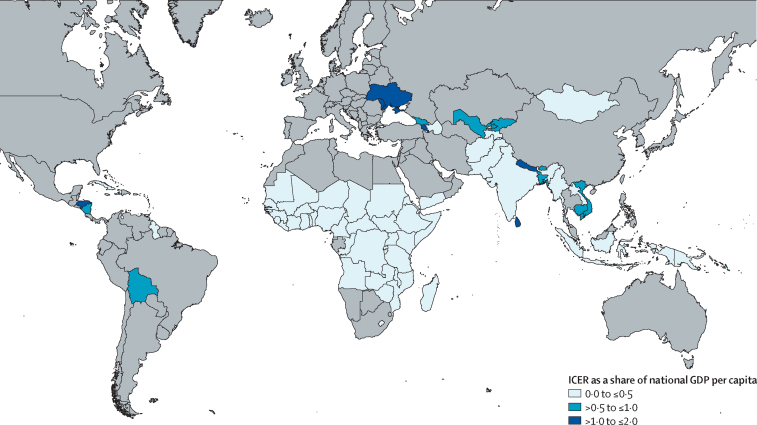
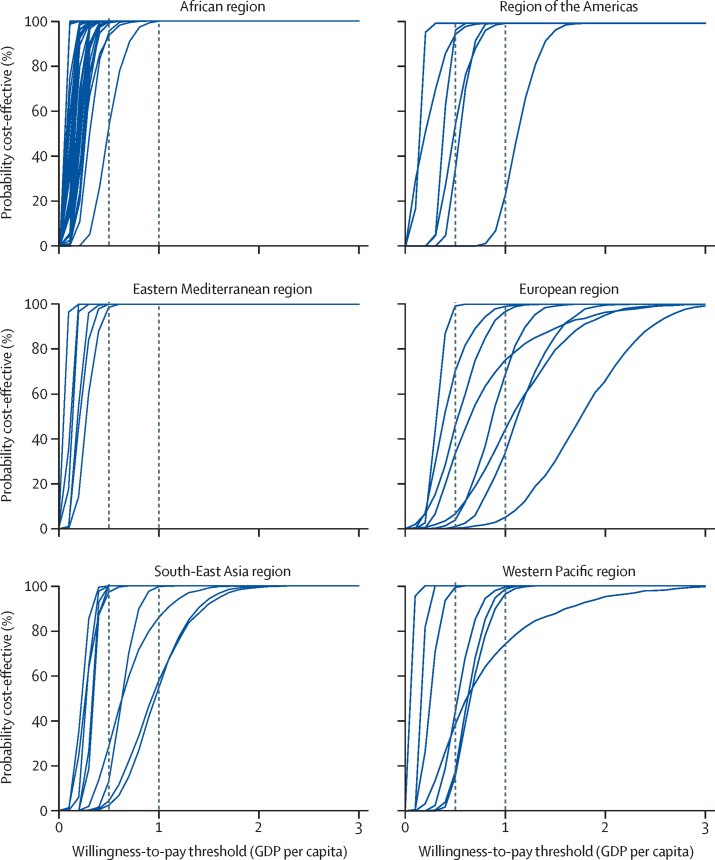
Over the period 2018-27, rotavirus vaccination has the potential to prevent nearly 600 000 deaths in Gavi countries. Averted outpatient visits and hospitalisations could lead to treatment savings of approximately $484·1 million from the government perspective and $878·0 million from the societal perspective. The discounted dollars per disability-adjusted life-year averted has a very high probability (>90%) of being less than 0·5 times the gross domestic product per capita in 54 countries, and less than 1·0 times gross domestic product per capita in 63 countries.
Rotavirus vaccination continues to represent good value for money across most Gavi countries despite lower rotavirus mortality estimates and more stringent willingness-to-pay thresholds.
Bill & Melinda Gates Foundation.
既往研究发现,轮状病毒疫苗在低收入国家具有很高的成本效益。然而,目前有几项投入的更新证据(即轮状病毒疾病死亡率、轮状病毒年龄分布、疫苗及时性以及根据随访时间的疫苗效力)可用,新的轮状病毒疫苗已进入市场,疫苗价格已降低,成本效益阈值已重新审查。我们旨在提供更新的成本效益估计,以告知有关轮状病毒疫苗在 Gavi 国家新引入和当前使用的国家决策。
我们计算了在 73 个先前和当前有资格获得 Gavi 支持的国家中,十个人连续出生队列接种轮状病毒疫苗的潜在成本和效果,与不接种疫苗进行比较。我们使用确定性队列模型计算了出生至 5 岁之间有无轮状病毒疫苗接种时轮状病毒胃肠炎病例、门诊就诊、住院和死亡的数量。我们从政府和社会角度计算了治疗费用。主要的结果衡量指标是增量成本效益比(每避免一个残疾调整生命年的增量成本,以贴现后的美元计)。国家特定的模型输入参数基于科学文献、已发表的荟萃分析和国际数据库。我们进行了确定性和概率性不确定性分析。
在 2018-27 年期间,轮状病毒疫苗接种有可能在 Gavi 国家预防近 60 万例死亡。从政府的角度来看,避免门诊就诊和住院可节省约 4.841 亿美元的治疗费用,从社会的角度来看,可节省 8.780 亿美元的治疗费用。避免一个残疾调整生命年的折扣后美元具有很高的可能性(>90%),在 54 个国家中,低于人均国内生产总值的 0.5 倍,在 63 个国家中,低于人均国内生产总值的 1.0 倍。
尽管轮状病毒死亡率估计值降低,且更严格的支付意愿阈值,但轮状病毒疫苗接种在大多数 Gavi 国家仍然具有很高的成本效益。
比尔及梅琳达·盖茨基金会。