Radiology Unit 1, Department of Medical Surgical Sciences and Advanced Technologies "GF Ingrassia", University Hospital Policlinico "G. Rodolico-San Marco", 95123 Catania, Italy.
U.O.C. Medicina Interna, Dipartimento di Medicina, Ospedale "R. Guzzardi" di Vittoria, ASP Ragusa, 97100 Ragusa, Italy.
Tomography. 2022 May 1;8(3):1228-1240. doi: 10.3390/tomography8030101.
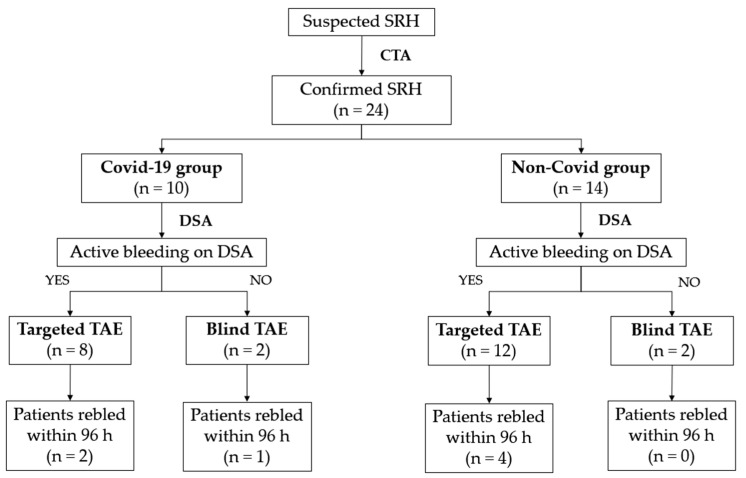
(1) Background: Spontaneous retroperitoneal hematomas are a relatively common occurrence in hospitalized patients with COVID-19 related pneumonia, and endovascular treatment of trans-arterial embolization (TAE) may be a life-saving procedure after failure of medical and supportive therapy. The aim of our study was to evaluate spontaneous retroperitoneal hematomas in the COVID-19 era, focusing on their imaging features at CTA and DSA and on the safety, as well as technical and clinical success, of TAE, comparing patients affected by COVID-19 and non-COVID-19 patients. (2) Materials and Methods: We retrospectively enrolled 24 patients with spontaneous retroperitoneal hematoma who underwent TAE; of these, 10 were hospitalized for COVID-19-related pneumonia, while the other 14 were without COVID-19 infection. We evaluated the demographic data, hemoglobin values before and after the procedure, preprocedural aPTT, preprocedural INR, diagnostic and interventional imaging findings, procedural outcome (technical success) and survival periprocedural (clinical success), and major and minor complications. (3) Results: The mean age of the study population was 72.7 ± 11.2 years. CTA revealed signs of active bleeding in 20 patients (83%). DSA showed signs of active bleeding in 20 patients (83%). In four patients (17%), blind embolization was performed. The overall technical success rate was 100%. Clinical success was achieved in 17 patients (71%), while seven patients (29%) rebled within 96 h, and all of them were retreated. No major periprocedural complication was reported. The comparison between the two groups did not show statistically significant differences for gender, mean age, mean pre- and postprocedural hemoglobin, aPTT and INR, mean hematoma volume (cm), or mean delay between CT and DSA. Active bleeding at CTA was detected in 90% of COVID-19 patients and 79% of non-COVID-19 patients ( = 0.61). At DSA, active bleeding was assessed in eight out of 10 (80%) patients in the COVID-19 group and 12 out of 14 (86%) patients in the non-COVID-19 group ( = 1). Technical success was obtained in 100% of patients in both groups. Clinical success rates were 70% for COVID-19 group and 71% for the non-COVID-19 group. We found no statistical significance between the clinical success rates of retroperitoneal spontaneous hematoma embolization in patients with or without SARS-CoV-2 infection. (4) Conclusions: We suggest that, similar to what has been reported in other studies in non-COVID-19 patients, TAE should be considered an important safe, effective, and potentially life-saving option for the management and the treatment of patients affected by COVID-19 who present with spontaneous retroperitoneal hematoma and who could not benefit from conservative treatment.
(1)背景:自发性腹膜后血肿在 COVID-19 相关肺炎住院患者中较为常见,经血管内治疗经动脉栓塞术(TAE)可能是在药物和支持治疗失败后的救命程序。我们研究的目的是评估 COVID-19 时代的自发性腹膜后血肿,重点关注 CTA 和 DSA 的影像学特征,以及 TAE 的安全性、技术和临床成功率,并比较 COVID-19 患者和非 COVID-19 患者。(2)材料和方法:我们回顾性纳入 24 例接受 TAE 的自发性腹膜后血肿患者;其中 10 例因 COVID-19 相关肺炎住院,另 14 例无 COVID-19 感染。我们评估了人口统计学数据、治疗前后的血红蛋白值、治疗前 aPTT、治疗前 INR、诊断和介入影像学发现、治疗过程中的结果(技术成功率)和围手术期的生存情况(临床成功率),以及主要和次要并发症。(3)结果:研究人群的平均年龄为 72.7 ± 11.2 岁。CTA 显示 20 例患者(83%)存在活动性出血征象。DSA 显示 20 例患者(83%)存在活动性出血征象。4 例患者(17%)行盲目栓塞。总的技术成功率为 100%。17 例患者(71%)达到临床成功,7 例患者(29%)在 96 小时内再次出血,均进行了再次治疗。未报告主要围手术期并发症。两组之间的比较在性别、平均年龄、治疗前后血红蛋白、aPTT 和 INR、平均血肿体积(cm)或 CT 与 DSA 之间的平均延迟时间方面均无统计学差异。COVID-19 患者中有 90%和非 COVID-19 患者中有 79%(=0.61)在 CTA 上检测到活动性出血。在 DSA 上,COVID-19 组的 10 例患者中有 8 例(80%)和非 COVID-19 组的 14 例患者中有 12 例(86%)(=1)评估为活动性出血。两组患者的技术成功率均为 100%。COVID-19 组的临床成功率为 70%,非 COVID-19 组为 71%。我们发现,在 COVID-19 患者和非 SARS-CoV-2 感染患者中,腹膜后自发性血肿栓塞的临床成功率之间没有统计学意义。(4)结论:我们建议,与非 COVID-19 患者的其他研究报告相似,TAE 应被视为治疗 COVID-19 患者自发性腹膜后血肿的重要安全、有效和潜在救生选择,这些患者不能从保守治疗中受益。