Getachew Samuel, Medhin Girmay, Asres Abyot, Abebe Gemeda, Ameni Gobena
Department of Biology, College of Natural and Computational Sciences, Mizan-Tepi University, PO Box 121, Tepi, Ethiopia.
Aklilu Lemma Institute of Pathobiology, Addis Ababa University, PO Box 1176, Addis Ababa, Ethiopia.
Heliyon. 2022 May 18;8(5):e09478. doi: 10.1016/j.heliyon.2022.e09478. eCollection 2022 May.
Majority of people in Ethiopia heavily rely on traditional medicinal plants to treat a number of diseases including tuberculosis (TB). However, there has been lack of comprehensive evidences on taxonomic distribution of medicinal plant species, methods of preparation of remedies from these plants and how the remedies are administered. This systematic review is designed to examine and synthesize available evidences focusing on medicinal plants that have been used for TB treatment in Ethiopia.
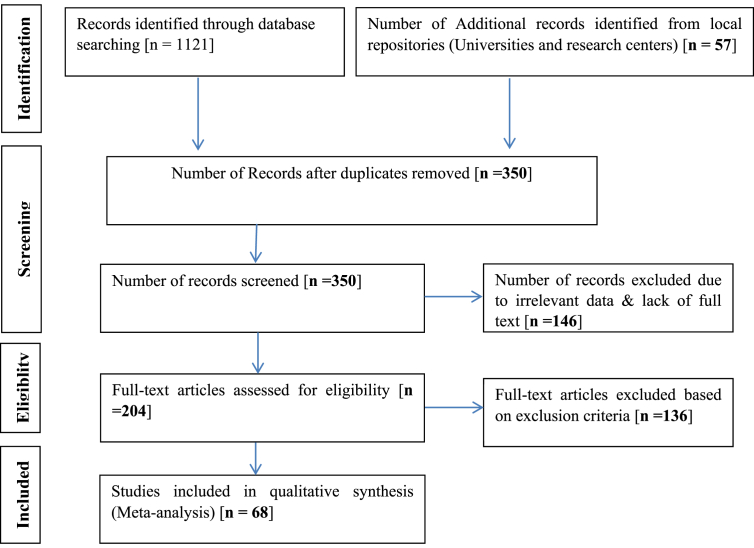
Research findings related to ethno-botanical and pharmacological approaches of TB remedies were retrieved from databases. Electronic libraries of Ethiopian Universities and relevant church-based religious books were also reviewed as additional sources. Evidences are searched and organized in accordance with the Preferred Reporting Items for Systematic Reviews and Meta-Analyses (PRISMA) guideline.
From a total of 68 research documents that reported use of plants for treatment of TB 98 plants species belonging to 82 genera and 49 families were identified. The most frequently reported plant species belonged to family (n = 8), (n = 7), (n = 6) and (n = 6). were the most often mentioned anti-TB medicinal plants. Shrubs (35.7%) and trees (29.6%) were reported as dominant growth forms while plant roots (31.6%) and leaves (28.6%) were frequently used plant parts for the preparations of the treatment. The most favored administration route was oral (59.1%). About 87% of the preparations were made from fresh plant materials. No experimental/clinical evidence was presented for 79.6%(78/98) of the reported plants to support their anti-mycobacterial activities.
In Ethiopia, the number of herbal remedies is enormous and their use for TB treatment is a common practice. However, majority of them are not yet backed up by evidence generated through scientific experimentation and this warrants further experimental and clinical validations. Moreover, the efficacy, toxicity and safety tests should be initiated and this would help in the rapid identification of new anti-TB regimens, and possibly it would lead to developing more effective new plant-based drugs. This systematic review will serve as a reference for the selection of plants for developing new anti-TB regimens.
埃塞俄比亚的大多数人严重依赖传统药用植物来治疗包括结核病(TB)在内的多种疾病。然而,关于药用植物物种的分类分布、这些植物制成药物的制备方法以及药物的给药方式,一直缺乏全面的证据。本系统评价旨在审查和综合现有证据,重点关注埃塞俄比亚用于治疗结核病的药用植物。
从数据库中检索与结核病药物的民族植物学和药理学方法相关的研究结果。埃塞俄比亚大学的电子图书馆和相关的教会宗教书籍也作为额外的来源进行了审查。证据按照系统评价和Meta分析的首选报告项目(PRISMA)指南进行搜索和整理。
在总共68份报告使用植物治疗结核病的研究文献中,鉴定出98种植物,属于82属49科。报告频率最高的植物物种属于 科(n = 8)、 科(n = 7)、 科(n = 6)和 科(n = 6)。 是最常被提及的抗结核药用植物。灌木(35.7%)和树木(29.6%)被报告为主要生长形式,而植物根(31.6%)和叶(28.6%)是制备治疗药物时最常用的植物部位。最受欢迎的给药途径是口服(59.1%)。约87%的制剂由新鲜植物材料制成。在所报告的植物中,79.6%(78/98)没有提供实验/临床证据来支持其抗分枝杆菌活性。
在埃塞俄比亚,草药疗法的数量众多,用于治疗结核病是一种常见做法。然而,它们中的大多数尚未得到科学实验产生的证据支持,这需要进一步的实验和临床验证。此外,应启动疗效、毒性和安全性测试,这将有助于快速鉴定新的抗结核治疗方案,并可能导致开发更有效的新型植物性药物。本系统评价将为选择用于开发新抗结核治疗方案的植物提供参考。