
埃塞俄比亚南部南奥莫地区传统医者用于治疗人类和牲畜疾病的植物的民族医学研究。
Ethno-medicinal study of plants used for treatment of human and livestock ailments by traditional healers in South Omo, Southern Ethiopia.
机构信息
Department of Chemistry, College of Natural and Computational Science, Hawassa University, P,O, Box 05, Hawassa, Ethiopia.
出版信息
J Ethnobiol Ethnomed. 2013 May 16;9:32. doi: 10.1186/1746-4269-9-32.
BACKGROUND
Plants have traditionally been used for treatment of human and livestock ailments in Ethiopia by different ethnic and social groups. However, this valuable source of knowledge is not adequately documented, which impedes their widespread use, evaluation and validation. Here, we recorded indigenous knowledge and standard practices for human and livestock disease control, of three ethnic groups (Aari, Maale and Bena-Tsemay) in South Omo Zone of Southern Nations, Nationalities and Peoples Regional State, Ethiopia.
METHODS
A cross-sectional study was carried out using a semi-structured questionnaire to document knowledge of 50 traditional healers (40 male and 10 female) in medicinal plant use for treatment of human and livestock ailments. Descriptive statistics were used to analyze and summarize the ethno-botanical data.
RESULTS
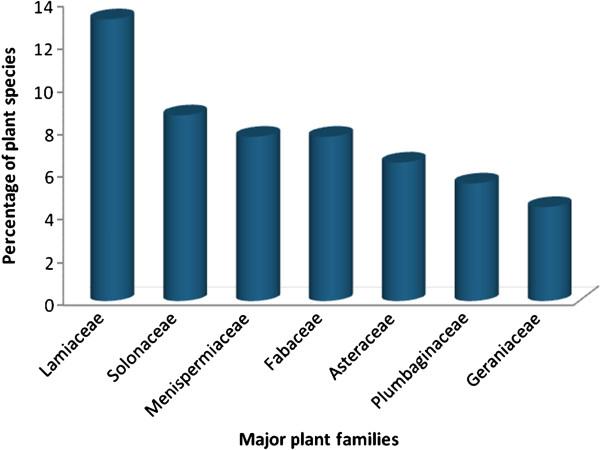
Ninety-one plants, with claimed medicinal properties against a total of 34 human and livestock ailments, were reported and botanically identified as belonging to 57 genera and 33 plant families. Most of the plant species reported belonged to one of seven major families: Lamiaceae, Solanaceae, Menispermiaceae, Fabaceae, Asteraceae, Plumbaginaceae and Geraniaceae. Woody plants (shrubs 21% and trees 29%) were the major growth form used, whilst roots (40%) and leaves (35%) were the major plant parts used in the study areas. Healers mostly practice oral administration of plant preparations (65%). Multiple medicinal plants were cited against particular ailments, and mixing of two or more different medicinal plants (14.3%) against a single ailment was also commonly reported.
CONCLUSION
This study showed that traditional medicine, mainly involving the use of medicinal plants, is playing a significant role in meeting the primary healthcare needs of the three ethnic groups. Acceptance of traditional medicine and limited access to modern healthcare facilities could be considered as the main factors for the continuation of the practice. Documented knowledge of the traditional healers can be used to support the country's human and livestock health care system and improve lives and livelihoods. Information generated will be used in future studies to validate bioactivity of selected medicinal plants used by traditional healers, so to increase their acceptability in health care systems both nationally and internationally.
背景
在埃塞俄比亚,不同的民族和社会群体一直以来都将植物用于治疗人类和牲畜疾病。然而,这种宝贵的知识来源没有得到充分记录,这阻碍了它们的广泛使用、评估和验证。在这里,我们记录了三个民族(Aari、Maale 和 Bena-Tsemay)在埃塞俄比亚南部奥莫地区的传统知识和标准做法,用于控制人类和牲畜疾病。
方法
我们进行了一项横断面研究,使用半结构化问卷记录了 50 名传统治疗师(40 名男性和 10 名女性)在使用药用植物治疗人类和牲畜疾病方面的知识。使用描述性统计数据对民族植物学数据进行分析和总结。
结果
报告了 91 种植物,据称这些植物具有治疗 34 种人类和牲畜疾病的特性,并通过植物学鉴定属于 57 属和 33 个植物科。报告的植物物种大多属于七个主要科之一:唇形科、茄科、防己科、豆科、菊科、白花丹科和牻牛儿苗科。木本植物(灌木占 21%,乔木占 29%)是主要的生长形式,而根(40%)和叶(35%)是研究地区使用的主要植物部位。治疗师主要采用口服植物制剂(65%)。针对特定疾病引用了多种药用植物,也经常报告将两种或多种不同的药用植物混合使用(14.3%)来治疗单一疾病。
结论
这项研究表明,传统医学主要涉及药用植物的使用,在满足三个民族的基本医疗需求方面发挥着重要作用。传统医学的接受程度和现代医疗设施的有限获取可以被认为是这种实践继续存在的主要因素。传统治疗师的记录知识可以用于支持该国的人类和牲畜保健系统,改善生活和生计。所生成的信息将用于未来的研究,以验证传统治疗师使用的选定药用植物的生物活性,从而提高它们在国内外保健系统中的可接受性。



 Zotero 插件