Chen Xin, Xu Yuexin, Li Chenlong, Lu Xinyu, Fu Yaoyao, Huang Qingqing, Ma Duan, Ma Jing, Zhang Tianyu
ENT institute, Eye & ENT Hospital, Fudan University, Shanghai 200031, China.
Key Laboratory of Metabolism and Molecular Medicine, Ministry of Education, Department of Biochemistry and Molecular Biology, School of Basic Medical Sciences, Fudan University, Shanghai 200032, China.
ACS Omega. 2022 May 13;7(20):16917-16927. doi: 10.1021/acsomega.1c07059. eCollection 2022 May 24.
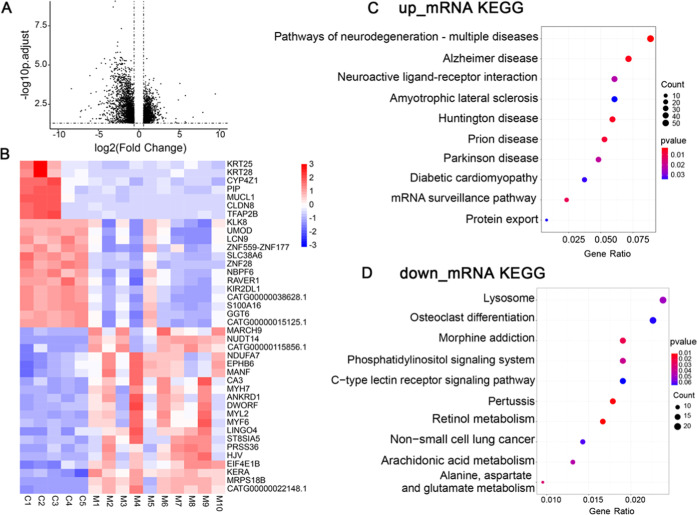
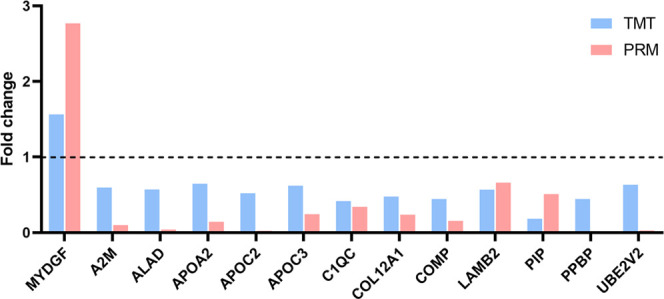
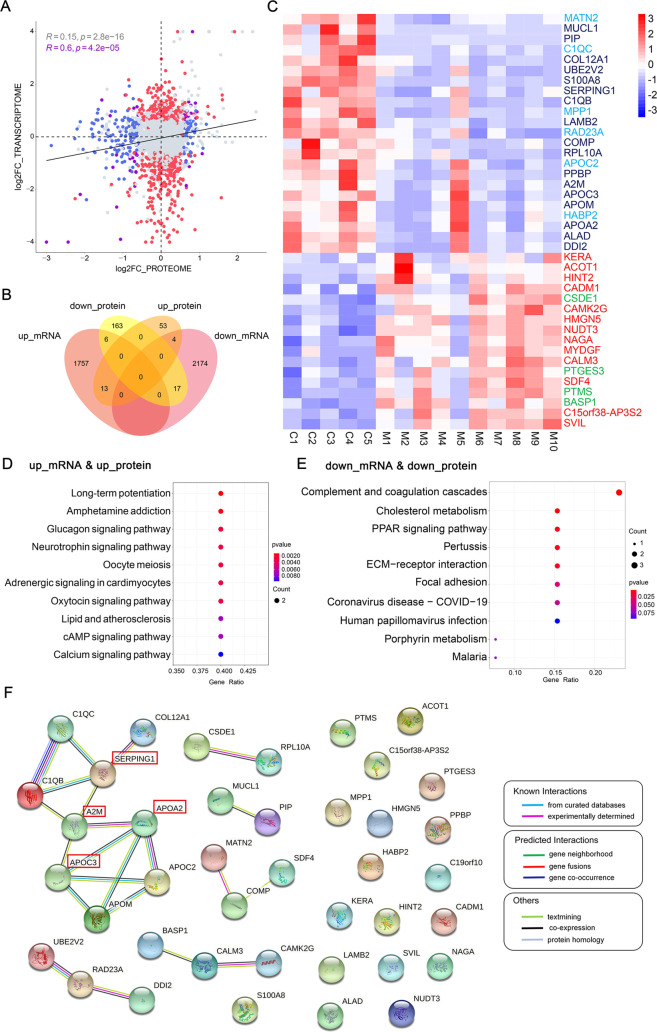
As one of the common birth defects worldwide, nonsyndromic microtia is a complex disease that results from interactions between environmental and genetic factors. However, the underlying causes of nonsyndromic microtia are currently not well understood. The present study determined transcriptomic and proteomic profiles of auricular cartilage tissues in 10 patients with third-degree nonsyndromic microtia and five control subjects by RNA microarray and tandem mass tag-based quantitative proteomics technology. Relative mRNA and protein abundances were compared and evaluated for their function and putative involvement in nonsyndromic microtia. A total of 3971 differentially expressed genes and 256 differentially expressed proteins were identified. Bioinformatics analysis demonstrated that some of these genes and proteins showed potential associations with nonsyndromic microtia. Thirteen proteins with the same trend at the mRNA level obtained by the integrated analysis were validated by parallel reaction monitoring analysis. Several key genes, namely, 2, 2, 2, 3, and 2, were found to be dysregulated, which could contribute to nonsyndromic microtia. The present study is the first report on the transcriptomic and proteomic integrated analysis of nonsyndromic microtia using the same auricular cartilage sample. Additional studies are required to clarify the roles of potential key genes in nonsyndromic microtia.
作为全球常见的出生缺陷之一,非综合征性小耳畸形是一种由环境和遗传因素相互作用导致的复杂疾病。然而,目前对非综合征性小耳畸形的潜在病因尚不清楚。本研究通过RNA微阵列和基于串联质量标签的定量蛋白质组学技术,确定了10例三度非综合征性小耳畸形患者和5例对照受试者耳软骨组织的转录组和蛋白质组谱。比较并评估了相对mRNA和蛋白质丰度及其在非综合征性小耳畸形中的功能和可能作用。共鉴定出3971个差异表达基因和256个差异表达蛋白质。生物信息学分析表明,其中一些基因和蛋白质与非综合征性小耳畸形存在潜在关联。通过平行反应监测分析验证了综合分析在mRNA水平上具有相同趋势的13种蛋白质。发现几个关键基因,即2、2、2、3和2,表达失调,这可能导致非综合征性小耳畸形。本研究是首次使用相同耳软骨样本对非综合征性小耳畸形进行转录组和蛋白质组综合分析的报告。需要进一步的研究来阐明潜在关键基因在非综合征性小耳畸形中的作用。