• 文献检索
  • 文档翻译
  • 深度研究
  • 学术资讯
  • Suppr Zotero 插件Zotero 插件
  • 邀请有礼
  • 套餐&价格
  • 历史记录
应用&插件
Suppr Zotero 插件Zotero 插件浏览器插件Mac 客户端Windows 客户端微信小程序
定价
高级版会员购买积分包购买API积分包
服务
文献检索文档翻译深度研究API 文档MCP 服务
关于我们
关于 Suppr公司介绍联系我们用户协议隐私条款
关注我们

Suppr 超能文献

核心技术专利:CN118964589B侵权必究
粤ICP备2023148730 号-1Suppr @ 2026

文献检索

告别复杂PubMed语法,用中文像聊天一样搜索,搜遍4000万医学文献。AI智能推荐,让科研检索更轻松。

立即免费搜索

文件翻译

保留排版,准确专业,支持PDF/Word/PPT等文件格式,支持 12+语言互译。

免费翻译文档

深度研究

AI帮你快速写综述,25分钟生成高质量综述,智能提取关键信息,辅助科研写作。

立即免费体验

英文新闻媒体中的 COVID-19 疫苗错误信息:回顾性队列研究。

COVID-19 vaccine misinformation in English-language news media: retrospective cohort study.

机构信息

Center for Science in the Public Interest, Washington, DC, USA

Cision Inc, Chicago, Illinois, USA.

出版信息

BMJ Open. 2022 Jun 1;12(6):e058956. doi: 10.1136/bmjopen-2021-058956.

DOI:10.1136/bmjopen-2021-058956
PMID:35649595
原文链接:https://pmc.ncbi.nlm.nih.gov/articles/PMC9160593/
Abstract

OBJECTIVES

To describe COVID-19 vaccine misinformation and track trends over time in traditional news media.

DESIGN

Retrospective cohort study of a large database of online articles, July 2020-June 2021.

SETTING

English-language articles from 100 news outlets with the greatest reach.

MAIN OUTCOME MEASURES

Numbers and percentages of articles containing COVID-19 vaccine misinformation over the study period. Further analysis by misinformation themes and whether articles included primary misinformation, fact-checking or simply referred to misinformation.

RESULTS

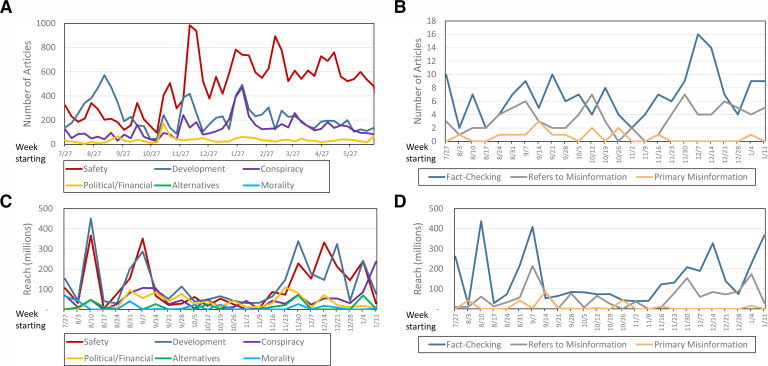
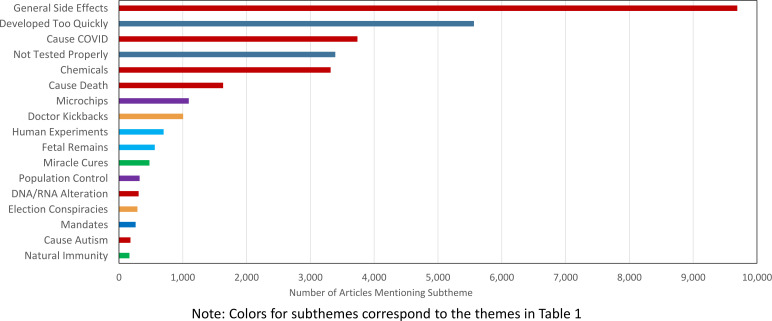
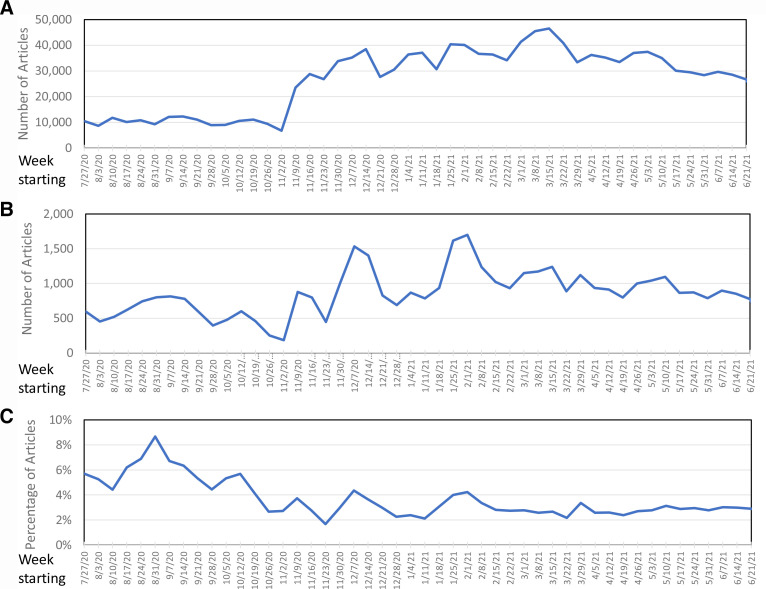
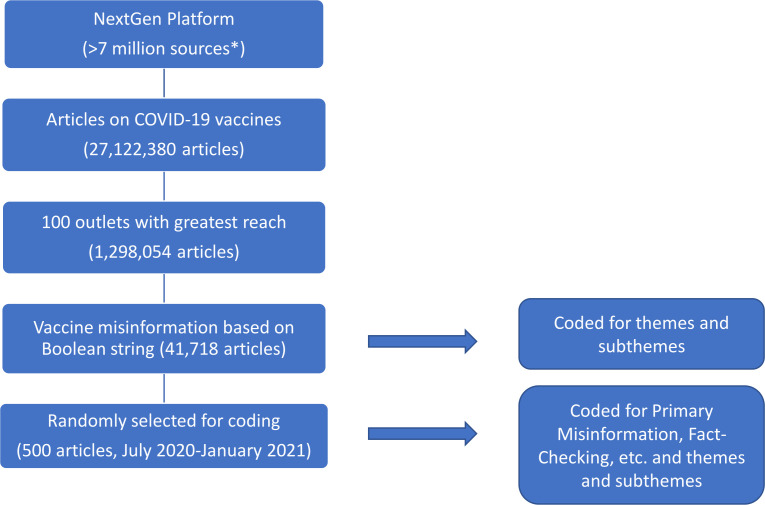
41 718 (3.2% of all COVID-19 vaccine articles) contained at least one of the vaccine misinformation themes based on the Boolean string developed for this study. The volume of such articles increased beginning in November 2020, but their percentage of all articles remained essentially stable after October 2020. 56.2% contained at least one mention of a safety theme, followed by development, production, and distribution (26.6%), and conspiracies (15.1%). Of 500 articles through January 2021 randomly selected from those identified by the Boolean string, 223 were not relevant, and 277 included either fact-checking (175 articles), refers to misinformation (87 articles) or primary misinformation (15 articles). In eight study weeks, the reach of these 277 articles (defined as visitors to the sites containing the articles) exceeded 250 million people. Fact-checking accounted for 69.6% of all reach for these articles and the number of such articles increased after November 2020. Overall, approximately 0.1% (95% CI 0.05% to 0.16%) of all articles on COVID-19 vaccines in our sample contained primary misinformation.

CONCLUSIONS

COVID-19 vaccine misinformation in traditional news media is uncommon but has the capacity to reach large numbers of readers and affect the vaccine conversation. Recent increases in fact-checking may counteract some of the misinformation currently circulating.

摘要

目的

描述 COVID-19 疫苗错误信息,并追踪传统新闻媒体随时间的变化趋势。

设计

对 2020 年 7 月至 2021 年 6 月期间一个大型在线文章数据库的回顾性队列研究。

地点

影响力最大的 100 家新闻媒体的英语文章。

主要观察指标

研究期间含有 COVID-19 疫苗错误信息的文章数量和百分比。进一步按错误信息主题进行分析,并分析文章是否包含主要错误信息、事实核查或仅提及错误信息。

结果

41718 篇(COVID-19 疫苗文章总数的 3.2%)根据本研究开发的布尔字符串包含至少一个疫苗错误信息主题。此类文章的数量从 2020 年 11 月开始增加,但自 2020 年 10 月以来,其占所有文章的百分比基本保持稳定。56.2%的文章至少提到了一个安全主题,其次是开发、生产和分发(26.6%)以及阴谋论(15.1%)。从通过布尔字符串确定的 500 篇文章中随机选择的 2021 年 1 月前的 500 篇文章中,有 223 篇不相关,277 篇文章包含事实核查(175 篇)、提及错误信息(87 篇)或主要错误信息(15 篇)。在 8 个研究周内,这些 277 篇文章的传播范围(定义为访问包含这些文章的网站的人数)超过 2.5 亿人。事实核查占这些文章总传播量的 69.6%,且自 2020 年 11 月以来,此类文章的数量有所增加。总体而言,我们样本中约有 0.1%(95%CI 0.05%至 0.16%)的 COVID-19 疫苗文章包含主要错误信息。

结论

传统新闻媒体中的 COVID-19 疫苗错误信息并不常见,但有能力接触到大量读者并影响疫苗接种的讨论。最近增加的事实核查可能会抵消当前一些错误信息的影响。
https://cdn.ncbi.nlm.nih.gov/pmc/blobs/8908/9160593/5a965860e019/bmjopen-2021-058956f04.jpg
https://cdn.ncbi.nlm.nih.gov/pmc/blobs/8908/9160593/2ee5c11b23d6/bmjopen-2021-058956f01.jpg
https://cdn.ncbi.nlm.nih.gov/pmc/blobs/8908/9160593/05e8243c487b/bmjopen-2021-058956f02.jpg
https://cdn.ncbi.nlm.nih.gov/pmc/blobs/8908/9160593/8abfec43c72b/bmjopen-2021-058956f03.jpg
https://cdn.ncbi.nlm.nih.gov/pmc/blobs/8908/9160593/5a965860e019/bmjopen-2021-058956f04.jpg
https://cdn.ncbi.nlm.nih.gov/pmc/blobs/8908/9160593/2ee5c11b23d6/bmjopen-2021-058956f01.jpg
https://cdn.ncbi.nlm.nih.gov/pmc/blobs/8908/9160593/05e8243c487b/bmjopen-2021-058956f02.jpg
https://cdn.ncbi.nlm.nih.gov/pmc/blobs/8908/9160593/8abfec43c72b/bmjopen-2021-058956f03.jpg
https://cdn.ncbi.nlm.nih.gov/pmc/blobs/8908/9160593/5a965860e019/bmjopen-2021-058956f04.jpg

相似文献

1
COVID-19 vaccine misinformation in English-language news media: retrospective cohort study.英文新闻媒体中的 COVID-19 疫苗错误信息:回顾性队列研究。
BMJ Open. 2022 Jun 1;12(6):e058956. doi: 10.1136/bmjopen-2021-058956.
2
Impact of COVID-19 Vaccine Misinformation on Social Media Virality: Content Analysis of Message Themes and Writing Strategies.社交媒体上 COVID-19 疫苗错误信息的传播影响:信息主题和写作策略的内容分析。
J Med Internet Res. 2022 Jul 6;24(7):e37806. doi: 10.2196/37806.
3
One Year of COVID-19 Vaccine Misinformation on Twitter: Longitudinal Study.《推特上一年的 COVID-19 疫苗错误信息:纵向研究》。
J Med Internet Res. 2023 Feb 24;25:e42227. doi: 10.2196/42227.
4
Lessons Learned From Monitoring Spanish-Language Vaccine Misinformation During the COVID-19 Pandemic.从监测 COVID-19 大流行期间西班牙语疫苗错误信息中学到的经验教训。
Public Health Rep. 2023 Jul-Aug;138(4):586-592. doi: 10.1177/00333549231168452. Epub 2023 Apr 27.
5
COVID-19 Vaccine Hesitancy on Social Media: Building a Public Twitter Data Set of Antivaccine Content, Vaccine Misinformation, and Conspiracies.社交媒体上对 COVID-19 疫苗的犹豫:构建一个关于反疫苗内容、疫苗错误信息和阴谋论的公共 Twitter 数据集。
JMIR Public Health Surveill. 2021 Nov 17;7(11):e30642. doi: 10.2196/30642.
6
Effects of fact-checking social media vaccine misinformation on attitudes toward vaccines.社交媒体疫苗错误信息事实核查对疫苗态度的影响。
Prev Med. 2021 Apr;145:106408. doi: 10.1016/j.ypmed.2020.106408. Epub 2021 Jan 1.
7
COVID-19 vaccine rumors and conspiracy theories: The need for cognitive inoculation against misinformation to improve vaccine adherence.COVID-19 疫苗谣言和阴谋论:需要进行认知免疫接种以抵制错误信息,提高疫苗接种率。
PLoS One. 2021 May 12;16(5):e0251605. doi: 10.1371/journal.pone.0251605. eCollection 2021.
8
COVID-19 Vaccine Fact-Checking Posts on Facebook: Observational Study.**中文译文**: 脸书上的 COVID-19 疫苗事实核查帖子:观察性研究。
J Med Internet Res. 2022 Jun 21;24(6):e38423. doi: 10.2196/38423.
9
The Prevalence and Impact of Fake News on COVID-19 Vaccination in Taiwan: Retrospective Study of Digital Media.《台湾地区假新闻对 COVID-19 疫苗接种的流行与影响:数字媒体回溯性研究》
J Med Internet Res. 2022 Apr 26;24(4):e36830. doi: 10.2196/36830.
10
Quantifying Changes in Vaccine Coverage in Mainstream Media as a Result of the COVID-19 Outbreak: Text Mining Study.量化新冠疫情导致的主流媒体中疫苗接种覆盖率变化:文本挖掘研究
JMIR Infodemiology. 2022 Sep 20;2(2):e35121. doi: 10.2196/35121. eCollection 2022 Jul-Dec.

引用本文的文献

1
Key lessons from the COVID-19 pandemic: Role of intensive care, politics and science communication (Review).2019冠状病毒病大流行的关键经验教训:重症监护、政治及科学传播的作用(综述)
Med Int (Lond). 2025 Aug 8;5(5):60. doi: 10.3892/mi.2025.259. eCollection 2025 Sep-Oct.
2
COVID-19 vaccines as a game-changing tool? A corpus-based study of vaccine communication in People's Daily and The New York Times.新冠疫苗是一种改变游戏规则的工具?一项基于语料库的《人民日报》与《纽约时报》疫苗相关报道研究
Heliyon. 2025 Jan 17;11(2):e42082. doi: 10.1016/j.heliyon.2025.e42082. eCollection 2025 Jan 30.
3
Conspiracy narratives and vaccine hesitancy: a scoping review of prevalence, impact, and interventions.

本文引用的文献

1
COVID-19 vaccine rumors and conspiracy theories: The need for cognitive inoculation against misinformation to improve vaccine adherence.COVID-19 疫苗谣言和阴谋论:需要进行认知免疫接种以抵制错误信息,提高疫苗接种率。
PLoS One. 2021 May 12;16(5):e0251605. doi: 10.1371/journal.pone.0251605. eCollection 2021.
2
Examining the effect of information channel on COVID-19 vaccine acceptance.考察信息渠道对 COVID-19 疫苗接受度的影响。
PLoS One. 2021 May 12;16(5):e0251095. doi: 10.1371/journal.pone.0251095. eCollection 2021.
3
Positive aspects of the mRNA platform for SARS-CoV-2 vaccines.
阴谋叙事与疫苗犹豫:流行状况、影响及干预措施的范围综述。
BMC Public Health. 2024 Nov 29;24(1):3325. doi: 10.1186/s12889-024-20797-y.
4
The impact of the COVID-19 pandemic on UK parents' attitudes towards routine childhood vaccines: A mixed-methods study.COVID-19 大流行对英国家长对待常规儿童疫苗态度的影响:一项混合方法研究。
PLoS One. 2024 Aug 13;19(8):e0306484. doi: 10.1371/journal.pone.0306484. eCollection 2024.
5
Perceptions of COVID-19 and the Use of Health Information Technology Among People Who Are Uninsured: Multimethod Survey Study.未参保人群对2019冠状病毒病的认知及健康信息技术的使用:多方法调查研究
JMIR Form Res. 2023 Jul 28;7:e45349. doi: 10.2196/45349.
6
COVID-19 News Exposure and Vaccinations: A Moderated Mediation of Digital News Literacy Behavior and Vaccine Misperceptions.新冠疫情新闻接触与疫苗接种:数字新闻素养行为和疫苗误解的中介调节作用
Int J Environ Res Public Health. 2023 Jan 3;20(1):891. doi: 10.3390/ijerph20010891.
7
The Prevalence, Features, Influencing Factors, and Solutions for COVID-19 Vaccine Misinformation: Systematic Review.新冠病毒疫苗错误信息的流行情况、特征、影响因素和解决方案:系统评价。
JMIR Public Health Surveill. 2023 Jan 11;9:e40201. doi: 10.2196/40201.
8
Misinformation in the media: global coverage of GMOs 2019-2021.媒体中的错误信息:2019 - 2021年全球转基因生物报道
GM Crops Food. 2022 Nov 17;16(1):1-10. doi: 10.1080/21645698.2022.2140568.
mRNA 平台在 SARS-CoV-2 疫苗方面的积极方面。
Hum Vaccin Immunother. 2021 Aug 3;17(8):2445-2447. doi: 10.1080/21645515.2021.1900713. Epub 2021 Apr 8.
4
Measuring the impact of COVID-19 vaccine misinformation on vaccination intent in the UK and USA.测量 COVID-19 疫苗错误信息对英国和美国疫苗接种意愿的影响。
Nat Hum Behav. 2021 Mar;5(3):337-348. doi: 10.1038/s41562-021-01056-1. Epub 2021 Feb 5.
5
High Rates of COVID-19 Vaccine Hesitancy and Its Association with Conspiracy Beliefs: A Study in Jordan and Kuwait among Other Arab Countries.新冠疫苗犹豫率高及其与阴谋论的关联:在约旦、科威特及其他阿拉伯国家开展的一项研究
Vaccines (Basel). 2021 Jan 12;9(1):42. doi: 10.3390/vaccines9010042.
6
A Proactive Approach for Managing COVID-19: The Importance of Understanding the Motivational Roots of Vaccination Hesitancy for SARS-CoV2.一种应对新冠疫情的积极方法:理解对新冠病毒疫苗接种犹豫的动机根源的重要性。
Front Psychol. 2020 Oct 19;11:575950. doi: 10.3389/fpsyg.2020.575950. eCollection 2020.
7
Social media and vaccine hesitancy.社交媒体与疫苗犹豫
BMJ Glob Health. 2020 Oct;5(10). doi: 10.1136/bmjgh-2020-004206. Epub 2020 Oct 23.
8
Conspiracy theories as barriers to controlling the spread of COVID-19 in the U.S.阴谋论是美国控制 COVID-19 传播的障碍
Soc Sci Med. 2020 Oct;263:113356. doi: 10.1016/j.socscimed.2020.113356. Epub 2020 Sep 21.
9
Impact of HPV vaccine hesitancy on cervical cancer in Japan: a modelling study.HPV 疫苗犹豫对日本宫颈癌的影响:建模研究。
Lancet Public Health. 2020 Apr;5(4):e223-e234. doi: 10.1016/S2468-2667(20)30010-4. Epub 2020 Feb 10.
10
Repetition increases perceived truth equally for plausible and implausible statements.重复同样会增加人们对似是而非和难以置信的陈述的信任感。
Psychon Bull Rev. 2019 Oct;26(5):1705-1710. doi: 10.3758/s13423-019-01651-4.